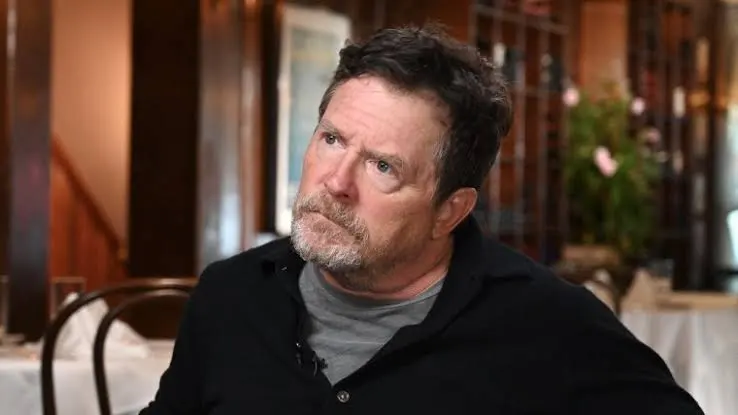
His voice does not tremble from fear. It trembles from a battle that has raged quietly within him for more than thirty years. When Michael J. Fox finally speaks the words so many hoped would never come, there is no drama in his tone—only clarity. Parkinson’s is advancing. The falls are happening more often. Bones break more easily. Surgeries accumulate faster than recovery can keep pace. He says he does not expect to see 80, and the honesty of that admission lands heavily. But when the camera moves closer, searching for surrender, it finds none. He does not dilute the truth. He does not mask it with false optimism. He meets it directly, smiling through tremors that refuse to be still, making it clear that while the disease may be gaining ground, he is not retreating from the fight.
For three decades, he has lived beyond the limits quietly predicted for him. In the early years after his diagnosis, when doctors spoke in cautious tones and friends whispered uncertain timelines, few imagined the length or impact of the road ahead. Yet he continued—working, advocating, laughing, raising a family, building a foundation, standing in front of crowds with hands that would not cooperate and a body that often betrayed him. He has outlasted every prognosis. He has rewritten expectations not with denial, but with endurance.
Time, however, leaves its evidence. Today he appears physically smaller, as though the disease has slowly carved away at him piece by piece. His movements are less predictable, sometimes sharp and sudden, other times rigid and slow. His spine bears the memory of surgery. A benign tumor once threatened his mobility. Falls have shattered bones—an arm here, a cheekbone there—each incident a reminder that Parkinson’s is not only about tremors but about balance, fragility, and risk. The fractures heal, but the recovery is longer each time. Strength returns more reluctantly. When he says, “It’s getting tougher,” the words are not casual. They are earned. They carry the weight of sleepless nights, chronic pain, and the mental exhaustion of recalibrating daily life around new limitations.
And yet, what refuses to erode is the part of him that insists on showing up. In the documentary Still: A Michael J. Fox Movie, he strips away the polished façade often associated with celebrity. He allows cameras to capture the unsteady steps, the sudden jolts, the fatigue that lingers in quiet moments between conversations. He does not edit out the difficulty. He does not frame himself as heroic. Instead, he reveals something more powerful: persistence without illusion. Humor breaks through the hardest scenes—not as denial, but as defiance. He jokes about his condition, not because it is light, but because laughter remains one of the few tools fully under his control.
Parkinson’s disease is progressive by nature. It does not pause out of respect for past achievements or public admiration. It advances methodically, altering speech, posture, sleep, cognition. Fox understands this better than anyone. He speaks openly about the unpredictability—good days that allow for relative ease followed by stretches where even simple tasks demand immense concentration. There is no steady plateau, only adjustment after adjustment. Yet within that instability, he has constructed a philosophy grounded in acceptance rather than surrender.
Acceptance, for him, is not passive. It is active, deliberate. It means acknowledging that he may not have decades left while still investing fully in the present. It means recognizing the body’s betrayal without allowing it to define the entirety of his identity. Long before Parkinson’s, he was known for his quick wit and kinetic energy. Now, even as the physical energy fades, the wit remains sharp. The spirit that propelled his career has not disappeared; it has simply adapted to new terrain.
There is also grief—an undercurrent he does not deny. Grief for the ease of movement once taken for granted. Grief for spontaneity. Grief for the version of himself who could run across a set without calculating the risk of falling. But that grief coexists with gratitude. He often speaks of luck—not the superficial kind, but the profound fortune of access to medical care, to support, to family, to purpose. He understands that many living with Parkinson’s do so without the resources or visibility he possesses. That awareness fuels his advocacy as much as his personal resilience.
When he admits he may not reach 80, it is not a surrender to despair. It is a recognition of statistics, of accumulated complications, of a body that has endured trauma after trauma. But in the same breath, he makes clear that time’s uncertainty sharpens his focus rather than dulls it. If anything, the narrowing horizon intensifies his commitment to honesty. He refuses platitudes. He refuses the illusion that positive thinking alone can reverse neurological decline. What he offers instead is something rarer: a model of living truthfully within limitation.
The camera lingers on his face—the tremor visible, the smile steady. There is vulnerability there, but not defeat. The shaking is constant, sometimes subtle, sometimes pronounced. It interrupts gestures, alters posture, complicates speech. But it does not silence him. If anything, it underscores the message. The tremor becomes evidence of the cost, and the smile becomes evidence of choice.
He does not promise recovery. He does not claim that perseverance guarantees victory. Parkinson’s, he acknowledges, is advancing. The fractures, the surgeries, the cumulative strain all suggest a body under siege. Yet what he insists upon is this: winning and losing are not measured solely by physical decline. The disease may take territory, but it has not taken his clarity, his humor, or his will to remain present.
In the end, his story is not about denial of mortality. It is about confrontation. It is about standing in full view of what is happening and refusing to look away. He allows the world to witness the tremors, the imbalance, the exhaustion—because hiding them would grant the disease a different kind of power. By showing them, he transforms them into testimony.
The battle inside his body continues, unrelenting and unfair. He knows it. We know it. And still, when he speaks—voice shaking, eyes steady—there is a quiet insistence beneath the words. Parkinson’s may be gaining ground, but he is not disappearing. He is still here. Still honest. Still choosing hope, not because it guarantees a happy ending, but because it gives meaning to whatever time remains.