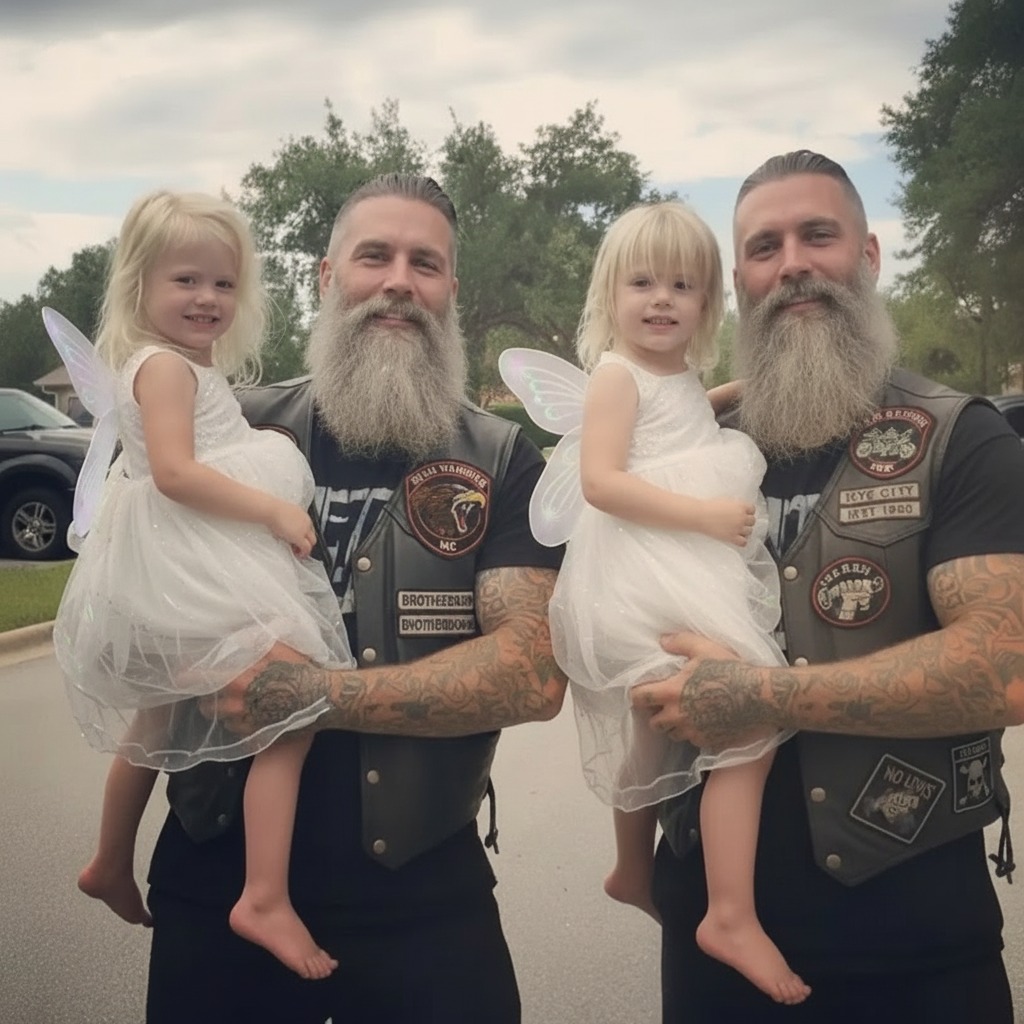
I understand how the headline sounds. I know the immediate image it creates—panic, danger, engines fading into the distance. But before you decide what kind of mother I am, look closely at my tears. They weren’t born from fear. They came from an overwhelming sense of relief, the kind I hadn’t felt in years. To understand why I asked those bikers to keep my children, you first have to understand what it’s like to be silently drowning for three long years.
My name is Sarah. I’m a single mother to three-year-old twins, Anna and Ethan. Their father disappeared when they were barely six months old, leaving behind almost nothing—just a few supplies and a life that suddenly rested entirely on my shoulders. From that moment on, survival became my routine. I worked mornings at a medical office and nights cleaning downtown buildings. My mother was the only reason I managed at all, caring for the twins while I ran myself into the ground just to keep us afloat.
Everything came to a head on a Tuesday that felt painfully ordinary. I had forty-seven dollars in my bank account and nearly a week to survive before payday. My grocery list was stripped down to essentials: milk, bread, diapers. As I pushed the stroller through the store, I tracked every item with my phone calculator, watching the total rise with each step. I was exhausted—running on three hours of sleep after a late shift. Anna was crying for cookies I couldn’t afford, and Ethan kept dropping his toy on the floor over and over again.
At the checkout, the total came up: fifty-two dollars. My stomach sank. Five dollars might as well have been five hundred. The people behind me shifted impatiently as I began removing items, calculating whether we could last with fewer diapers or less food.
That’s when a voice cut through the moment—deep, steady, impossible to ignore.
“Leave the bread. I’ll cover the rest.”
I turned to see a man who looked like every warning I’d ever heard growing up. He was huge, heavily tattooed, wearing a worn leather vest with patches I didn’t recognize. Without hesitation, he handed the cashier cash and waved off my protests. When I tried to object, he simply met my eyes and said, “It’s already done.”
He carried my groceries to my old Honda and then surprised me again. He crouched down in front of my twins and spoke gently, telling them to listen to their mom and reminding them how hard she worked for them. Before leaving, he looked at me and said something I hadn’t heard in years: “You’re doing great.” Then he rode away on his motorcycle.
I cried the whole drive home. I assumed that was the end of it—a brief, unexpected kindness from a stranger. But I kept seeing him after that. At the store. Near the park. Always just a nod or a wave. It didn’t feel threatening—it felt protective.
Then everything truly fell apart. My mother suffered a massive stroke. In a single moment, I lost my childcare, my safety net, and my sense of stability. Sitting alone in my car, overwhelmed by hospital bills and the looming threat of eviction, I felt my world closing in. That’s when someone tapped on my window. It was him. His name was Marcus.
He listened without interrupting as I told him everything. The next day, I met him and another man named Jake at a diner. They explained that their motorcycle club—mostly veterans—ran a volunteer support network for struggling single parents. They showed me paperwork, references, background checks. They knew how they looked, and they knew how unbelievable it sounded.
I was scared. But I had no other options.
We started slowly, with supervised visits. I watched these intimidating-looking men patiently play games on the floor with my kids, building towers and pretending to drink tea. Eventually, they began caring for the twins while I worked—completely free of charge. Jake worked from home. Marcus was retired military. They gave me time to breathe.
They became more than babysitters. They filled the gaps in our lives. They helped my son learn new skills, supported my daughter’s learning, brought food when I was sick, and showed up when my car broke down. They became the “village” everyone talks about but so few actually provide.
The night I asked them to keep my children was after their club’s family picnic. For the first time in years, I spent an entire day alone in silence. When Marcus called to say the twins had fallen asleep after a long, happy day, I went to see them—and found my children sleeping peacefully under blankets, surrounded by bikers whispering and playing cards so they wouldn’t wake them. One man was even knitting.
I couldn’t hold back the tears.
“Can they stay tonight?” I asked. “I just need to rest.”
Marcus didn’t hesitate. He told me everything was handled and sent me home. I slept for twelve uninterrupted hours. When I woke up, I had a photo of my kids smiling over pancakes.
People still judge us. They see leather and tattoos and make assumptions. They don’t see the men who saved my family when no one else noticed we were falling apart. They don’t see kindness, patience, or quiet strength.
Marcus and Jake didn’t take my children from me—they gave us our lives back. They reminded me that compassion doesn’t always come in familiar packaging. Sometimes, it arrives on a motorcycle, exactly when you need it most.
They are our family now. And they are proof that real goodness is shown not by how someone looks, but by how they show up when it matters most.