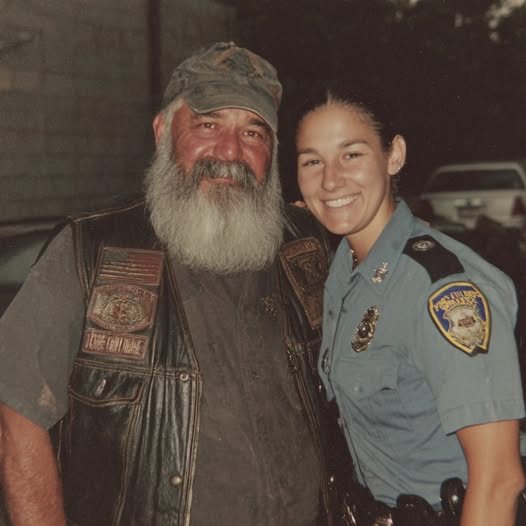
Under the bruised purple and amber of a fading sun, Highway 49’s asphalt gleamed. Over the long, lonely miles Robert McAllister had walked for more than half of his life, it was the kind of evening that felt heavy with the weight of things left unsaid. His motorcycle’s steady vibration was a recognizable pulse against his thighs, a mechanical heartbeat that had kept him going when his own felt empty. The road had been his only real friend for decades, a means of keeping one step ahead of a past that never quite ceased pursuing him.
His rearview mirror flickered sharply and staccatoly, interrupting him. Blue and red. cool and rhythmic.
Robert exhaled sharply and lowered the bike onto the gravel shoulder. The abrupt silence of the wide-open plains surged in to fill the void as he killed the engine. He was well aware of the cause: a flickering taillight that he had vowed to fix three towns prior. One consequence of living on the periphery, where time was measured in petrol tankfuls rather than birthdays or anniversaries, was procrastination.
He stayed sat, listening to the deliberate crunch of footsteps on dirt with his gloved hands resting comfortably on the handlebars. They were professional, self-assured steps.
“Sir, good afternoon,” a voice said. It conveyed the trained authority of someone who has worn a uniform long enough to become accustomed to it; it was youthful and steady. “Are you aware of the reason I stopped you today?”
Robert took a while to turn around. His voice sounded like dried leaves scuffing on pavement as he said, “I’d bet on the taillight.” “I really want to get to it.”
“Please get a license and register.”
Robert grabbed into his worn leather jacket pocket. He produced his wallet with a slight tremble in his fingers, which had been gnarled by time and the harsh wind of a thousand highways. After giving the papers to them, he glanced up at last.
The world stopped, not simply slowed down. The air appeared to become sharp and brittle glass.
The officer’s outfit stood out against the waning light, and she appeared to be in her early thirties. The final fragments of the sunset caught the sparkle of her insignia. Officer Sarah Chen was written on it.
Sarah.
From Seattle to the Florida Keys, the name was a physical blow, a phantom he had tracked through every Greyhound station and truck stop. It was as if water had suddenly flooded his lungs. He convinced himself that he was an elderly man experiencing the hallucinations of loneliness, a result of a lifetime of sorrow. However, he had more clarity in his eyes than he had in years.
Her eyes were dark, perceptive, and framed by a ferocious intellect that only softened at the corners when she blinked, just like her grandmother’s. Then he noticed it. There was a tiny, dark crescent-moon birthmark underneath the lobe of her left ear, so subtle that most people wouldn’t detect it.
31 years.
He had searched every busy shopping center and city street for the mark for thirty years. While rocking a fussy baby in a dark apartment and murmuring promises into the top of her head, he had committed its curvature to memory. He had assured her that he would always locate her. Then came the night of the empty rooms, when her mother vanished along with her, leaving only a quiet that would reverberate in Robert’s ears for the remainder of his life.
She read aloud, “Robert McAllister,” drawing him back from the edge of his recollections. “Is this Montana address up to date?”
“Yes, ma’am,” he said in a barely audible whisper. His propensity of disappearing before anyone could find out his true name earned him the nickname “Ghost,” which most people used to refer to him. It was as if a dead tongue had been revived when she spoke his entire name.
The name didn’t make her wince. Those familiar eyes did not enlarge or flash with recognition. Why would she, if her mother had done a good job of hiding her, giving her a new identity, a new life, a new past? He was just another ephemeral ride on an old-fashioned bike to her.
However, Robert observed her. He noticed how she transferred her weight to her rear foot, which was a subconscious tendency he once had. He saw her use a particular, delicate flick of her wrist to tuck a wayward lock of dark hair behind her ear. He had witnessed the identical gesture in a three-year-old girl who used to sit on their living room floor and carefully arrange her crayons according to color.
Her voice changed as she said, “Sir.” There was a new sense of responsibility, yet the professional courtesy persisted. “You must get off the motorcycle for me.”
Slowly, his joints hurting from the shock and the cold, he obeyed. It felt like he was traveling through deep water as he flung his leg over the seat.
Put your hands behind your back, please.
His wrists should have been humiliated by the icy, sharp snap of the handcuffs. Rather, it had the feel of an anchor.
With expert hands, she double-locked the cuffs and added, “You have an outstanding warrant from three years ago regarding an unpaid citation in another county.” “I must take you in.”
The warrant didn’t matter to Robert. The jail cell that awaiting him didn’t matter to him. He was looking at the badge that marked his daughter as a stranger, at the back of her head, at the way her hair glinted in the light.
He halted as she guided him to the patrol car.
“Officer Chen,” he muttered.
Her hand was on the door doorknob as she hesitated. “Yes?”
“May I ask you a question? Before we leave?
Her training fought an unexpected, unexplained flare of curiosity as she hesitated. She turned to look directly at him. “Go quickly.”
He inquired, “Have you ever wondered where you got that little scar on your left eyebrow?”
She was instantly transformed. Her professional mask started to break as her hand gripped the door frame more tightly. Her voice faltered as she questioned, “How do you know about that?” That’s from when I was a baby. According to my mom, I tripped.
With his eyes fixed on hers, Robert swallowed the lump in his throat. He whispered, “You were three years old.” One of the wheels of the red tricycle you were riding was squeaky. You hit the brick planter’s edge as you turned too quickly in the driveway. After crying for five minutes straight, you turned to face me and insisted on getting me a bowl of strawberry ice cream as if it were the most important thing in the world.
Now the highway was quiet. The click of the cooling motorcycle engine was the sole sound for a moment as the wind subsided.
Sarah’s pupils dilated and her eyes grew wide as she examined the handcuffed man’s face. She observed the contours of his nose, the lines surrounding his eyes, and the optimistic, desperate expression on his face. On her face, amazement, doubt, and a horrifying, hidden recognition vied for supremacy.
“How are you able to know that?” “Officer” vanished from her voice as she whispered.
Robert moved forward as far as the handcuffs would permit. “Because I carried you inside,” he explained. “And I purchased the ice cream for you.”
On the shoulder of Highway 49, thirty-one years of searching came to an end in the last light of a Montana evening. The Ghost had finally returned home for the first time in thirty years, but the handcuffs remained and the law continued to demand its due.