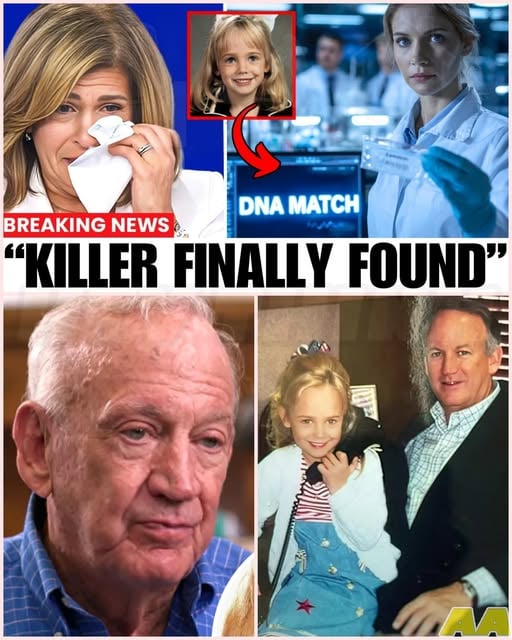
For nearly three decades, the name JonBenét Ramsey has been synonymous with the ultimate American tragedy—a story where beauty, wealth, and a chillingly unsolved crime converged to create an enduring national obsession. Since that cold December morning in 1996, when the six-year-old was discovered in the basement of her family’s Boulder home, the case has remained a fixture of true crime lore, a labyrinth of conflicting theories, flawed investigations, and a media frenzy that often prioritized sensationalism over the search for truth. Headlines blurred the lines between evidence and conjecture, and the nation became captivated by every new development, every whisper, and every conflicting report. However, as 2026 unfolds, the landscape of this infamous cold case is experiencing a seismic shift. The convergence of advanced forensic science, next-generation DNA sequencing, and the burgeoning field of investigative genetic genealogy (IGG) is finally peeling back the layers of a mystery that many believed would remain buried forever.
The early days of the investigation were defined by chaos, confusion, and high-stakes pressure. The discovery of JonBenét’s body followed a frantic morning triggered by a bizarre, three-page ransom note found on the back staircase. This note, with its unusual phrasing, grandiose demands, and apparent familiarity with the family, immediately fueled suspicion, speculation, and fear. The initial response by Boulder police has since been heavily criticized for failing to secure the crime scene, allowing crucial evidence to become contaminated almost immediately. Without clear signs of forced entry, investigators quickly turned their gaze toward the parents, John and Patsy Ramsey, as well as their young son, Burke. This narrative—of a seemingly perfect family hiding a dark secret behind a polished facade—was amplified relentlessly by national outlets, fueling public judgment before the evidence had fully spoken. Despite their profound grief, the Ramseys found themselves ensnared in a decades-long trial by headlines, enduring suspicion, rumors, and media scrutiny even as physical evidence began to hint at a far more complex and disturbing truth.
The first major turning point came years later as DNA testing technologies matured. Genetic material found on JonBenét’s clothing was eventually determined to belong to an “unidentified male,” a breakthrough discovery that effectively exonerated the Ramsey family and shifted the focus of the investigation entirely. In 2008, District Attorney Mary Lacy took the unprecedented step of publicly exonerating John and Patsy Ramsey in a formal letter, offering an apology for the decades of suspicion and distress the family had endured. Yet the stain of public doubt proved difficult to erase. Without a specific name attached to the DNA profile, the so-called “intruder theory” remained a matter of debate, and the case remained stubbornly cold, simmering in both law enforcement files and the collective imagination of the American public.
Now, in 2026, the silence that has surrounded the case for thirty years is being pierced by the hum of modern technology. Boulder Police Chief Stephen Redfearn, representing a new era of leadership within the department, has reaffirmed that the case remains a top priority. In coordination with the Colorado Bureau of Investigation (CBI) and federal partners, investigators are applying forensic techniques that were pure science fiction at the time of the murder. The focus has expanded beyond conventional DNA matching to the revolutionary field of Forensic Genetic Genealogy—the same cutting-edge method that helped unmask the Golden State Killer. This process involves taking the minute, degraded samples of unidentified male DNA collected at the crime scene and cross-referencing them with enormous public genealogical databases. By identifying distant relatives and tracing family trees across generations, investigators can progressively narrow the search toward a living suspect, offering a real pathway to resolution that was previously unimaginable.
The “broken open” nature of the case in 2026 is driven by the re-examination of items long considered too small, too damaged, or too contaminated to yield viable results. Modern “touch DNA” technology now allows investigators to extract usable genetic profiles from objects that the killer merely handled, from the garrote used in the crime to a broken window grate in the basement, previously overlooked or discarded as evidence. John Ramsey, now in his 80s, has emerged as a vocal advocate for applying these advanced techniques, publicly urging that every piece of evidence be re-tested by specialized laboratories. His cautious optimism reflects decades of frustration and false starts, yet he acknowledges that for the first time, the investigative team is led by a commitment to science over speculation.
In addition, the Cold Case Review Panel, convened to examine the 21,000 tips and 1,000 interviews collected over thirty years, is reportedly pursuing new leads based on these forensic breakthroughs. Investigators are revisiting a list of persons of interest originally compiled by legendary detective Lou Smit, who spent his final years advocating the intruder theory. Applying 2026 technology to evidence preserved from 1996 is bridging the gap between unidentified DNA and a living suspect, moving the investigation from decades of theoretical discussion into tangible, actionable leads.
The psychological weight of the case remains immense. For thirty years, JonBenét’s image in her pageant costumes has haunted the nation—a reminder of a life stolen and of institutional failures that allowed her death to remain unresolved. The “chilling truth” emerging is not solely about the perpetrator’s identity; it is a testament to the persistence of justice and the inevitability of scientific progress. Every re-tested sample, every genealogical match, and every careful analytical step represents humanity’s refusal to let time permanently obscure the truth.
As the DNA profiles are refined, cross-referenced, and genealogical branches mapped, the cloud of suspicion that has loomed over the Boulder community is beginning to lift. The pursuit of justice for JonBenét has moved from shadows, rumor, and conjecture into a clinical, methodical hunt guided by biological evidence. While no final name has yet been presented in a courtroom, the walls around the killer are closing in. In this new era of forensic transparency, the “perfect” cold case is becoming a thing of the past, proving that while time can hide a crime, it cannot erase the traces left in the silent language of DNA.
The world watches with bated breath, aware that for the first time in thirty years, resolution is not a question of “if” but “when.” For families, investigators, and the millions captivated by JonBenét’s story, the possibility of closure signals that patience, science, and perseverance can finally bring light to a darkness that has persisted far too long. The JonBenét Ramsey case is transforming from a cautionary tale of media frenzy and investigative error into a beacon of hope—proof that even the coldest cases may one day yield their secrets.
JonBenét Ramsey Murder Case Update
This video provides an in-depth, up-to-date look at the renewed investigative efforts by Boulder Police, emphasizing the re-testing of evidence and the pivotal role of modern DNA technology and forensic genetic genealogy in the ongoing search for justice.