On the morning of my daughter’s wedding, I woke up carrying a tension I’d been dragging for over ten years. Weddings are meant to be soft, hopeful days, where families set aside their issues to celebrate something bigger than themselves. But I knew better than to expect that kind of miracle from my own past.
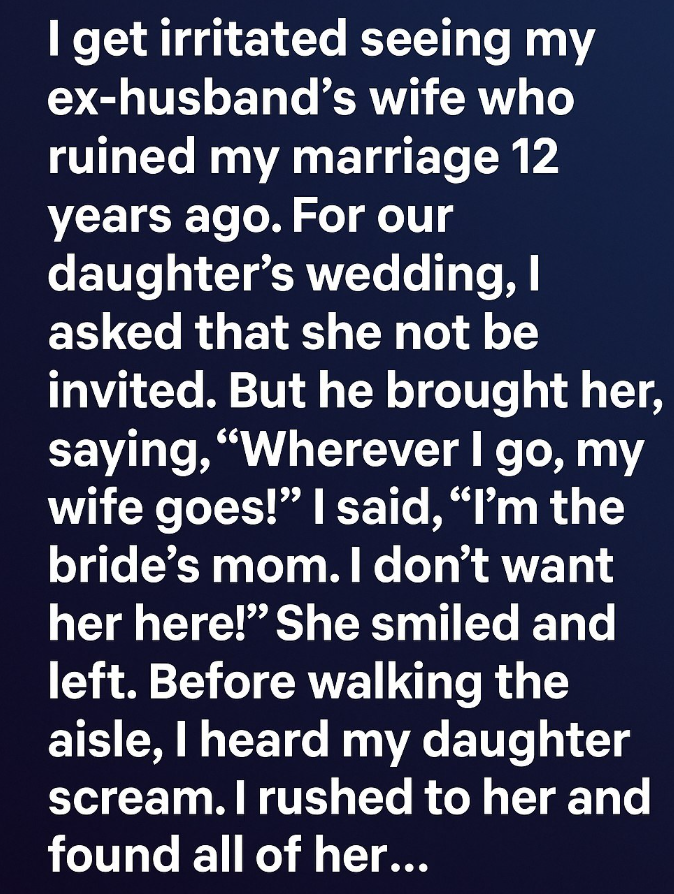
I had made one simple request: I asked my ex-husband not to bring his wife—the same woman whose presence had played a role in the unraveling of my marriage, the reason I’d spent years trying to put myself back together. I didn’t yell, accuse, or dredge up old wounds. I only said it would be easier for me on a day already filled with emotion.
But when his car pulled up and he stepped out with her—her manicured hand tucked around his arm like a trophy—I felt the old bitterness flare hot in my chest.
“Where I go, my wife goes,” he said, as if it were noble.
For a moment, I forgot how to breathe. It wasn’t jealousy—it was that familiar feeling of being dismissed, minimized, overridden. I forced a smile, said nothing, and reminded myself this day was about my daughter, not me, not him, not the wreckage we’d left behind. I swallowed every sharp retort and focused on keeping my voice calm whenever someone needed me.
I made it almost to the ceremony. Almost.
Twenty minutes before my daughter was to walk down the aisle, a scream ripped through the building.
I ran. She was in the bridal suite, shaking, holding the remains of her bouquet. The floral tape had come undone. The petals were crushed, a section of lace near her hip ripped, her face blotched from crying.
Before I could speak, she fell against me.
“Mom,” she whispered, “I just want peace today. Please. I don’t care about the past. I don’t want fighting or tension. I just want today to feel happy.”
In that moment, everything inside me cracked. I’d spent a decade clutching anger as a shield, convinced letting go meant forgiving the unforgivable. None of that mattered to her. She wasn’t carrying my resentment—she wanted her wedding to be a day without shadows.
I held her as she cried, brushing back her hair. Then something unexpected happened.
My ex-husband’s wife entered quietly, slowly, cautiously, as if stepping into a sacred space. In her hands was a bouquet—my daughter’s bouquet, repaired. Reconstructed from spare flowers, ribbon rewrapped, stems retied, petals replaced.
She didn’t explain. She didn’t apologize. She didn’t try to look heroic.
She just held it out. “She deserves a beautiful day,” she said.
It was simple. Soft. Sincere.
For years, I had only seen her as the villain—the woman who replaced me, the cause of my marriage’s collapse. Every insecurity, heartbreak, and unanswered question was tied to her.
But watching her quietly repair something broken—not for me, but for my daughter—I felt something shift. Not forgiveness yet, but a loosening, a release, the recognition that she hadn’t come to ruin anything. She was respecting the moment, helping where she could.
I took the bouquet. “Thank you,” I said, and I meant it.
She nodded once and stepped back.
The ceremony began shortly after. When I saw my daughter walk down the aisle—dress repaired, bouquet restored, eyes clear and steady—I felt something in my chest unclench. She radiated joy, real joy, not the brittle kind people force when pretending all is fine.
At the reception, my ex-husband’s wife stayed on the edges, blending into the background. She didn’t demand attention, insert herself into photos, or insist on acknowledgment. She simply existed quietly.
Later, I approached her.
“I want to thank you,” I said. “Not just for the bouquet, but for giving space, for understanding what this day meant.”
She looked surprised, almost relieved. “She’s your daughter. This was your moment. I wasn’t going to take it.”
It landed heavier than she probably intended. For years, I had convinced myself she wanted to take everything from me. Perhaps she never had. Perhaps I’d been carrying a story that wasn’t entirely true.
Watching my daughter dance later, laughing with her new husband, I realized: letting go of bitterness doesn’t rewrite the past—it stops it from choking the present.
The wedding didn’t magically heal everything, but it opened a door I had slammed shut long ago. A door to something kinder, quieter, lighter.
Sometimes we hold onto pain thinking it keeps us safe. Sometimes it just keeps us stuck.
That day, I finally allowed myself to move. And somehow, in the middle of a wedding I thought might unravel, I found a version of peace I didn’t even know I was still searching for.