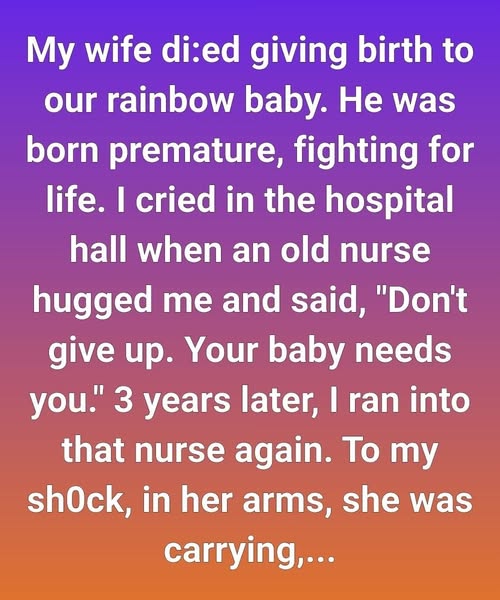
Grief ripped the world out from under my feet and left me teetering on a precipice I never thought I would face. The machines shrieked in relentless alarm, each beep a reminder that life and death were dancing on the edge of my control. My wife, the center of my universe, slipped away in ways I could barely comprehend, leaving me untethered in a storm of fear, despair, and helplessness. I felt myself falling toward a darkness so absolute that I didn’t even want to struggle against it. Every inhale felt heavy, every exhale optional. I was ready to disappear entirely, to stop choosing breath, to surrender to the void that seemed so much easier than the relentless terror of hope. Then, as if from some hidden corner of the universe, a stranger’s arms wrapped around me mid-fall, catching me in a way that wasn’t loud, dramatic, or celebrated—but profound enough to remind me that the world might still offer a tether.
I never could have imagined that my first act as a father would be conducted in the sterile corridors of a hospital, signing death certificates and consent forms with the same trembling hand that barely hours earlier had traced the smooth, plastic wall of an incubator. The NICU was a battlefield disguised in soft pastel colors, a place where hope and horror swapped places by the hour, where the ordinary rhythms of life had been replaced by machines, charts, and whispered diagnoses. Each day I walked in, convinced I would not survive another alarm, another cautious sentence from a doctor, another small defeat. And yet, there she was, that nurse—unassuming, steady, just close enough that my collapse didn’t read as weakness but as grief performing its brutal, necessary work.
She didn’t offer platitudes, promises, or cheer; she didn’t demand that I find courage I didn’t feel I had. Instead, she translated terror into words I could manage, into sentences that made the incomprehensible survivable. She turned the chaos of life-and-death medicine into something I could digest, step by step: one breath, one signature, one whispered lullaby over plastic, one hand lightly guiding mine over the fragile body of my child. In that quiet, unassuming presence, she created an island of humanity amidst the storm. Years later, when I saw her as a foster mother, I finally understood the quiet rebellion in her kindness: the way she refused to let despair dictate the narrative, the way she gave life not only to my baby but to me, to my capacity to survive the unspeakable.
She hadn’t just kept my baby alive. She had, without ceremony or recognition, taken my trembling hand at the very edge of the grave and led me back toward life. She reminded me that survival isn’t always heroic in the way the world imagines it; sometimes it is found in the smallest, quietest acts of empathy, in a presence that refuses to look away. And in those moments, I learned that love, courage, and hope are not always explosive—they are sometimes gentle, insistently patient, and quietly stubborn, refusing to allow grief to complete its claim. Through her, I discovered that even in the shadow of unimaginable loss, the simplest touch, the softest word, the unshakable steadiness of another human being can guide a soul back from the brink, teaching that life can begin again even after it seems utterly impossible.