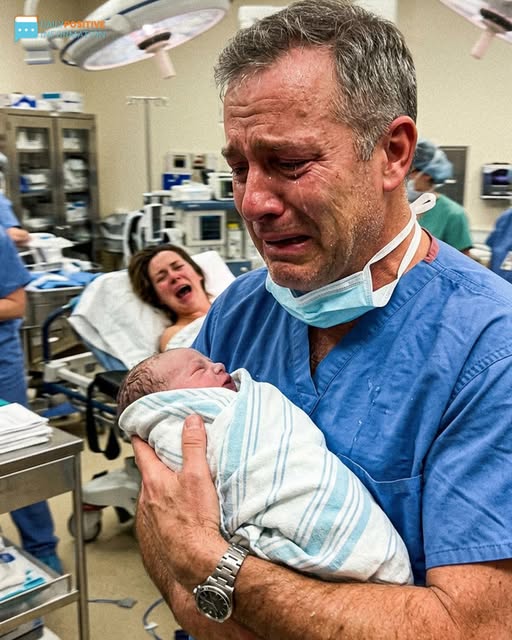
Clara Mendoza entered St. Gabriel Medical Center on a cold Tuesday morning in January, carrying a small rolling suitcase, a wool sweater she had owned since college, and the kind of exhaustion that doesn’t come from a bad night, but from nine consecutive months of getting through everything alone.
There was no one beside her.
No husband. No mother. No best friend insisting on being in the room. No hand to hold in the elevator or in the hallway that smelled of antiseptic, industrial floor cleaner, and the specific institutional silence of a maternity ward at eight in the morning. There was only Clara, twenty-six years old, breathing through a contraction with the focused intensity of someone who has learned that the only thing to do with unavoidable pain is to move through it, and the weight of everything she had not allowed herself to fall apart over since July.
The intake nurse at the desk had a kind face and the professional warmth of someone who has welcomed thousands of people through this same door.
“Is your partner on the way?” she asked, looking up from the computer with an easy smile.
Clara had been asked this question eleven times in the past nine months. By nurses, by the obstetric receptionist, by a woman in a birthing class she had attended alone and left early because sitting in a circle of couples had been too much that week. She had developed a response that was smooth, automatic, and cost her almost nothing to deliver.
“He’s coming,” she said, smiling back. “He just got held up.”
It was a lie so practiced it no longer felt like one.
Emilio Salazar had left seven months earlier, on the same night Clara had sat across from him at the kitchen table of their apartment in Austin and told him, her hands wrapped around a cup of tea she couldn’t drink, that she was pregnant. He hadn’t yelled. He hadn’t thrown anything or slammed doors or made any of the dramatic exits that at least have the decency to announce themselves clearly. He had simply gone to the bedroom, come back with a backpack, said he needed time to think, and walked out the door with the quiet, clean efficiency of a man who had already been deciding this long before the conversation began.
The door closing—barely a sound, almost polite—was the worst part.
She had cried for three weeks.
Then she stopped, not because the grief was over, but because reality had run into what came next, and practical reality does not wait for grief to resolve. She found a smaller apartment. She took more shifts at the diner where she worked part-time, then even more shifts, then double shifts, until her feet swelled at the end of every night and she rubbed them herself, sitting on the edge of her bed, speaking quietly to the baby who could not hear her yet, but soon would.
“I’m going to be here,” she told the baby every night, her hand flat against her stomach. “Whatever happens. I’m going to be here.”
The Labor Lasted Twelve Hours and She Held the Bed Rail for Most of It, Asking Only One Thing
Twelve hours.
The contractions came in waves that built and broke without giving her a real pause in between, and Clara held the bed rail with both hands, breathed as instructed, and fixed her eyes on a point in the ceiling, telling herself every twenty minutes that she was still doing it.
The nurses were kind. One of them, Patricia, who had the manner of someone’s favorite aunt in a professional setting, wiped Clara’s forehead with a cool cloth and said “you’re doing beautifully” in a tone Clara chose to believe because she needed to believe something.
“Is the baby okay?” Clara asked.
It was the only question she asked throughout the twelve hours, in different forms. Is everything okay? Is she moving right? Are the numbers good? Patricia answered yes every time, and Clara nodded and returned to the work of getting through the next contraction.
At 3:17 in the afternoon, the baby was born.
The sound of his cry filled the room with the unmistakable voice of a newborn—high, insistent, and entirely new, a sound that had never existed before this exact moment in all of history—and Clara leaned back into the pillow and cried harder than she had cried the night Emilio left. This was different. This was fear releasing. Eleven months of held breath finally exhaled.
“Is he okay?” she asked. “Is everything—”
“He’s perfect,” Patricia said, wrapping the baby in a white blanket with the practiced tenderness of someone who has done this thousands of times but still treats each one like it matters. “Absolutely perfect.”
They were bringing the baby to Clara’s arms when the on-call physician entered.
He was around sixty, with the calm presence of a man who had spent decades walking into rooms containing the most important moments of other people’s lives. His hands were steady. His voice carried the authority of someone people instinctively trust. He came in to review the chart—the standard final step in closing a birth record.
His name, according to the badge on his coat, was Dr. Richard Salazar.
He took the chart.
He looked at the baby.
And went completely still.
The Moment the Doctor Saw the Baby, He Stopped Moving — and What the Senior Nurse Noticed First Was That His Hands Were Shaking
Patricia saw it first.
The doctor had gone pale—not the faint kind of pale, but the kind that suggests blood has drained inward. His hand, which had been steady for decades, now trembled just enough to notice.
His eyes, usually controlled, were filling with tears.
“Doctor?” Patricia said. “Are you alright?”
He did not answer.
He was looking at the baby.
Clara pushed herself upright, weak and trembling from twelve hours of labor, alarmed in the way a new mother is when her baby is not immediately in her arms but instead a physician stands frozen at the foot of the bed.
“What’s wrong?” she said. “What’s wrong with my baby?”
“Nothing is wrong with your baby,” Dr. Salazar said. “He is healthy. I promise you that.”
“Then why—”
He looked up at her.
“I need to ask you something,” he said. “The father of your child. His name.”
Clara’s expression changed.
“He’s not here,” she said.
“I understand. I’m asking for his name.”
“Why does that matter right now?”
Dr. Salazar looked at her with an expression that is difficult to name. It was grief, yes—but something older than grief as well.
“Please,” he said. “Tell me his name.”
“Emilio,” she said. “Emilio Salazar.”
The room went completely silent.
The only sound was the baby.
Dr. Richard Salazar closed his eyes.
A single tear moved slowly down his face.
“Emilio Salazar,” he said quietly, “is my son.”
No one moved for several seconds.
The senior nurse would later say she had never seen anything like it in twenty-two years.
Clara held her newborn son while the room rearranged itself around a new truth.
“That’s not possible,” she said.
“I know.”
“It can’t be—”
“I know how it sounds.”
He pulled a chair to the bedside and sat down.
“There is a mark on his neck,” he said. “The same as my son’s.”
Clara looked at the baby.
Then at the doctor.
And began to cry.
“Where is Emilio?” Dr. Salazar asked.
“I don’t know,” Clara said. “He left the night I told him I was pregnant.”
“How long ago?”
“Seven months.”
He absorbed this.
“So he has been gone,” he said slowly, “for almost as long as his mother has been gone.”
What Dr. Salazar told her about his family that afternoon was a story that had been waiting for someone to hear it.
He told it carefully.
Not all at once — nurses came and went, paperwork was completed, and Clara fed her son for the first time with the tentative wonder of someone doing something they had prepared for in theory but now discovered was entirely different in reality. Through all of it, between the necessary interruptions of the medical environment, Dr. Richard Salazar sat in the chair beside her bed and told her the story of a family that had broken apart two years earlier and had never managed to find its way back together.
Emilio had left after a fight — a bad one, the kind that builds slowly over months from smaller disagreements and eventually explodes, releasing everything that had been left unsaid. He had felt, his father explained with the quiet honesty of a man who had spent two years examining his own role in it, that he was living in the shadow of a father who was respected by everyone, and that no version of himself would ever be enough. He had taken that feeling and turned it into distance. The distance became habit, and the habit became two years of silence.
“His mother—” Dr. Salazar paused. “Her name was Margaret. Maggie. She died eight months ago.”
Clara closed her eyes briefly.
“She never stopped waiting,” he continued. “She kept his room exactly the same. She left his place at the table set every Sunday. She said the candle she lit each week was just habit. I knew it wasn’t habit.”
“I’m so sorry,” Clara said.
“She died without seeing him again,” he said simply. No bitterness, only acceptance — the tone of someone who has made peace with a fact by sitting with it long enough. “I don’t know if she ever would have. But she deserved the chance.”
Clara looked down at her son.
“She has his nose,” Dr. Salazar said, his voice softening, almost uncertain now, as if touching something fragile.
Clara looked up.
He was watching the baby with an expression that had shifted beyond grief into something else — something beginning rather than ending.
“Maggie’s nose,” he said. “That same slight tilt at the tip. Emilio has it too. I used to tease her about it.”
Clara let out a laugh that surprised her — brief, real, slightly broken by everything else in the room. The kind of laugh that comes when a person desperately needs one and finds it unexpectedly.
“What are you going to name him?” he asked.
She looked down at her son.
She had been turning over a short list of names for weeks, trying each one against a face she hadn’t yet seen. None of them had felt final.
“I think,” she said slowly, looking at the baby and then at the man who was now part of his family history, “his name is going to be Mateo.”
Dr. Salazar nodded.
Before he left that evening — to begin what he already understood would become a complicated search — he paused at the door.
“You told the nurse you had no one coming,” he said.
Clara looked down at the bed.
“That was true when I said it.”
“It may not be true anymore,” he said. “If you’re willing. That child is my family. And by extension — if you want it — so are you.”
Clara had spent nine months building walls with the careful discipline of someone who had been hurt enough to treat protection as construction. But there was something in Richard Salazar’s voice that wasn’t pity, wasn’t obligation, and wasn’t performance. It was simply steady. Undemanding. Like an open door that does not insist you walk through it.
She didn’t say yes.
But she didn’t say no.
And for that evening, that was enough.
Three weeks later, Dr. Salazar found Emilio in a motel outside Waco, and he went alone.
He drove four hours each way.
He had considered calling first, but decided against it. Phone calls can be declined with a single action, and this conversation did not deserve that ease.
The motel was the kind that rents by the week, with a vending machine outside the ice room that worked only sometimes. Emilio’s truck was in the parking lot. Dr. Salazar knocked and waited.
When Emilio opened the door, he looked like a man who had been running for two years and had finally used up what running costs. Thinner. Older in a way that wasn’t about time, but accumulation. He stared at his father with the exhausted recognition of someone who had run out of surprises.
“Dad.”
“Emilio.”
They stood in silence for a moment.
Dr. Salazar reached into his coat pocket and placed a photograph on the doorframe.
A newborn. Small fists. Closed eyes. A tiny birthmark just beneath the left ear.
Emilio looked at it but did not take it.
Something in his face began to shift — slowly, structurally, like something long fixed in place finally being asked to move.
“His name is Mateo,” Dr. Salazar said. “He has your mother’s nose. His mother worked double shifts at a diner until her final month of pregnancy so he would have everything he needed. She was alone in that hospital. No one held her hand.”
Emilio said nothing.
“She’s stronger than anyone I’ve met in a long time,” his father continued. “And she didn’t have to be. It would have been easier for her to break — but she didn’t.”
Emilio kept looking at the photograph.
“I’m not enough for them,” he said finally, barely audible. “I’ve never been enough for anyone.”
Dr. Salazar leaned forward slightly.
“That isn’t a fact,” he said. “That’s a story you’ve been telling yourself. Being a father isn’t something you’re ready for before it happens. It’s something you choose after it happens — every single day. And you’ve been running for two years, Emilio. Your mother ran out of time waiting.”
He slid an address across the ledge.
“Don’t run out of time with your son,” he said.
Then he drove home.
Two months passed before the knock on Clara’s door, and she was standing at the window with Mateo when it came.
Sunday morning.
Mateo had been awake since 5:30 with the dependable energy of an infant who does not recognize weekends, and Clara had fed him, changed him, and was now standing at the living room window while he rested against her shoulder, making the small half-asleep sounds of contentment. Outside, the light was shifting from gray to gold.
She had been thinking about whether she could afford an online certification course when the knock came.
Three knocks. Not aggressive. Not hesitant. A decision being carried out.
She opened the door.
Emilio was standing there.
He was thinner than she remembered, holding a small stuffed bear from a pharmacy with both hands as if it were keeping him grounded.
He didn’t speak immediately.
He looked at her — not with the confidence he once had, but stripped of it entirely.
Then he looked at Mateo, asleep against her shoulder.
“I don’t deserve to be here,” Emilio said.
“No,” Clara replied. “You don’t.”
Not to wound him. Just the truth — plain and unsoftened.
Silence stretched between them.
From the crib in the corner, Mateo shifted and made a small sound — almost nothing, but enough to confirm life.
Emilio’s face broke.
Not dramatically. Quietly. Like something finally giving way after a long time holding.
Clara stepped back from the doorway.
Not because she had forgiven him — she hadn’t. Not fully. Not yet. But because there was a child in the room who would one day need to understand the truth of his story. And part of that truth was that his father had come back.
Emilio walked inside slowly.
He knelt beside the crib.
He reached out and touched Mateo’s hand with two fingers — careful, uncertain.
Mateo closed his tiny fist around them and held on.
And Emilio cried without making a sound.
What came after that Sunday was not a clean story, but it was a real one.
Clara would later say, when she had gained enough distance for perspective to settle in, that the year after Emilio came back was in some ways harder than the months she had spent alone.
When she was alone, the difficulty had been practical: money, exhaustion, logistics — the physical weight of doing everything herself. It was hard, but it was a kind of hard that had solutions, even if those solutions were imperfect.
With Emilio back, the difficulty changed. It became the kind that lives in rooms rather than spreadsheets — in conversations that had to happen before trust could even begin to form again, in days when Clara’s patience reached its limits and she had to decide, again and again, what she was still choosing. In the moments when Emilio seemed close to disappearing again, and she watched him choose not to, trying not to let him see that she was watching.
Dr. Richard Salazar was there through all of it.
He began coming on Sunday afternoons, initially with the stated purpose of seeing Mateo — which was true, but also not the entire truth. He brought soup sometimes, diapers always, and opinions about the best way to do things that he offered without insisting, which Clara appreciated more than she expected to. He sat in the armchair in the corner holding Mateo and talked to him about Maggie — about the way she sang while she cooked, about the practical, unglamorous ways she loved people.
“She would have been here every day,” he told Clara once. “You would have had to ask her to leave.”
“I wouldn’t have asked her to leave,” Clara said.
He smiled at that — a small, tired, genuine smile.
He was also there when Emilio needed the kind of honesty only a father who has already lost everything he was too proud to admit can give. He did not excuse him. He did not soften what had happened or reframe it into something easier to carry. He simply made it impossible, through his steady presence, for Emilio to avoid the real weight of what he had done — and what it would take to build something honest from it.
Emilio got a job — not a glamorous one. A position at a print shop in East Austin, with early mornings, physical work, and a modest but honest salary. He stopped drinking, something Clara hadn’t fully realized had been a problem until it stopped, and she saw the clearer version of him underneath it.
He started therapy.
“Your father suggested it,” he told her.
“I know,” Clara said. “I told him to.”
Emilio looked at her.
“You’ve been talking to my father about my therapy.”
“I’ve been talking to your father about a lot of things,” she said. “He was easier to talk to than you were for a while.”
Emilio took that in with the expression of someone choosing not to defend something that was true.
“He told me something you said,” he continued. “About not expecting love to do the fixing.”
“I meant it.”
“I know you meant it. That’s why I can’t stop thinking about it.”
Mateo took his first steps at eleven months, and all three of them were there.
It happened on a Sunday afternoon.
He had been standing with support for weeks, gripping furniture edges with the focused determination of someone who had identified a skill worth mastering. He had been let go carefully, a few times, and each time had sat down with the calm curiosity of someone studying the concept of falling.
That Sunday, he stood at the coffee table, turned, and simply walked — three uncertain steps toward Clara — before his knees quietly gave up and lowered him onto the rug.
He laughed.
A full-body laugh, uncontained and absolute, the sound of a child discovering something new and entirely delighted by it.
Clara scooped him up immediately, laughing too.
Emilio was already down on his knees, reaching toward him, laughing as well.
In the armchair, Dr. Richard Salazar pressed both hands to his mouth. His eyes were bright, and Clara understood, looking at him, that he was not only seeing Mateo. He was seeing something larger — something about time, about loss, and about what still remains possible even after life has taken so much.
“Maggie,” he said quietly — to no one, or to all of them.
Clara passed by and briefly rested her hand on his arm.
Two years later, Emilio sat across from Clara with a small box on the table.
Mateo was asleep in his room.
The apartment had changed over time — not dramatically, but in the quiet accumulation of care. A real bookshelf now. Drawings on the walls from Mateo’s early attempts at finger painting. A kitchen table that had become the center of both ordinary and important conversations.
Emilio sat with the careful posture of someone who had prepared for something but was no longer entirely certain of his preparation.
He placed the box on the table.
Clara looked at it.
“Don’t do anything—”
“I know,” he said gently. “Just let me say this.”
She waited.
“I’m not giving you this because I think it fixes anything,” he said. “I’m not giving it because I think I’ve earned it. I’m giving it because I finally understand what it means to stay. Not in theory. In practice.”
He looked at the box.
“And if you say no, I stay anyway. As Mateo’s father. As the person your father-in-law has yelled at twice about not installing a car seat correctly. As whatever you’ll allow me to be. But if someday you choose this — not because you need it, but because you want it — I want to be the person you choose.”
Clara stayed quiet for a long time.
She looked at the box.
She thought about St. Gabriel Medical Center, about a small suitcase and a worn sweater, and a lie told to a nurse about a husband on his way. She thought about Dr. Richard Salazar’s trembling hands. About a birthmark beneath a small ear. About a man sitting in a hospital chair speaking of a woman named Maggie and a candle that had never gone out.
She thought about a drugstore teddy bear and a knock on a door she chose to open.
“I didn’t forgive you in the hospital,” she said.
“I know.”
“Not even when you came back.”
“I know that too.”
“I’ve been forgiving you piece by piece. Some days I still am not done.”
He nodded. He didn’t argue. He accepted it as truth.
Clara reached across the table.
She picked up the box.
Then she put it in her pocket.
“Stay tomorrow,” she said. “And the day after. And in ten years. That’s what I need. Not a ring yet. Not a ceremony. Just presence. Consistent, ordinary, Tuesday-morning presence.”
Emilio’s eyes filled.
“I’m going to stay,” he said.
From the hallway, where Dr. Salazar had fallen asleep in the armchair while Mateo napped, a soft sound drifted through the apartment — a child’s half-asleep laughter, the kind that belongs to dreams or to simple contentment.
Clara looked at Emilio.
Emilio looked at her.
Neither of them spoke.
Some things don’t need to be said when they are already true.