At first, it seemed like a minor thing.
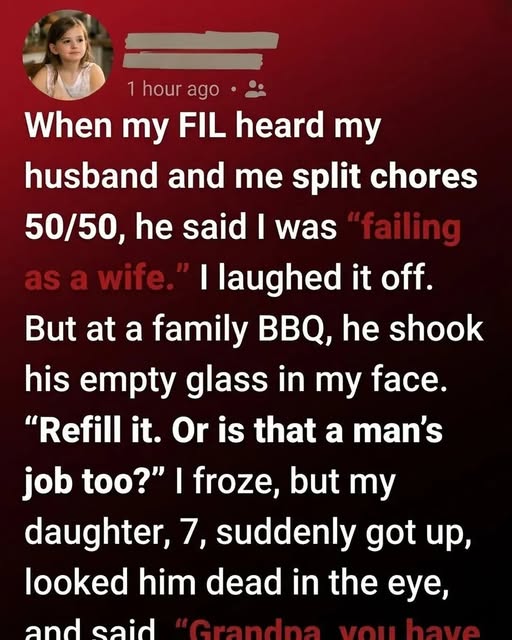
When my father-in-law learned that my husband and I shared household responsibilities—cooking, cleaning, raising our daughter—he chuckled lightly and shook his head. Then he said it, casually, as if it didn’t matter:
“Well, sounds like you’re failing as a wife.”
I didn’t react. Not really.
I smiled politely, shrugged it off, and let the conversation continue. I’ve learned over time that not every comment deserves a response. Some things are better left ignored, especially when they come from someone set in their ways.
Still, the words lingered.
Quietly, in the back of my mind. I reminded myself it didn’t matter. What we had at home worked for us. Our partnership was not weakness—it was strength.
And it was.
My husband and I had created a life that felt balanced and genuine. We didn’t divide life into “his job” and “my job.” We simply showed up for each other. Some days he cooked, some days I did. Some days I handled everything, and other days he stepped in without being asked. That was our normal.
And it worked.
A week later, at a family barbecue, the warm afternoon seemed easy on the surface. The smell of grilled food filled the air, people laughed, children ran around the yard, and conversations floated lightly from topic to topic. I reminded myself to relax, to enjoy the moment, and to leave that comment in the past.
For a while, it worked.
I stayed present, chatting, smiling, keeping things light. I didn’t overthink, didn’t search for tension.
Then it happened again.
In the middle of a casual conversation, my father-in-law walked over, stopping right in front of me. He held out his empty glass—not aggressively, but not kindly either. A half-smile touched his face, the kind that never reaches the eyes.
“Refill it,” he said, and then added, just loud enough for others to hear, “Or is that a man’s job too?”
The room shifted instantly.
Conversations slowed. A few people paused. Others pretended not to notice, but the subtle change was palpable.
I froze for a second—not because I didn’t know what to say, but because I weighed whether it was worth responding. I’ve always valued peace over pride, avoiding conflict when possible.
But this felt different.
Not just because of what he said, but where he said it—right in front of everyone, a quiet challenge.
I opened my mouth.
Then I heard it.
A soft scrape of a chair on the ground.
It wasn’t loud, but it cut through everything.
My daughter—seven years old—stood up. Quiet, observant, steady. She walked just enough to be seen. No hesitation, no fear.
She looked straight at her grandfather.
“Grandpa,” she said, voice clear and unwavering, “in our house, everyone helps. That’s what makes it fair.”
That was it.
No anger. No dramatics. No raised voice.
Just truth.
Simple, honest, unfiltered truth—the kind only a child can deliver, with no attempt to argue or prove a point.
Suddenly, everything stopped.
Not tense silence. Something heavier. Thoughtful.
My father-in-law’s hand lowered slightly. His expression shifted—not dramatically, but enough.
No one laughed. No one jumped in. For once, the moment spoke for itself.
The afternoon continued, quieter. Conversations resumed, but more carefully. Something had changed, though unspoken.
Later, as we walked home, evening sky softening, I held my daughter’s hand a little tighter. She walked beside me, as if nothing unusual had happened.
Children often don’t realize the weight of their words. And that’s exactly why they can be so powerful.
I smiled at her—not because she “defended” me or “stood up” to someone—but because she reflected something deeper:
Partnership. Respect. Fairness.
Not just ideas, but lived reality.
In that moment, she understood—and she showed us that she got it, quietly and powerfully.
And honestly? That mattered more than anything anyone else could have said.