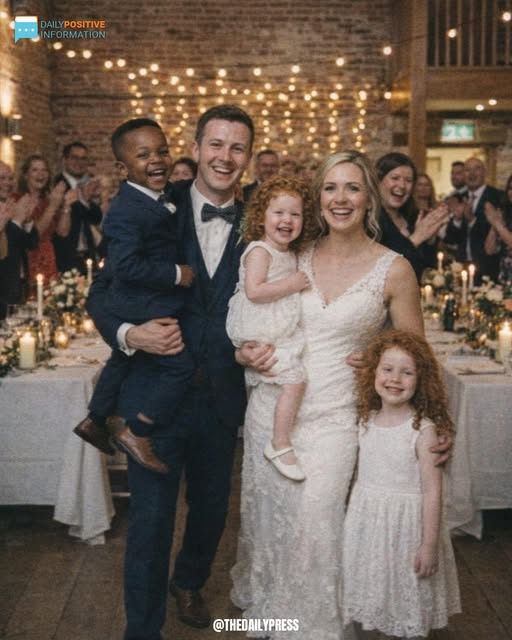
I thought I was marrying the man who loved me and my children like his own. I thought I’d finally found someone who saw us—all three of us, the whole broken but beautiful package—as a gift rather than a burden. Then I overheard him and his mother laughing about taking my house, using my kids as leverage, and dumping me after the wedding. So I planned. And when it was time to say “I do,” I chose something better: I chose my children. I chose the truth. I chose a future that didn’t include someone who’d been calculating how to destroy it from the very beginning.
The Second Chance That Wasn’t Supposed to Happen
Most people only get one second chance at life. Mine came with three extra hearts.
When my sister died—suddenly, devastatingly, in a way that split my world into before and after—I became a mother overnight to her two daughters, Selena and Mika. They were seven and five years old, still young enough to believe that grief was something you could survive through sheer will and presence. I already had my son Harry, who was nine at the time, and somehow, with hand-me-down backpacks and freezer meals that I’d learned to stretch across a week, we made it work.
Love wasn’t something I was looking for. I was too busy trying to keep three kids fed, clothed, and emotionally intact to think about romance. I was a single mother of three with a teaching job that paid reasonably well but not generously, and a house that my sister had left me in her will—the only thing standing between us and financial chaos.
Then I met Oliver.
He was charming without trying too hard, kind without putting on a show, and on our third date—after he’d picked up Harry from soccer practice and brought him home with ice cream, after he’d helped Selena with her reading homework without being asked, after he’d sat on the floor building Lego structures with Mika for over an hour—I told him the truth.
“You should know what you’re getting into,” I said, my voice steady but my hands shaking. “I’m a package deal. Three kids, no time, no games. I don’t have energy for people who aren’t serious.”
His answer changed everything—or so I thought.
“I’m not scared of a ready-made family, Sharon. I’m grateful. Let me be the man who stays. Let me be the one you can trust.”
I laughed—more out of disbelief than anything—but he proved himself in the months that followed. He made dinner on nights when I was grading papers until midnight. He helped with homework, sitting patiently with Harry while he worked through math problems that frustrated him. He built pillow forts with the girls on rainy days, creating entire kingdoms out of couch cushions and blankets. He said he wanted the girls to call him “Dad,” and when they finally did—tentatively, testing the word like it was made of glass—I watched something shift in his face that I interpreted as love.
I fell anyway.
The wedding was going to be small: just close friends, a handful of coworkers who’d held my hand through the hardest years, and family who had watched me claw my way back to something approaching joy. We’d booked a venue in Oak Park, chosen flowers that complemented the late-September weather, written vows that I’d revised a dozen times trying to get them right.
We were two days away, and everything was in motion.
The FaceTime That Changed Everything
Oliver was staying at his parents’ house across town—some superstition about not seeing the bride before the wedding, some tradition that I’d agreed to even though it meant sleeping alone in the house I’d built my life in. That Thursday evening, he FaceTime’d me while I was busy with the endless cycle of chores: folding laundry, washing dishes, preparing lunches for the next day.
“Hey, quick question,” he said, his face filling my phone screen, his expression bright and engaged. “Table runners—blush or red?”
He flipped the camera toward a sample board of linens that his mother had apparently been researching. The lighting was terrible, the colors washed out, but I could see what he meant.
I held up the floral mock-up from the wedding planner, the one I’d been carrying around in my bag for weeks.
“Blush. It’ll match the roses perfectly,” I said. “It’ll be elegant without being overdone.”
“Perfect,” he said, flashing that easy grin that had made me believe in second chances. “Hold on, darling. My mom’s calling me.”
The screen went black.
I waited, assuming he’d pop back on any second. Maybe his mother had a question about the rehearsal dinner logistics, or maybe she wanted to finalize something about the reception. I kept folding laundry—Harry’s socks, the girls’ t-shirts, the everyday fabric of our lives.
Then, I heard voices.
Not knowing he was still on the line, not realizing the call hadn’t actually ended, they began talking.
“Did you get her to sign it, Oli?” a woman asked. Her voice was clipped and purposeful.
I recognized it immediately. It was Sarah, my soon-to-be mother-in-law. Her voice had a particular quality—controlled, strategic, the voice of someone making calculations.
Oliver chuckled. The sound made my stomach tighten.
“Almost, Mom. She’s weird about paperwork. But after the wedding? She’ll do whatever I say, I promise. Especially with those freak kids of hers… She’s clinging to security. That’s the card I hold.”
I went still. The laundry fell from my hands.
“Once we’re married, I’ll get the house and the savings. She’ll have nothing. It will be perfect. I can’t wait to dump her, I’m tired of pretending to love these kids.”
They laughed—easy, casual, the kind of laughter that comes from people who believe themselves to be completely alone, completely safe in their conspiracy.
My hands went numb.
I didn’t speak. I didn’t throw the phone or scream or do any of the things that betray women when their entire understanding of their future collapses in a matter of seconds. I just reached down and ended the call, my finger moving with mechanical precision to the red disconnect button.
The Plan
My body moved on instinct, walking out of my room and down the hallway to the living room where the kids were asleep. Harry was sprawled across one cushion, his mouth slightly open, his arm hanging off the edge. Selena was curled up beside Mika, one of her feet still twitching like she’d been dreaming, still processing something in her unconscious mind.
I stood in the doorway and looked at them for a long time.
“Okay,” I whispered, exhaling slowly.
I didn’t cry. Not then. There wasn’t space for that—not yet. Not when everything I felt needed to be channeled into something productive, something strategic, something that would protect the three people sleeping in my living room.
Instead, I went back to my room, opened my laptop, and started planning something that Oliver and Sarah would never forget. It wasn’t just revenge—revenge is messy and emotional and rarely satisfies the way people hope it will. This was something different. This was proof of their behavior, documented and irrefutable, delivered in front of everyone they cared about.
“Okay,” I repeated to myself, my fingers moving across the keyboard. “You’re not marrying that man, Sharon. You’re dodging a trap.”