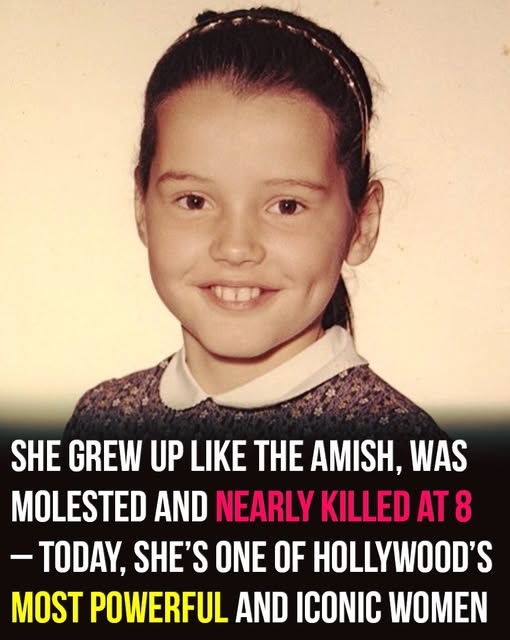
Geena Davis became one of the most iconic faces of modern Hollywood—a performer with a natural charm and a presence capable of transforming a scene effortlessly. In the 1980s and 1990s, she transitioned from modeling to major films with an almost dreamlike momentum, eventually earning an Academy Award and helping to define an era of women-led cinema. But her story isn’t just about success—it’s also about a childhood steeped in extreme restraint, fear, silence, and a near-death experience that taught her the wrong lesson far too early: always be polite, no matter what.
Born on January 21, 1958, in Wareham, Massachusetts, Geena’s world before Hollywood was small and tightly controlled. Her upbringing, she has described, was almost Amish in its simplicity. Her parents, Bill and Lucille, led modest lives, heating their home with wood her father chopped and growing much of their own food. Entertainment was limited, and exposure to the outside world was slow. Geena once joked that she knew she wanted to act at three years old, though she couldn’t quite grasp what it meant to have a “job” when the only films she was allowed to watch were animated Disney movies.
Her childhood wasn’t just about what she could watch—it was about how she behaved. Politeness was paramount. You didn’t complain. You didn’t draw attention to yourself. You didn’t cause trouble. These values shaped her into an adult, and in ways she didn’t fully understand at the time, they also made her vulnerable.
At eight years old, Geena experienced a moment that could have cost her her life. She was in a car with her 99-year-old great-uncle Jack, who was driving. As they drifted into oncoming traffic, no one spoke up—not her, not her parents. They watched a vehicle speeding toward them in silence, out of fear and habit. Just in time, Jack swerved and avoided a head-on collision. Everyone survived, but the message stuck: even when danger is imminent, don’t be rude. Don’t confront. Don’t interrupt. Stay polite.
That lesson would echo throughout her life and eventually become the focus of her memoir, Dying of Politeness. In that book, she also revealed a darker experience from her childhood—a traumatic event she carried as a secret, unable to understand or talk about it at the time. While delivering newspapers, she was molested by a neighbor. She didn’t fully comprehend what was happening, and the shame came later, especially after seeing her mother’s reaction. Though her mother confronted the man, the incident was never explained to Geena, and no police report was filed. Without that understanding, it became something she felt responsible for, something she learned to bury instead of process.
As she later reflected, many children in similar situations face a brutal dilemma: they know something terrible has happened but are taught—either directly or indirectly—that silence is the safest option. The lesson was clear: complaining attracts attention, and attention is dangerous. Geena wanted to talk, but she didn’t.
School wasn’t a refuge either. Geena’s height became another source of discomfort. She was tall from an early age, and standing out made her self-conscious. Teachers tried to recruit her for sports, and though she found her niche in track and field, it didn’t change the feeling of being different. Boys teased her with the nickname “Kareem Abdul-Jabbar,” turning her height into a punchline. This insecurity wasn’t vanity—it was survival. When you’re shy and self-conscious, being physically unavoidable can feel like a spotlight you can’t turn off.
Despite this discomfort, she kept building skills—she played the flute in the marching band and spent her senior year abroad in Sweden, becoming fluent in the language. These accomplishments reflected the discipline and intelligence beneath her quiet exterior.
After high school, she attended New England College and later transferred to Boston University to study drama. Her parents weren’t stage parents—they simply didn’t fully understand how improbable a successful acting career was. Geena later admitted that she never told her parents she didn’t graduate, and they passed away without ever knowing the truth.
In 1977, she moved to New York City, doing whatever work she could find—window mannequin, sales clerk, waitress—while pursuing modeling as a potential entry point into film. Her thinking was straightforward: models like Christie Brinkley and Lauren Hutton were getting film offers, so she believed modeling might be her quickest route to movies. It wasn’t about fashion for fashion’s sake; it was about opening a door.
She signed with the Zoli Agency and landed work, including a feature in the Victoria’s Secret catalog. This appearance caught the eye of director Sydney Pollack, who cast her in Tootsie (1982), launching her acting career in ways she couldn’t have planned. Suddenly, she was on screen with Dustin Hoffman, receiving strong reviews and entering a larger circle of opportunity. She moved to Los Angeles, and her name began to carry weight.
Throughout the 1980s, she worked steadily in both television and film. Her big break came in 1986 with The Fly, in which she starred opposite Jeff Goldblum. The film became iconic, and Geena became a rising star.
Then came a string of projects that cemented her place in Hollywood. Beetlejuice (1988), The Accidental Tourist (1989)—the latter of which earned her an Academy Award for Best Supporting Actress. She wasn’t just a pretty face; she was a talented actor with range and control.
Her most culturally significant role came with Thelma & Louise (1991), a feminist landmark directed by Ridley Scott. This film wasn’t just a career peak; it was a personal turning point. Geena has credited her friendship with Susan Sarandon with teaching her how to stop shrinking herself to fit the room, how to speak plainly, and how to assert herself. The film’s success highlighted a persistent issue in Hollywood—stories centered on women were still seen as exceptions, even when they were clearly in demand.
Following Thelma & Louise, she starred in A League of Their Own (1992), another women-driven hit that reinforced her position as a major star in roles that didn’t revolve around men. At the height of her fame, she enjoyed the glamour of red carpets and Oscar nights. Yet, she also recognized the distance between her small-town roots and her newfound Hollywood reality.
However, as she approached forty, the industry’s familiar pattern emerged: roles for women narrowed. Hollywood’s imagination for women, it seemed, had an expiration date. This moment, she later described as “falling off the cliff,” when even proven actresses find opportunities less frequent.
Despite this, Geena’s influence didn’t fade. She married four times, including a marriage to Jeff Goldblum, and later became a mother for the first time at 46. She had three children with her fourth husband, Reza Jarrahy: a daughter, Alizeh, and fraternal twin sons, Kaiis and Kian. Becoming a mother later in life came with challenges, but it also brought emotional clarity and a newfound understanding of love.
Motherhood also sharpened her perspective on media. Watching children’s content, she noticed patterns of who got to speak, who got to lead, and who was relegated to the background. This realization led her to establish the Geena Davis Institute on Gender in Media in 2004, advocating for measurable change in the representation of women in film and pushing for greater gender equality, especially in directing and decision-making roles.
Today, Geena continues to act and take on new projects, but her influence extends far beyond acting. She has become a powerful advocate, shifting conversations in Hollywood and beyond. The woman who once learned to stay quiet now uses her voice to change the room.
Her story isn’t just about fame—it’s about survival, about breaking free from the lessons of silence, and about using the strength of experience to make a lasting impact.