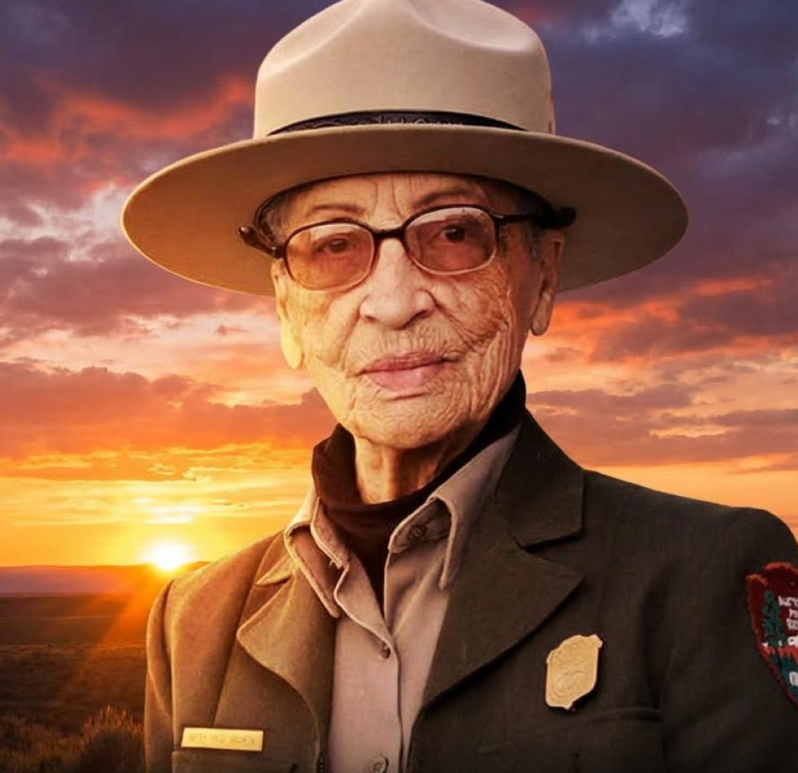
In addition to being a biography of longevity, Betty Reid Soskin’s narrative is a powerful illustration of the strength of the human voice in the vast scheme of American history. Soskin died quietly at the age of 104, leaving behind a world that, as a result of her existence, appears radically altered. She was a woman who did more than simply live in her century; she questioned it, questioned its exclusions, and became its most articulate interpreter. Soskin started her most important chapter at an age when most people have long since retired into the peace of retirement, demonstrating that the most important work of a lifetime can frequently start in its twilight.
Until her retirement at the age of 100 in 2022, Soskin was the oldest active ranger in the history of the National Park Service, and her name became synonymous with the agency. But her influence was measured by more than simply her years of service or the famous hat with a flat brim that she wore with such dignity. In Richmond, California’s Rosie the Riveter/World War II Home Front National Historical Park, she served as its moral compass. Soskin was the voice in the room that prevented the story from being sanitized during the park’s conception. She realized that although the “Rosie” persona was a potent representation of female empowerment, the story’s conventional recounting frequently avoided the systemic exclusion and segregated realities that African Americans endured throughout the war effort.
She had the special power to change that history because she had lived it. Soskin was born in 1921 into a multicultural family with strong ties to California and Louisiana. His early years were a microcosm of what it was like to be an American. As a file clerk for a segregated labor organization during World War II, she found herself at the nexus of local discrimination and national advancement. She seen personally the conflict that arises when a nation struggles to implement democracy at home while fighting for it overseas. When her friends were looking back, she was looking forward, determined to make sure that the “lost stories” of the home front were given a permanent place in the national memory. It was this lived experience that she took to the National Park Service in her eighties.
Soskin worked as a cultural architect and community builder prior to becoming a ranger. She and her husband, Mel Reid, co-founded Berkeley’s Reid’s Records in 1945. For more than 70 years, gospel music and community discourse thrived at what began as a modest enterprise and grew into a renowned cultural landmark. As a testament to Black tenacity and enterprise, the store withstood the neighborhood’s gentrification and the changing tides of the music industry. Her conviction that history is preserved in the places where people congregate, exchange music, and speak their truths was strengthened by this period of her life.
Her abilities as a representation advocate were further refined during the ensuing decades as she moved into government and public service positions. Soskin was constantly concerned with the “invisible” citizen, whether he was serving on neighborhood boards or lobbying for local legislators. She realized that deciding whose story is told and whose is ignored frequently determines power. By the time she put on the ranger uniform, she was more than just a government worker; she was a seasoned truth-seeker with a century of experience and a strong, enduring love for a nation she wished to see fulfill its ideals.
When she was invited to the White House to take part in the National Christmas Tree Lighting ceremony in 2015, it was one of the most moving occasions in her public life. Soskin stood next to President Barack Obama, symbolizing the link between the challenges of the past and the opportunities of the future. Seeing a Black president recognize her accomplishments was a bizarre and deeply humbling experience for a lady who had grown up in a segregated America, she said. Her longstanding goal—that you can someday modify the menu if you sit at the table long enough—was validated.
As she approached her second century, Soskin continued to play an important role in public life. Her famed performances at Richmond Park frequently sold out months in advance. Visitors came to hear a sage, not only to view a historical monument. Her delivery transformed far-off statistics into emotional realities, compelling her audience to face the intricacies of the American identity with candor rather than sentimentality. She showed us that a country can only fully mend its scars if it has the courage to face them head-on.
Although Betty Reid Soskin’s bodily journey came to an end at the age of 104, her legacy endures. She changed the way the National Park Service told stories, shifting it from a “great man” view of history to a more democratic, inclusive account that honors the achievements of many. In their sadness, her family has called for ongoing funding for education and the preservation of various historical accounts in order to respect her legacy. They realize that Betty’s art was never about her; rather, it was about the generations that would follow her, trying to figure out where they fit into the narrative of America.
We are reminded that history is a living, breathing entity as we consider her century of life. It is a dialogue between the past and the present; it is not stagnant. A master of that dialogue was Betty Reid Soskin. She transferred the torch to us with the quiet, clear expectation that we would keep the flame blazing, corrected the stories that were being told incorrectly, and safeguarded the stories that were in risk of being forgotten.
Her life is an example of how to age with meaning. She demonstrated that even when the body is exhausted, the heart and intellect can stay open. She demonstrated to us that speaking the truth with elegance and integrity is the most radical thing one can do at a time of disinformation. Not only did Betty Reid Soskin observe American history, but she also contributed to its most candid moments. By doing this, she made sure that the monuments and parks of the place she loved would always have the voices of the underprivileged. Her legacy serves as a reminder that the truth, once spoken, endures eternally despite the passage of time.