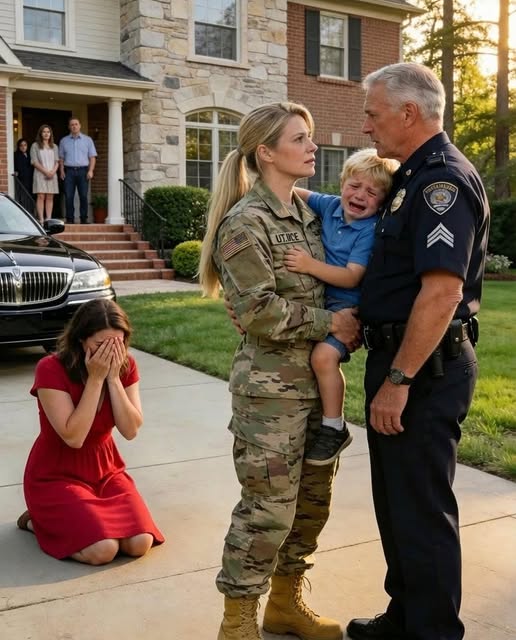
I never told my sister-in-law what I actually did for a living.
To Lisa, I was just her husband’s quiet, forgettable sister—the one who “never made it,” the one who “wasted years in the military and came back with nothing to show for it.” She never had to say it directly; the tone, the smirks, the little “jokes” were enough.
In her world, status meant everything. And Lisa had plenty to lean on.
Her father was the city’s police chief. Her husband had a solid corporate job. Their house was big, loud, always full of people who prided themselves on influence and connections. Lisa thrived in that environment. She liked being seen, being the center of attention, subtly—or not so subtly—reminding everyone that she came from power.
I never corrected her assumptions. I didn’t feel the need to. Rank doesn’t define you in a living room. It doesn’t matter at family gatherings. Honestly, I preferred it that way. Simpler. Cleaner. No expectations, no attention.
That afternoon was supposed to be just another family barbecue. Kids running around, adults gathered near the grill, drinks in hand, voices overlapping. The kind of chaos that feels normal for weekends.
My son, Eli, was playing near the patio, close enough for me to watch without hovering. He laughed, chasing bubbles with the other kids, blissfully unaware of the tension that always hovered when Lisa was around.
Then it happened—everything changed in a heartbeat.
A loud crash. A sharp cry.
I spun around. Eli lay on the ground near the grill, curled in on himself, screaming. One of the metal skewers had fallen, and the hot coals had shifted. His arm was burned badly.
I moved instantly, before anyone else could process it.
“Get water!” I barked, kneeling beside him.
He shook, terrified, his skin reddening in a way no parent wants to see.
“Mom…” he whispered.
“I’ve got you,” I said, steadying him even as my chest tightened.
Then Lisa’s voice cut through everything.
“Oh my God, this is such a mess,” she said, annoyed more than concerned. “Why wasn’t someone watching him?”
I ignored her.
“Call an ambulance,” I told the nearest adult.
Before anyone could react, Lisa stepped in front of me, arms crossed.
“Relax,” she said. “It’s just a burn. No need to make a scene.”
I looked at her, disbelief settling in.
“He needs medical attention. Now.”
She rolled her eyes. “You’re overreacting. Dad’s here. He can handle it.”
Her father approached, drawn by the noise—uniform crisp, presence commanding, the kind of man people instinctively listened to.
He took one look at Eli, then at me.
“What’s going on?”
“Minor accident,” Lisa said quickly. “She’s making it dramatic.”
“It’s not minor,” I said, controlled but firm. “We need paramedics.”
He hesitated. Not because he didn’t understand, but because Lisa had framed the story first.
“She’s right,” Lisa said, louder. “You always overreact. Everything has to be dramatic.”
That was it.
I stood, still holding Eli.
“This isn’t about you,” I said. “Move.”
She didn’t. She leaned closer, voice lowering just enough to be personal.
“You don’t get to come into my family and start giving orders like you’re somebody important. You’re not.”
Her father shifted, uncomfortable, caught between authority and assumption. I met his eyes.
“Chief, call for medical support. Now.”
Before he could respond, Lisa interrupted again.
“No. This is ridiculous.”
“Dad, do something. She’s making a scene,” she hissed.
He reached for his cuffs—not because I’d done anything wrong, but because control in his world had to be enforced quickly.
“Ma’am,” he said, trying to sound official, “you need to calm down.”
I stared at him, quietly.
“You’re making a mistake.”
He didn’t stop.
So I did something I’d avoided for years in family settings. I pulled out my identification.
The moment he saw it, his hand froze. Everything shifted. His posture changed. His confidence drained.
“The law doesn’t bend for anyone,” I said calmly. “And you’re obstructing medical care for a child.”
His mouth opened, nothing came out. Lisa scoffed, oblivious to the shift.
“Dad, arrest her!” she shouted.
He turned to her, voice sharp, unsteady. “Be quiet.”
Then back to me—smaller, stripped of authority.
“I… I didn’t know.”
“You didn’t need to. The law doesn’t change for who I am.”
A tense silence. Then I stepped aside.
“Call the ambulance,” he said immediately, reaching for his radio.
This time, no one argued.
Paramedics arrived within minutes. Eli was lifted carefully, his cries softer but still piercing. I stayed by him the entire time.
Before loading him, I reached into my bag. The medal he had earned, scorched by the coals, was still intact.
“It’s still here,” I said gently. “Just like us.”
He smiled faintly, hand reaching for mine.
“You were brave,” I whispered.
His fingers tightened weakly but certain.
In that quiet room, none of the earlier noise mattered—accusations, arrogance, the moment everything shifted, the rank I’d carried in silence for years—none of it mattered compared to that small hand holding mine.
Because in the end, there was only one thing that mattered.
And it wasn’t general.
It was mom.