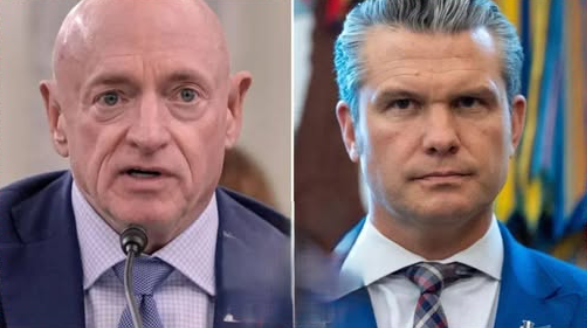
The hammer finally dropped, and it did so with unmistakable force. A sitting United States senator — once a decorated Navy captain who spent decades inside the military chain of command — now finds himself accused of “serious misconduct” by the very defense establishment he once pledged to serve and obey. What initially surfaced as a controversial, politically charged video has escalated into something far more severe: a formal Command Investigation ordered by the Pentagon itself. The implications are enormous. Quiet conversations now include words once thought unthinkable for an elected official: court-martial, formal censure, and permanent reputational damage.
At the center of the storm stands Senator Mark Kelly. For years, he has been publicly defined by service, discipline, and credibility — a veteran, an astronaut, a lawmaker with a carefully cultivated image of responsibility. That image is now under direct scrutiny. Allies who once defended him loudly have gone silent. Political opponents, sensing vulnerability, are circling aggressively. And within military circles, where loyalty to civilian authority is sacred but insubordination is intolerable, alarm bells are ringing.
The escalation from internal review to an official Command Investigation is not procedural routine. It is a serious step reserved for cases where allegations are considered credible enough to warrant sworn testimony, formal evidence gathering, and the possibility of punitive consequences. In plain terms, the Pentagon is signaling that this is no longer a matter of optics or partisan disagreement — it is a question of whether a former officer violated fundamental military norms.
The controversy stems from Kelly’s appearance in a video that urged members of the armed forces and intelligence community to resist what he characterized as “unlawful” orders. Supporters framed the message as a warning about constitutional duty. Critics saw something far more dangerous: a sitting senator encouraging selective disobedience within the ranks of a military that depends on discipline, clarity, and lawful hierarchy to function.
This is where the line becomes perilously thin. The U.S. military is built on the principle of civilian control, but it is equally built on the idea that service members do not individually decide which orders to obey based on political interpretation. That responsibility belongs to courts, commanders, and lawful processes — not viral videos. By inserting himself into that space, Kelly didn’t merely enter a political debate; he stepped into a legal and ethical minefield that the military treats with extreme seriousness.
Now, investigators have broad authority. They can compel testimony under oath, examine communications, assess intent, and determine whether Kelly’s actions constituted protected speech or crossed into conduct that undermines military order. The consequences range from formal reprimand to far more severe outcomes, depending on the findings. Even absent criminal charges, the mere existence of the investigation carries immense weight.
Kelly and his defenders argue that the investigation is politically motivated — a vendetta fueled by ideological opponents seeking to silence dissent. That claim may resonate in partisan media spaces, but the Pentagon’s language and posture tell a more restrained, institutional story. This is not a cable-news spectacle. It is a sober process driven by concern over precedent and principle, not sound bites.
What makes this moment especially volatile is timing. Trust between America’s elected officials and its military institutions is already under strain. Repeated politicization of national security, public feuds between commanders and politicians, and growing skepticism within the ranks have frayed a relationship that depends on mutual restraint. This case threatens to widen those cracks.
If a former officer turned senator is perceived as encouraging resistance within the military, the implications extend far beyond one man’s career. It raises uncomfortable questions about how political actors use military credibility for influence — and where the hard limits must be drawn.
No matter the outcome, damage has already been done. Kelly’s reputation as a steady, disciplined public servant will now be filtered through this investigation. The Pentagon, by acting decisively, has signaled it will defend institutional boundaries even when doing so risks political backlash. And the broader civil-military relationship absorbs yet another stress test in an era already defined by division.
This clash — between a group critics deride as the “seditious six” and the Defense establishment — will not end quietly. It will echo in future debates about dissent, authority, and the responsibilities of those who have worn the uniform and later seek political power. The question is no longer whether this moment matters. It is how deep the scar will be — and whether it heals or hardens.