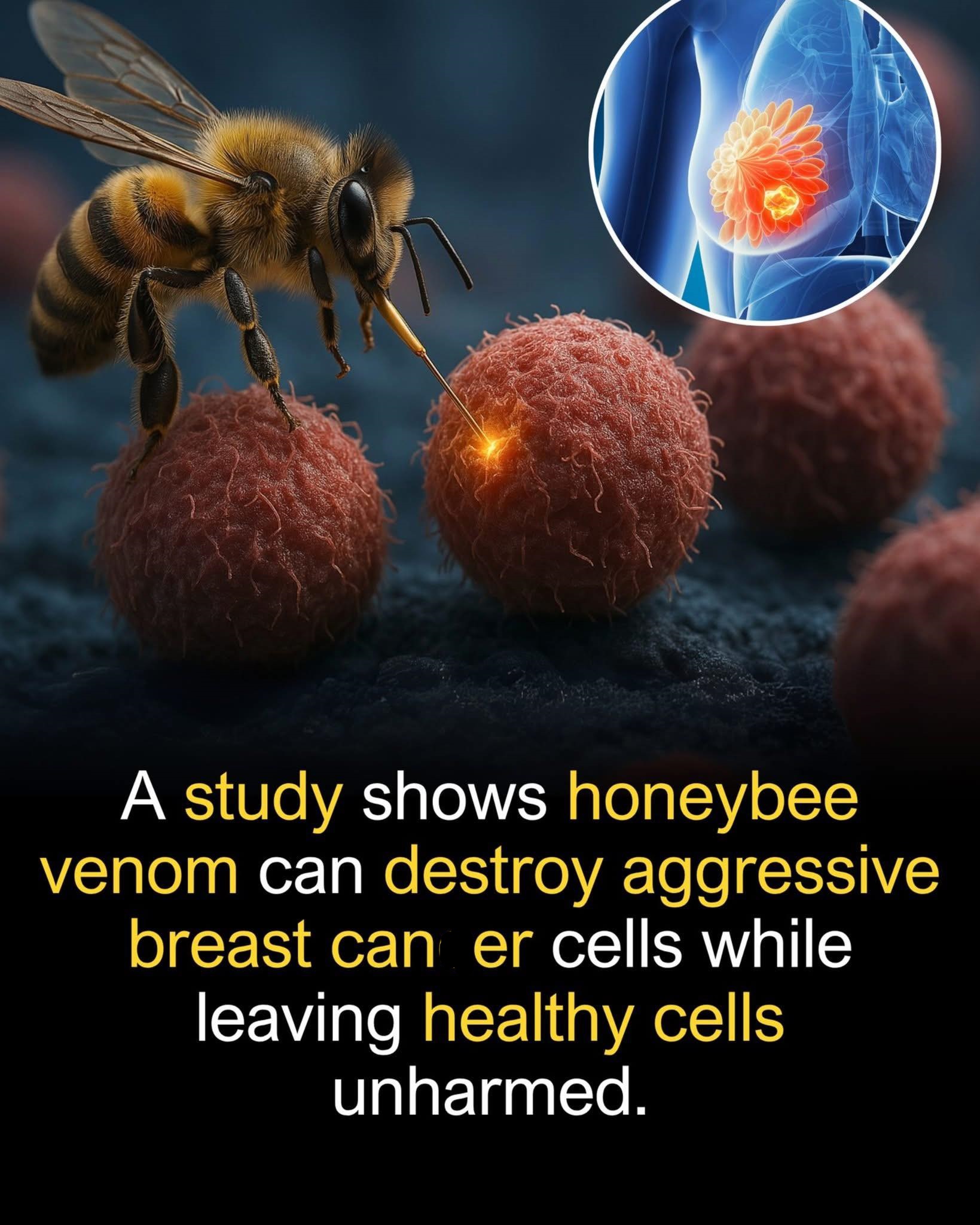
A bee’s sting might one day save your life. In a quiet laboratory tucked away in Australia, a team of researchers observed something that seemed almost impossible: the venom of honeybees, long feared for its pain and swelling, tearing through some of the most aggressive and deadly forms of breast cancer ever studied. Tumors that had resisted chemotherapy, radiation, and targeted drugs suddenly faltered. Healthy cells, astonishingly, remained largely untouched. For the doctors in the room, it was a moment of awe and disbelief. Could nature’s smallest but most potent weapon become the sharpest scalpel in medicine’s arsenal?
The secret lies in a molecule called melittin, the primary active ingredient in bee venom. Acting with a precision that rivals surgical instruments, melittin penetrates the membranes of malignant cells, disrupting their internal communication networks and effectively halting their ability to grow or metastasize. Researchers found that in particularly aggressive breast cancers—such as triple-negative and HER2-enriched types, which are notoriously resistant to conventional therapies—melittin could induce cell death while sparing the surrounding healthy tissue. In a field where collateral damage to the body is often unavoidable, this selectivity is nothing short of revolutionary.
Early laboratory tests revealed the molecule’s mechanism: it binds to the lipid layers of cancer cell membranes, forming pores that compromise the cells’ structural integrity. Once the membranes are breached, the tumors lose their ability to signal, divide, and migrate. Researchers liken it to cutting off a city’s communication and supply lines: the infrastructure collapses from within. In animal studies, treated tumors shrank dramatically, sometimes disappearing almost entirely, while nearby organs remained unharmed. The results, though preliminary, offered a tantalizing glimpse of a future where cancer treatment could be as precise as a surgeon’s hand but without invasive procedures.
Yet the journey from petri dish to patient is complex and fraught with caution. So far, these findings are confined to controlled laboratory experiments. Human trials, which must evaluate safety, dosage, and potential immune reactions, have yet to be conducted at scale. Scientists caution that melittin’s natural potency is a double-edged sword; administered incorrectly, it could damage healthy tissues or trigger dangerous allergic responses. Still, the potential for a therapy that selectively targets cancer cells has energized researchers worldwide.
The implications of this discovery extend beyond breast cancer. If melittin or similar venom-derived molecules can be harnessed safely, they might offer new avenues against other stubborn cancers, such as pancreatic, ovarian, or even certain brain tumors. Scientists are exploring ways to attach melittin to nanoparticles, antibodies, or other delivery systems to enhance precision and reduce risk. The vision is clear: a drug that seeks out malignant cells like a guided missile, leaving the rest of the body intact—a dream long pursued but rarely glimpsed in oncology.
Beyond the clinical promise, there is a symbolic poetry in the finding. One of the smallest, most feared creatures in the natural world—the honeybee—may hold the key to overcoming one of humanity’s greatest medical challenges. A sting once associated with pain, irritation, and allergic shock could become a life-saving tool, redefining how we understand both nature and medicine. It is a reminder that sometimes, solutions to our most complex problems come from the most unexpected sources.
For patients facing cancers that stubbornly resist existing treatments, the discovery of melittin offers a glimmer of hope—a tangible reason to believe that science is still capable of miracles. It also highlights the importance of curiosity-driven research, the kind of work that examines nature’s quirks not just for wonder, but for life-altering applications. Though years may pass before melittin-based therapies reach clinics, the promise is already reshaping the conversation about what cancer treatment could become.
Researchers continue to probe the molecule’s intricacies, asking questions about how to optimize its delivery, minimize potential side effects, and combine it with other therapies. Each experiment, each microscopic observation, builds toward a vision of a future in which cancer’s deadliest forms are no longer invincible. In the meantime, melittin serves as a striking testament to the untapped potential in the natural world, a reminder that the smallest of creatures can sometimes hold the largest keys to survival.
The path ahead is uncertain, and the stakes are immense. But for now, scientists, doctors, and patients alike can marvel at the remarkable possibility: that a drop of venom, once feared, might one day be wielded to protect life, heal, and conquer disease in ways we have only just begun to imagine.