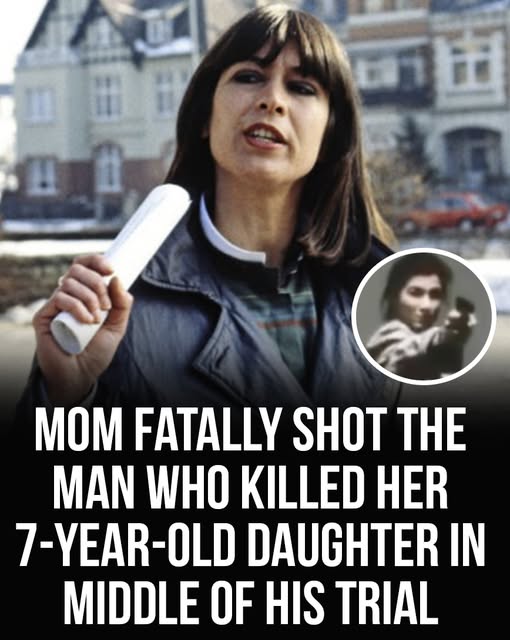
Marianne Bachmeier walked into a Lübeck, Germany, courtroom on March 6, 1981, determined to succeed.
Then she abruptly pulled a loaded weapon out of her purse and started shooting at Klaus Grabowski, a 35-year-old sexual offender.
The man was charged with the abduction, maltreatment, and killing of Anna Bachmeier, Marianne’s 7-year-old daughter.
After being struck by seven of Marianne’s shots, Grabowski breathed his last and passed away on the courthouse floor a few seconds later. Despite being detained right away, the vindictive mother shown no signs of regret. Forty years later, “Revenge mom” is still remembered by many, and her sentencing still causes division in the entire country.
The greatest tragedy is losing a kid, which is sometimes described as the worst thing a parent can go through.
Marianne Bachmeier’s life was irrevocably altered on May 5, 1980. Marianne was a struggling single mother who owned a pub in Lübeck, northern Germany, in the 1980s.
Marianne’s own childhood was characterized by hardship and a number of tragedies. One of the most notorious groups in Nazi Germany was the Waffen-SS, of which her father had been a member.
She had experienced multiple rapes as a child from various males. Marianne was only sixteen when she became pregnant. She chose to place the baby for adoption because, as a teenager, she was unable to raise it alone. Marianne got pregnant a second time when she was eighteen, and she once more gave her child up for adoption.
Marianne gave birth to her third child, a daughter named Anna, in 1973. Despite raising Anna alone, Marianne remained a single mother.
Sources claim that Anna was a “happy, open-minded child,” but a horrible incident would soon befall her and her family.
Anna and Marianne got into a fight in May 1980. The little girl made the decision to stroll to a friend’s house rather than attend school. However, a local butcher named Klaus Grabowski, 35, abducted Anna on her way there.
Before killing Anna by strangulation, Grabowski mistreated the young child and imprisoned her in his room for hours. After killing Anna, the killer placed her body in a box and kept it at a secret location on a canal bank.
Later, Grabowski went back to the scene to bury his victim’s body, but after his fiancé reported him in to the police, he was taken into custody that same night in his favorite Lübeck pub.
Grabowski was already a convicted sexual offender at the time, having served time in prison for assaulting two females.
He deliberately underwent castration in 1976 while incarcerated. In order to establish a romantic relationship with his fiancé, he started hormone therapy two years later to reverse the chemical castration.
Grabowski denied sexually abusing Anna, but he quickly admitted to killing her. Grabowski even went so far as to accuse Anna of attempting to extort and seduce him during his trial.
Grabowski actually held his murder victim responsible for his ignominious deed. He asserted that the young girl’s desire to blackmail him was the only reason he killed her. According to Grabowski, Anna threatened him and said that she wanted money – otherwise she would tell her mother that Grabowski had touched her in an inappropriate way.
The court rejected Grabowski’s justification.
However, his bizarre and upsetting tale made Anna’s mother Marianne insane, leaving her feeling helpless, enraged, and furious. On the third day of the trial, March 6, 1981, Marianne made the decision to act independently.
Bypassing the security checks and all of the guards, she managed to sneak a gun into the courtroom. She emptied the magazine, aimed the loaded gun at her daughter’s attacker, and took it out of her handbag shortly after she entered the hall. Grabowski was hit by seven of the eight shots, and he fell instantly. He passed away instantly.
Anna’s mother dropped her Beretta M1934 just after the shooting. Then she spoke, filling the room:
“My daughter was killed by him. I shot him in the back instead of the face, as I had intended. I’m hoping he’s deceased.
After she started shooting, Marianne also referred to Grabowski as a “pig,” according to two responding police officers.
She was first accused of murder after being taken into custody by police in the courtroom. Marianne stated during her 1982 trial that she had a dream in which she saw her daughter in court and then shot Grabowski.
However, specialists who testified during the trial stated that Marianne’s deed necessitated special firearms practice, suggesting that she had prepared and planned everything before the shooting.
Doctors also examined the mother and asked if she could provide a sample of her handwriting. Marianne responded back, “I did it for you, Anna.” Seven hearts were also used to embellish the sample; many people thought this was a nod to each of Anna’s years.
Marianne faced a life sentence in jail if found guilty.
Both in Germany and beyond, the mother’s act of vigilantism garnered a great deal of media attention. At the trial, Marianne was referred to as “Revenge mom,” and many people believed she should be found not guilty.
Despite the vigilante justice she carried out, the distraught mother who exacted revenge for the death of her cherished daughter was greatly applauded and showed a great deal of understanding and support.
In the beginning, the media presented Marianne as a saint. Journalists then began to investigate her past. The adoption of Marianne’s first two children was reported in the newspapers. One of the things that started to damage the image of a selfless and loving mother was the fact that she spent a lot of time in the bar where she worked.
Marianne was found guilty in 1983 of unauthorized firearm possession and premeditated manslaughter. Despite receiving a six-year prison sentence, she was released after three years.
An Allensbach Institute survey revealed that her punishment caused division among the populace. About 28% of respondents thought her six-year sentence was right, 27% thought it was too harsh, and 25% thought it was too light.
Marianne fled to Nigeria and married a German teacher after completing her prison sentence. She relocated to Sicily, Italy, after getting divorced in 1990.
Sadly, Marianne returned to Lübeck, her homeland and motherland, after receiving a pancreatic cancer diagnosis.
Many Germans still remembered her act of retaliation, and the episode was covered in publications well into the 1990s.
Thirteen years after her performance, she made a rare appearance on German radio in 1994.
“I believe there is a significant difference if I murder a young girl because I fear that I will then have to spend the rest of my life in prison.” Then comes the “how,” which is derived precisely from his statement: “I heard something come out of her nose, I was fixated, then I could not stand the sight of her body any longer,” she said. As a result, I stand behind the girl and strangle her.
Marianne admitted in a 1995 interview with Das Erste TV that she had shot Grabowski after giving it some thought and to stop him from distributing additional false information about Anna.
Marianne died in a Lübeck hospital on September 17, 1996. She never succeeded in dying in her former Sicilian home.
Later, Marianne was laid to rest beside her cherished daughter in a Lübeck cemetery.
There is ongoing discussion on Marianne’s fate and the vigilante justice case. Many others supported her behavior and believed it was a just punishment for a sexual offender who had previously been found guilty of multiple child abuse convictions.
Others, on the other hand, believed that Marianne was wrong to enforce the law herself. Critics said she ought to have let the judge decide the case.