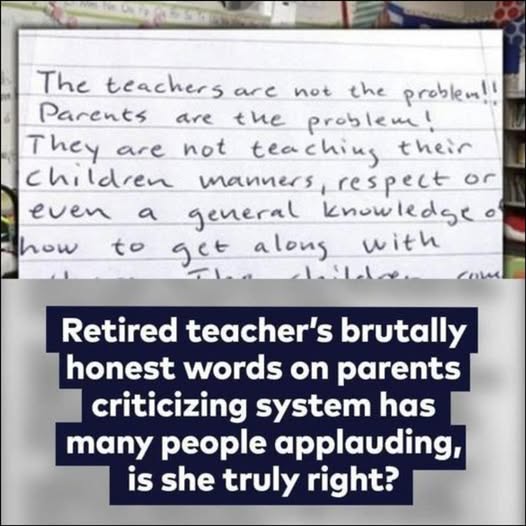
In the often heated conversation about the state of modern education, everyone seems to have a solution for what’s wrong in the classroom. Politicians, administrators, and advocacy groups scrutinize test scores and curriculum standards, searching for a scapegoat in the system itself. Yet a voice from the classroom has broken through the noise, refocusing attention from the chalkboard back to the home. Lisa Roberson, a retired teacher, went viral after publishing a candid open letter in the Augusta Chronicle. Her message was clear, unflinching, and provocative: the crisis in schools is not about teaching—it’s about parenting.
Roberson’s letter first appeared in 2017, but its relevance has only grown. Even amid the upheavals of a global pandemic and the digital shift in learning, her central argument remains powerful: the real problem lies not in pedagogy, but in the home. She opened her letter with a frustration familiar to educators, saying she was “tired of people who know nothing about public schools or haven’t been in a classroom recently deciding how to fix our education system.” For her, the gap between policy and classroom reality is the greatest barrier to meaningful reform.
At the heart of her argument is a bold reversal of the usual narrative that places all responsibility for student success on teachers. “Teachers are not the problem! Parents are the problem!” she wrote, her exclamation echoing across social media. According to Roberson, key foundations for learning—manners, respect, and basic social skills—are no longer instilled at home. She described classrooms where teachers spend more time managing behavior than teaching, trying to build a structure on a foundation that was never laid.
One striking point in her letter highlighted the distorted priorities of today’s consumer-driven households. Roberson observed that children often arrive at school in expensive sneakers, yet lack basic learning tools. “They have no pencil or paper,” she noted. “Who provides them? Often the teachers do, from their own pockets.” This image illustrates her larger point: some parents invest in appearances and status while neglecting the essential requirements of intellectual growth.
Roberson urges critics of the education system to reconsider what defines a “failing” school. She asks them to look beyond test scores and instead examine parental engagement: do parents attend open houses, communicate with teachers, ensure their children are prepared for the school day, or even provide a phone number where they can be reached if problems arise? The implication is clear: a “failing school” often reflects a struggling home or community, not a lack of teacher effort. A highly skilled teacher can use the best technology and methods, but if students are unwilling or unprepared, the system cannot succeed.
The viral response to Roberson’s words revealed a stark divide. Many educators and supporters embraced her, feeling she gave voice to the “invisible labor” of teachers acting as surrogate parents, social workers, and disciplinarians before they can even teach. Critics, however, argue that her perspective is overly simplistic, overlooking poverty, conflicting work schedules, and other systemic barriers that can prevent parental involvement.
Still, Roberson’s letter is not a sociological treatise—it’s a call for personal responsibility. She concludes with a clear challenge: “Teachers cannot do their jobs and the parents’ job. Until parents step up and do their job, nothing will improve!” Her words cut through the jargon of educational reform, returning agency to the family.
Even in 2026, her letter continues to resonate. It forces reflection on whether society has shifted too much of the child-rearing burden onto institutions. Governments can fund schools and supply textbooks, but they cannot legislate the curiosity, discipline, and respect that children learn at home. Roberson’s message is simple: the most important classroom in a child’s life is the one at the breakfast table, and the most influential teacher is the parent who tucks them in at night.
The lasting impact of her letter is not policy change, but the millions of conversations it sparked in homes, offices, and breakrooms. It reminds us that education is a partnership, not a service delivered to passive consumers. Until that partnership is restored, schools will continue to struggle, no matter how many new programs are implemented. Lisa Roberson didn’t just write a letter—she issued a challenge for the nation to remember where true learning begins.