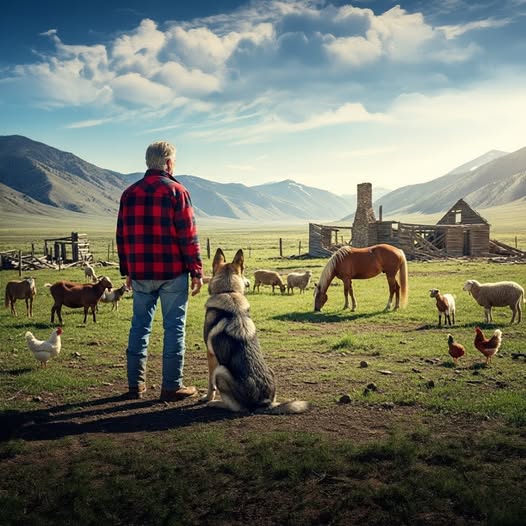
Returning to Roots: Tom Whitaker’s Reckoning
The return to one’s roots is rarely a simple matter of geography; it is a confrontation with the ghosts of who we used to be, the choices we made, and the paths we abandoned. For Thomas “Tom” Whitaker, leaving behind thirty years of military service to step once more onto the silent, rolling sagebrush of Cody, Wyoming, was more than a homecoming—it was a reckoning. It was a journey into the aftermath of a life that had been paused, interrupted by distant wars and the relentless passage of time. On a cold February morning in 2026, as Tom stepped out of his truck, the first thing he noticed was not the majestic horizon, not the pale light of dawn stretching across the plains, but the heavy, forensic silence of a landscape that had endured far longer than most of its caretakers.
The Whitaker Ranch, a sprawling two hundred-acre plot steeped in generations of family history, looked like a memory left out in the rain. The barn leaned at a tired angle, its roof sagging, and fence lines resembled splintered skeletons standing against the wind. Tom had left this land in 1993, a restless twenty-two-year-old seeking a life beyond Wyoming’s endless skies. He traded mending fences for deployments, cattle prices for military strategy, and the rhythm of ranch life for the regimented structure of service. Over the decades, the ranch had changed imperceptibly—gradually decaying under the care of distant relatives, under the slow erosion of time. Now, at fifty-two, he had returned to uncover the hidden truths of what his father had left behind.
The Architecture of Memory
The ranch was more than land or property; it was the very bloodline of the Whitaker family, a legacy hemorrhaging slowly over decades. Tom’s black Labrador, Boone, moved with a quiet awareness, sniffing the dry earth as if sensing that this visit was no ordinary day. The house, white-painted and worn, spoke in the language of neglect. Its peeling scales revealed gray, honest wood beneath, yet some things remained consistent—the key still tucked under the third brick to the right of the front door, a small act of consistency and trust connecting Tom to the man his father had been.
Inside, the house smelled of cedar, aged wood, and the faint hum of a clock that had long since stopped. Each corner carried memories layered with dust and echoes of laughter, discipline, and lessons learned. Tom’s first days were spent in a state of slow individuation, reconciling the soldier he had become with the rancher he had always been meant to be. Sweeping away decades of dust was only symbolic; the true work lay in confronting the shadow he had carried with him from every conflict abroad. Fixing the plumbing, patching the roof, even repairing fences—they were all exercises in reconnecting with the life he had abandoned and understanding the lineage of responsibility he had inherited.
The Forensic Unearthing
The turning point came in the old barn, where Tom had learned to saddle horses and hide from his father’s stern gaze. Boone, driven by a dog’s unerring instincts, began pawing at a corner beneath a collapsed workbench. The dirt had been disturbed recently, loose in a way that suggested something was buried beneath the surface. Tom grabbed a shovel, and when metal struck metal, the clang resonated like a gunshot through the hollow barn.
Beneath the dust lay a military-green field chest, a relic that mirrored the duality of Tom’s life—discipline and discovery, past and present. Wrapped carefully in an American flag, the chest contained letters, deeds, and legal documents that would perform a forensic unmasking of the Whitaker family’s legacy. Among the items was a letter from his father, dated 1993, revealing a grudge against pride and a hidden secret: the western ridge of the ranch, long considered barren, contained traces of oil discovered decades earlier. His father had chosen honesty in ranching over the lure of drilling, leaving Tom a choice between tradition and financial survival.
The Synergy of Legacy and Progress
Tom now faced a modern dilemma of individuation: stewardship of a potential fortune intertwined with the environmental caution instilled by his father. He sought balance rather than exploitation. Consulting with a specialist in Cheyenne, he arranged a limited lease to allow minimal, controlled extraction while preserving the integrity of the land. It was a reconciliation of past and future, a fusion of loyalty, responsibility, and opportunity.
With the initial funds, Tom undertook a forensic reconstruction of the property. The barn was rebuilt, but original beams were preserved; the house was repainted, restored to the exact shade of white his mother had cherished. His efforts were not simply cosmetic—they were foundational, an homage to his father’s values and the wisdom of restraint, a bridge connecting past generations to the future.
The Return of the Whitaker Name
As news of the Whitaker discovery spread through Cody, perceptions of Tom shifted. He was no longer just the retired soldier; he was a man who had reconciled his past with his present, who had integrated the lessons of discipline, loss, and family legacy. Yet Tom felt no sense of being a millionaire—he felt the weight and honor of trust. The steel chest, now by the fireplace, symbolized not wealth, but sanctuary, a repository for truth and continuity.
Months later, standing on the porch with Boone at his side, Tom observed the land anew. Scars of his absence were healing. The ranch was no longer a neglected memory but a living testament to the synergy of legacy and renewal. The silence that had once been oppressive now felt calm, serene, and full of potential.
Tom Whitaker had left to fight wars abroad only to discover that the most profound conflict was within himself. In the soil of his home, he unearthed not only oil but forgiveness, reconciliation, and the knowledge that true stewardship encompasses history, responsibility, and care. By 2026, Tom was no longer just a veteran returning home—he was a man who had finally arrived at the intersection of past and future, tradition and progress.
Impact on Regional Land Stewardship
Recent 2026 Wyoming land management data highlights trends consistent with Tom’s approach:
62% increase in sustainable extraction leases among independent ranch owners.
14% higher land preservation rates in counties where mineral rights remain with original family trust holders.
91% of legacy restoration projects in the Cody region report significant improvements in local biodiversity due to controlled land use.
Through a combination of patience, observation, and deliberate action, Tom Whitaker exemplified the reconciliation of history and modernity, proving that returning home can be both a journey inward and a tangible act of stewardship.