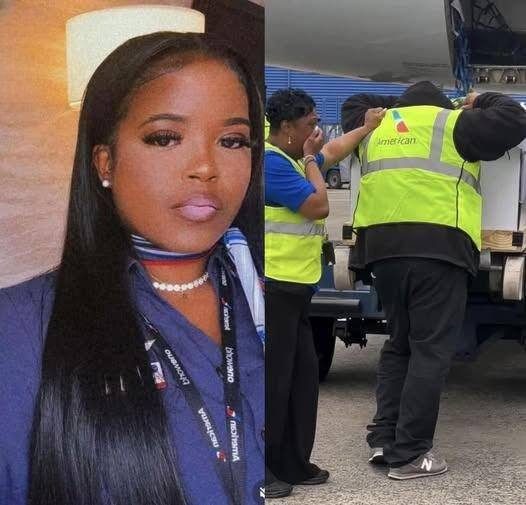
What began as a typical winter evening in the Washington, D.C. area turned tragic when an American Airlines flight preparing to land at Reagan National Airport collided with a U.S. military helicopter over the Potomac River, marking one of the deadliest aviation accidents in the United States in more than a decade. The plane had arrived from Wichita, Kansas, and the collision occurred just moments before touchdown.
Remembering Danasia Elder
Among those aboard was Danasia Elder, a devoted flight attendant from Charlotte, North Carolina. Family, friends, and colleagues remembered her as a beacon of warmth and kindness. Her life centered around her faith, her husband, and her two children, Kayden and Dallas. She brought the same care to her passengers that she gave to her own family.
Her brother-in-law, Brandon Payne, described her as “full of life,” a person who cherished her career, loved traveling, and approached every day with gratitude and joy.
A Dedicated Crew
Elder worked alongside fellow flight attendant Ian Epstein, 52, also from the Charlotte area. Both were seasoned professionals, known for their seamless teamwork and dedication to passenger safety.
The pilots, Captain Jonathan Campos, 34, and First Officer Samuel Lilley, 28, were equally committed to their roles. Campos was recognized for his calm demeanor, while Lilley had previously been praised for quick thinking during a mechanical issue on another flight.
In total, 67 lives were lost in the accident, including passengers and crew, leaving families and communities in deep mourning.
A Rare and Sudden Collision
The crash occurred shortly after 8:45 p.m. under clear skies. Preliminary reports indicate that both aircraft were following assigned flight paths in one of the nation’s busiest airspaces. The Potomac River corridor requires precise navigation due to its proximity to restricted zones and dense air traffic.
Experts note that such collisions are extremely rare, particularly with modern radar, communication systems, and civilian–military coordination. The fact that this accident occurred near an airport and in good weather has made investigators especially focused on determining exactly how it happened.
National Response
Transportation Secretary Sean Duffy addressed the nation, expressing condolences and pledging a transparent investigation. “Our top priority is public safety,” he said, emphasizing that every effort would be made to prevent similar tragedies.
The National Transportation Safety Board (NTSB) is leading the investigation in coordination with the FAA and the Department of Defense.
Investigating the Events
Recovery teams have been working under challenging conditions along the icy Potomac River, using divers and sonar equipment to retrieve wreckage and flight recorders. Investigators are examining:
Air traffic control communications
Flight data from both aircraft
Weather and visibility reports
Possible technical malfunctions
The goal is to create a precise timeline of the moments leading to impact. Early indications suggest no unusual maneuvers, though final conclusions may take months.
Honoring the Victims
Families and communities are honoring those lost through memorials in Charlotte, Wichita, and Washington, D.C. Passengers and airlines have shared stories highlighting Elder and Epstein’s warmth and professionalism. Elder’s “infectious smile” and Epstein’s attentive care left lasting impressions on travelers.
Emotional Impact
Aviation accidents leave lasting emotional scars. Families must navigate grief alongside legal and logistical challenges. Airlines have provided counseling and assistance with memorial arrangements. American Airlines emphasized its commitment to supporting the victims’ families in every possible way.
Calls for Enhanced Safety
Although air travel remains statistically safe, incidents like this prompt renewed scrutiny of protocols. Analysts suggest potential improvements, including:
Better coordination of civilian and military airspace near busy airports
Upgrades to collision-avoidance systems for mixed air traffic
Updated training for pilots and air traffic controllers for complex airspace
Former FAA officials note that previous accidents have often led to meaningful safety reforms.
Honoring a Legacy of Service
For the families of Elder, Epstein, Campos, Lilley, and the passengers, the focus is on remembering lives lived fully. Elder’s family plans to establish a travel scholarship in her name, while friends of Epstein are creating a charitable fund supporting youth mentorship and animal rescue. Colleagues of the pilots are petitioning for their inclusion in a national aviation memorial.
The Path Forward
As the investigation continues, the nation hopes for answers that provide closure and help prevent future tragedies. The Potomac accident has also renewed appreciation for airline crews, whose dedication often goes unnoticed until disaster strikes.
In the words of a fellow flight attendant:
“We take to the skies knowing safety comes first, but also that we have the privilege of brightening someone’s journey. Danasia, Ian, Jonathan, and Samuel did that every day. That is how they should be remembered.”