The 2026 Super Bowl Halftime Show was a sensory explosion, a high-octane spectacle headlined by global superstar Bad Bunny. As the stadium reverberated with cheers and the night sky erupted with pyrotechnics, cameras swept across a glittering sea of A-list attendees. Fans glimpsed Hailey and Justin Bieber dancing in their suite, Robert Irwin soaking in the atmosphere, and Adam Sandler laughing with friends—a quintessential portrait of celebrity excess. Yet amid the chaos, a single, striking image began to ripple across social media and the stadium’s giant jumbotrons, capturing the curiosity of an entire nation.
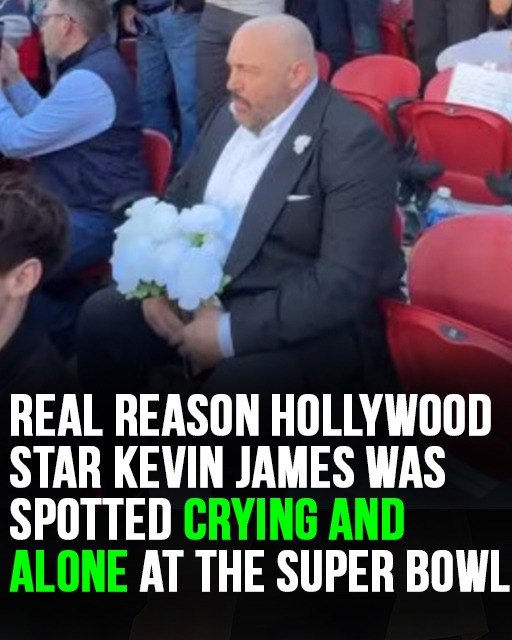
There, in a sparsely populated section despite the sold-out crowd, sat Kevin James. The 60-year-old actor, usually associated with boisterous physical comedy and the blue-collar charm of The King of Queens, appeared completely out of place. Dressed in a sharp suit amid a sea of jerseys and casual wear, he sat alone, clutching a bouquet of white flowers. His solemn expression and distant gaze suggested grief, a quiet, almost fragile presence in the loudest venue on Earth.
The stadium’s mood subtly shifted when the cameras lingered on him. For a brief moment, the high-energy music and pyrotechnics clashed with the raw vulnerability radiating from James. Fans nearby lowered banners and trained their phones on him, not in the frenzy of celebrity spotting, but with an unexpected empathy. A man holding symbols of devotion and purity, surrounded by chaos, was a sight too poignant to ignore. Within minutes, the internet began weaving dozens of speculative narratives.
The footage quickly went viral on TikTok and X, showing a close-up of James’ moist eyes and the careful way he held the bouquet. Social media users projected all kinds of stories: a failed public proposal, an homage to a lost loved one, a private moment of reflection in a public spectacle. Thousands shared the clip, reflecting on loneliness, human vulnerability, and the surreal sight of “Doug Heffernan” in apparent emotional desolation. For a rare moment, millions paused their Super Bowl celebrations to offer virtual support to a man seemingly suffering in silence.
But as post-game coverage unraveled, the truth emerged: James was at work. The entire scene had been a meticulously staged piece of performance art—a stealth promotional stunt for his upcoming romantic comedy, Solo Mio. He had been portraying Matt Taylor, a socially awkward, chronically unlucky-in-love protagonist, whose grand, failed gestures form the heart of the film’s story.
The brilliance of the stunt lay in its subtlety. In an era where Super Bowl ad spots cost upwards of seven million dollars for thirty seconds, the Solo Mio team chose “subtle storytelling.” Placing James in the stands as a living teaser generated organic emotional engagement far beyond a conventional trailer. No voiceover, no call to action—just Kevin James holding flowers. The silence invited the public’s imagination to do the marketing.
Once the reveal was made, admiration replaced pity. James, often typecast as a slapstick comedian, demonstrated the power of presence. His ability to command attention through subtle expression and stillness reminded audiences and critics of his understated dramatic range. Marketing experts hailed the stunt as one of the most effective “guerrilla campaigns” in modern cinema, perfectly exploiting the mechanics of viral culture: a real moment in the midst of an ultra-produced spectacle.
The image of James with the white flowers became the defining memory of the 2026 Super Bowl, arguably outshining the halftime show itself. While the Biebers and Sandlers embodied the expected glitz, James represented narrative power. Even in a venue built for the loudest spectacle, silence proved to be the most impactful tool.
As anticipation for Solo Mio builds, the “Crying Kevin” meme has shifted from sadness to a celebration of creative ingenuity. The film, exploring a man perpetually out of sync with the world, could not have found a more perfect introduction. By turning the Super Bowl into a stage for quiet storytelling, James not only promoted a movie but reminded the world that stories exist everywhere—even in the stands of a football game—and sometimes the most compelling performance is saying nothing at all. The flowers may have been a prop, the empty seats intentional, but the emotional connection he forged was undeniably real. In the end, the true winner of the Super Bowl wasn’t on the field or the stage—it was the man in the suit, sitting alone, waiting for a story to unfold.