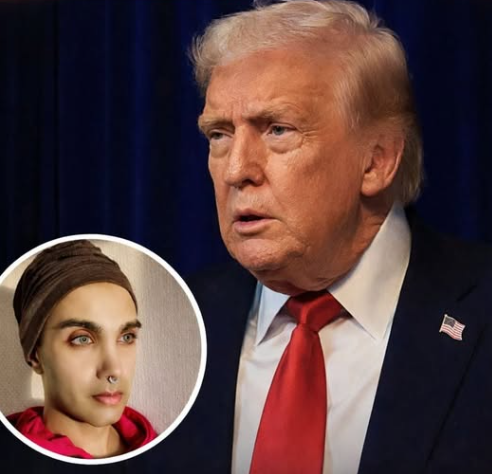
The psychic who claims he foresaw Covid is now issuing a far darker warning: 2026, he says, will break us. Not just Donald Trump. Not just the United States. But the entire world. According to his visions, the year ahead is marked by instability on every level—political, environmental, and psychological. He speaks of earthquakes tearing through beloved holiday destinations, places associated with escape and beauty suddenly transformed into scenes of fear and destruction. He warns of a “dangerous storm event” so severe that authorities and populations alike will be caught unprepared. Layered on top of the natural disasters are human ones: a royal scandal that poisons public sympathy, a baffling brain-related illness striking without warning, and a former president descending into public humiliation. Taken together, he paints 2026 not as a single catastrophe, but as a relentless series of shocks that erode our sense of control.
Nicolas Aujula insists he never sought attention or fame for his predictions. The London-based psychic says his visions arrive uninvited, crashing into his consciousness without warning or mercy. They come as vivid flashes—sometimes of what he believes are past lives, where he sees himself as an Egyptian queen, a Himalayan nun, or a Chinese seamstress. At other times, the images are unmistakably forward-looking, filled with scenes that feel urgent, symbolic, and deeply unsettling. He says there is no switch to turn them off, no way to choose what he sees. The future, in his telling, forces itself into view.
Aujula believes these are the same visions that previously showed him the Covid pandemic before it reshaped the world, as well as Donald Trump’s political rise, the eruption of the Black Lives Matter movement, and even high-profile celebrity breakups that later played out publicly. Those past “hits,” as he describes them, are what give him confidence now—even as he admits that interpreting symbols is never exact. What he sees, he says, is rarely literal at first glance. Meaning emerges later, sometimes only after events have already unfolded.
When he looks toward 2026, the imagery grows darker and more chaotic. He describes powerful earthquakes rumbling through southern Europe, Turkey, and parts of the Pacific region, places already vulnerable but unprepared for the scale of disruption he senses. These are not isolated tremors, he claims, but events that leave lasting damage—both physical and emotional. Alongside them is what he repeatedly calls a “dangerous storm event,” something larger and more destructive than recent storms, carrying an almost apocalyptic feeling. He suggests it will expose just how fragile infrastructure and emergency planning truly are.
Beyond natural disasters, Aujula speaks of upheaval among the powerful and famous. He predicts that Prince Harry and Meghan Markle will be engulfed in a scandal so unexpected that it flips public perception—turning long-standing sympathy into suspicion and doubt. He does not claim to know the exact nature of the controversy, only that it will feel deeply destabilizing and emotionally charged, especially for those who once viewed the couple as victims rather than participants.
He also describes a striking image involving Donald Trump: stumbling while climbing airplane steps. To Aujula, this is not merely a physical misstep, but a symbol of decline. He suggests it could represent a legal downfall, a health crisis, a public loss of authority—or some combination of all three. The image lingers in his visions as something humiliating and unavoidable, a moment where power visibly falters.
Hovering over all of this is what he calls a “mysterious illness,” one that resembles an aneurysm or sudden brain attack. According to his visions, it strikes quickly and without an obvious pattern, cutting across age, status, and geography. He emphasizes that this is not a familiar disease, but something confusing and frightening precisely because it appears random. Its unpredictability, he says, will amplify global anxiety already stretched thin by constant crisis.
Aujula is careful, at least in his own framing, to acknowledge uncertainty. He admits that symbols can be misread, that timelines can blur, and that no vision arrives with footnotes or explanations. But on one point, he remains unwavering. In his view, 2026 will not be a year we simply endure—it will be a year that actively tests humanity’s limits. A test of resilience, patience, and how much chaos societies can absorb before something fundamental gives way. Whether his visions are prophecy or projection, he believes the message is the same: the world is heading into a period where stability will no longer be taken for granted.