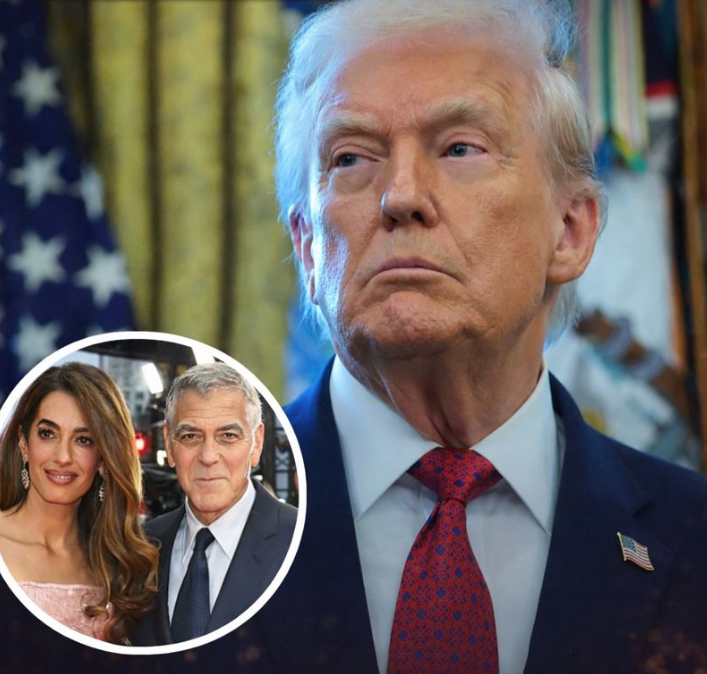
Trump’s fury was instant—and unmistakably personal. What might have been a quiet, almost private decision by George and Amal Clooney to pursue French citizenship instead erupted into a full-blown political street fight, with Truth Social serving as the battleground. Old grudges resurfaced, insults flew, and long-standing resentments were dragged back into public view. Trump mocked. Clooney, long critical of American media and politics, had already lashed out at the networks he believes helped create Trump in the first place. Somewhere between Hollywood, Paris, and Mar-a-Lago, a simple passport choice became yet another symbol of America’s cultural fracture.
Trump’s reaction to the Clooneys’ move had little to do with paperwork and everything to do with rivalry. On Truth Social, he framed their decision as proof of France’s supposed failures on crime and immigration, turning their relocation into political ammunition. The fact that the Clooneys chose a quiet life on a rural French farm only sharpened his rhetoric, allowing him to cast the move as both hypocritical and elitist. In Trump’s telling, this wasn’t a family seeking privacy or stability—it was a public statement, one that fit neatly into his broader culture war narrative.
He went further, using the moment to settle old scores. Trump dismissed George and Amal Clooney as failed political forecasters, mocking Clooney’s past calls for Democratic unity and tying him directly to Joe Biden and Kamala Harris. He ridiculed Clooney’s film career, portraying the actor not as a respected figure in Hollywood, but as an overpaid celebrity who had lost relevance and credibility. What looked on the surface like a comment about citizenship quickly expanded into a familiar Trump-style attack: personal, sweeping, and aimed at reinforcing loyalty among his supporters by painting critics as out-of-touch elites.
For George Clooney, this clash fits into a much larger story he has been telling for years. He has framed Trump not simply as a political opponent, but as a dangerous product of media cowardice. Clooney has openly criticized major networks like CBS and ABC, accusing them of choosing settlements and silence over principle and accountability. In his view, Trump was once a loud but harmless “goofball” from his New York days—someone known more for spectacle than substance—who was transformed into something far darker when media attention and political ambition collided.
Clooney’s criticism isn’t just about Trump as a person, but about the system that allowed him to thrive. He argues that fear of lawsuits, ratings pressure, and corporate caution created an environment where misinformation and extremism could flourish unchecked. That belief helps explain why Clooney and his wife, Amal, a prominent human rights lawyer, have increasingly distanced themselves from American political life, choosing instead to raise their twins away from Hollywood, cameras, and constant political noise.
Yet even that decision has not shielded them. Their move to France—meant to provide privacy, safety, and a different pace of life—has been pulled back into the American spotlight. Their rural home has become a symbol, whether they intended it or not. To some, it represents privilege and escape. To others, it reflects disillusionment with American politics and media culture. And to Trump, it serves as proof that his critics would rather flee than fight.
In the end, this feud is about far more than citizenship or celebrity. It’s about power, narrative, and who gets to define reality in a deeply divided country. While the Clooneys tend their farm and raise their children far from red carpets and cable news panels, their choices continue to echo back home. Love Trump or loathe him, admire Clooney or dismiss him, the argument remains unresolved: who gets to walk away from America’s chaos, and who is left to battle over its future in public, again and again.