For as long as I can remember, the sky felt like a promise.
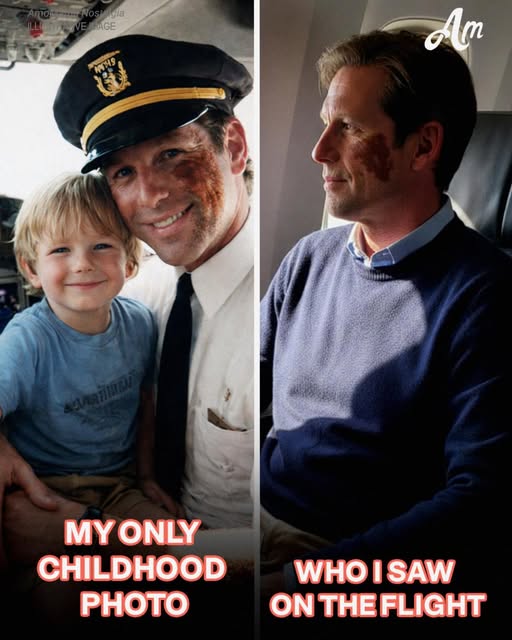
I grew up in an orphanage with almost nothing that truly belonged to me, except one treasure: a worn, creased photograph of a little boy sitting in the cockpit of a small plane, grinning as if he had already conquered the horizon. Behind him stood a pilot in uniform, hand resting proudly on the child’s shoulder. A dark, sweeping birthmark covered one side of the man’s face.
I was that boy.
For twenty years, I believed the man in the picture was my father.
That photograph became my compass. Whenever life threatened to knock me off course, I unfolded it and studied every detail—the angle of the cockpit window, the brightness in my younger self’s eyes, the pilot’s steady stance behind me. I convinced myself I had been placed there for a reason, that someone had wanted me in that seat.
When I struggled through ground school, when my savings vanished halfway through flight training, when I worked late-night shifts just to afford simulator hours, I clung to that image like proof I belonged in the sky. Instructors doubted me. Money ran thin. Exhaustion crept in. But the photo never wavered.
It told me I belonged.
At twenty-seven, I finally sat in the left seat of a commercial jet as captain for the first time. The gold bars on my shoulders felt heavy—not with pressure, but with achievement. My co-pilot, Mark, grinned at me as we taxied toward the runway.
“Nervous, Captain?”
I rested my hand briefly over my jacket pocket, where the photograph still lived. “A little,” I admitted. “But some dreams are worth the nerves.”
The takeoff was smooth, clean, almost poetic. As we climbed into the open blue, I felt something inside me settle. For years, I had searched for the man in that picture, scouring pilot directories, sending unanswered emails, scanning airport terminals for that unmistakable birthmark. I believed that finding him would make everything click into place.
But as we leveled at cruising altitude, I began to wonder if it mattered anymore. I was already where I had always wanted to be.
Then everything changed.
A sudden commotion erupted from first class. A loud crash. Raised voices. Mark and I exchanged a glance before the cockpit door swung open. Sarah, one of our flight attendants, stood pale and breathless.
“Captain, we need you. A passenger’s choking. He can’t breathe.”
Training overrode emotion. Mark took the controls, and I was out of my seat in seconds.
In the aisle of first class, a man lay slumped forward, clawing at his throat. Panic rippled through the cabin. I dropped to my knees beside him, issuing sharp instructions for space.
When I grabbed his shoulders to reposition him, my eyes caught something that made the world tilt: a dark birthmark stretched across one side of his face.
For a split second, time fractured. The engines faded. The cabin noise dimmed. My pulse thundered.
But I had a job to do.
I pulled him upright and positioned myself behind him. One thrust. Nothing. Another. Still nothing. His body weakened in my arms.
“Stay with me,” I muttered, more to myself than to him.
On the third thrust, a fragment of food dislodged. The man gasped, dragging in air. Applause broke out around us, but I barely registered it.
He turned toward me, eyes watering, breath unsteady.
“Dad?” The word slipped out before I could stop it.
He blinked, confused, then shook his head slowly. “No. I’m not your father.”
The blow hit harder than I expected.
“But I know who you are, Robert,” he said quietly. “That’s why I’m on this flight.”
The way he said my name wasn’t casual. It carried history.
I sat beside him, legs unsteady.
“I flew with your parents,” he said. “Cargo runs. Charter work. Long nights, longer routes.”
My throat tightened. “Then you know what happened.”
He nodded. “After your parents died in a crash, you were placed in foster care. You built an entire identity around the man in that photo.”
“Why didn’t you come for me?” I asked.
He looked at his hands. “I was never home. Contracts overseas. No roots. A child would have deserved more than that.”
“So you left me to the system.”
“I thought it was kinder than failing you.”
His words didn’t soothe. They clarified.
“Why are you here now?”
“They grounded me last year. Eyesight. Career over. I heard about you—young captain, top of your class. I wanted to see what kind of man you’d become.”
I pulled the photograph from my pocket and held it between us, its edges smooth from years of handling.
“I built my life on this image,” I said. “I believed it meant something.”
“It did,” he replied. “You became a pilot because of me.”
Something hardened inside me—not anger, but certainty.
“No,” I said. “I became a pilot because I wanted to fly. That picture gave me a dream. But I did the work. I studied. I paid the bills. I stayed up nights. You don’t get to claim this.”
He swallowed, eyes damp.
“I just… want to sit in the cockpit one more time,” he said quietly.
I stood slowly.
“For years, I thought finding you would explain everything,” I said. “But you’re not my father. You’re just a man who once stood behind me in a picture.”
I placed the photograph on his tray table.
“Keep it. I don’t need it anymore.”
Back in the cockpit, the door clicked shut. Mark glanced at me.
“Everything good?”
I settled into the captain’s seat, hands steady on the controls.
“Yeah,” I said, gazing at the endless horizon. “Everything’s clear.”
For the first time, I understood fully: I hadn’t inherited this life.
I had earned it.