The key felt icy in my hand as I twisted it in the lock of the guest-room door. Christmas morning. The house below was filled with laughter, the scent of honey-glazed ham mingling with pine-scented air freshener, a symphony of familial joy that somehow excluded me. I was “allowed to rest,” they said. Translation: they didn’t want to deal with me. I paused, letting the cold metal press into my palm, grounding me in the reality that the family celebration I had once loved had become a place where I was unwanted, a shadow in the corner of my own home.
I pressed my ear to the door, knees aching in protest from the long night spent tossing and turning. I needed to hear the truth directly, not the sugar-coated fragments they fed me over whispered phone calls and obligatory smiles. The truth hit like a physical blow when Nicholas’s voice floated up from the living room, casual, relieved, uncaring.
“Mom’s finally quiet,” he said. Relief laced his tone. “Maybe we can actually enjoy Christmas this year.”
That one line tore through me. I had raised that boy alone, holding together a life stitched with sacrifices and stubborn love after his father walked away. I had worked double shifts, patched scraped knees, consoled broken hearts—sometimes my own. And this? This was my reward: being treated like background noise in my own family, as if years of care and devotion could be erased with a single sentence.
Then came Meline’s voice, sharp and polished with condescension, slicing through the room like ice.
“Thank God. If she complained about the stuffing one more time, I was going to lose it. We know, Oprah—your mother’s recipe was better. She died twenty years ago. Move on.”
Her laughter, mingled with the giggles of my grandchildren, felt like needles. The same teenagers who once climbed into my lap for bedtime stories now mocked me in chorus with their mother. The hurt was sharp, but my heart didn’t break in an instant. No—it cracked slowly, deliberately, like ice under weight, fragile but terrifyingly strong.
I sank onto the edge of my bed, letting my fingers graze the quilt I had sewn decades ago, each stitch a testament to patience, endurance, and love. In the dresser lay my purse: $847 in cash, my ID, and a photograph of Nicholas at seven, holding a fish he’d caught with pride. That boy had adored me once, and I remembered that fiercely.
I reached for Meline’s fancy stationery and wrote a note. No theatrics. No pleas. Just truth, crisp and unyielding.
Thank you for making this Christmas so memorable. I’ve decided to give you the gift you clearly want: my absence.
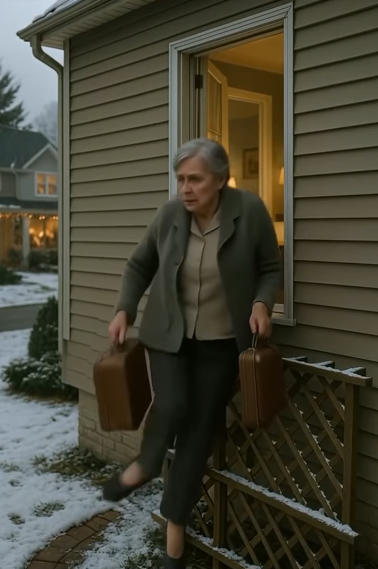
I placed it neatly on the pillow, the only part of me that remained there being the note itself. Then I opened the window, letting the frigid air hit me full in the face, invigorating and sharp, a reminder that life outside their walls still existed. Below, the trellis looked strong enough. At sixty-seven, I climbed out like a runaway teenager, feeling neither fear nor shame, only liberation.
By noon, I was at the Greyhound station downtown, the cold biting at my cheeks. My phone buzzed relentlessly with calls from Nicholas. I let them ring, one after the other, until finally I turned it off. Immediately, an invisible weight lifted from my chest.
“Where to?” the ticket clerk asked, glancing up from his ledger.
“Somewhere quiet,” I replied. “Somewhere far.”
He raised an eyebrow. “Escaping Christmas?”
“Escaping family,” I corrected.
My destination became Grand Rapids, Minnesota—a small town blanketed in snow, serenity, and quiet streets that invited reflection rather than confrontation. I rented a room at a modest inn, run by a warm woman named Rosa, who welcomed me like I had always belonged somewhere, even if not at my own family table. That night, I slept in a room smelling faintly of pine and old books, listening not to laughter that excluded me, but to the wind and the occasional distant bark, a symphony that felt restorative rather than punitive.
The next morning, I reached for a card I had kept tucked in my purse for decades: the number of a real estate agent named Janet. Practical, no-nonsense, no time for nonsense. She arrived in a red pickup and drove me to three potential homes. The third was perfect: a creaking farmhouse on twelve acres, full of history and promise, built by a woman named Louise who had lived there for sixty years. Standing on the sagging porch, I felt a sensation I hadn’t experienced in years—space. Freedom. Quiet that didn’t feel like rejection, but like possibility.
“I want it,” I told Janet, a smile tugging at the corners of my lips.
She nodded. “We can make it happen.”
With determination, I cashed out an old certificate my mother had given me decades ago. Negotiations with Louise’s children secured owner financing. Within two weeks, the farmhouse was mine. I scrubbed the floors, repainted walls, and converted a spare room into a cozy guest suite. I named the place Qualls’ Rest, honoring Louise, and opened it as a small bed-and-breakfast. For the first time in years, I woke up grateful, busy, alive, and proud.
Months later, a familiar car pulled into the driveway. Nicholas, Meline, and the kids stood there, awkward and unsure. Nicholas looked exhausted. Meline’s expensive boots seemed stiff, uncomfortable.
“Mom,” Nicholas began, hesitantly, “we’ve been worried sick.”
I raised an eyebrow. “Were you? Or did it just become inconvenient not to know where I was?”
He flinched, and I allowed myself a small, satisfying sense of justice.
“We came to apologize,” he said. “We didn’t mean—”
“You meant every word,” I interrupted. “You locked me away because I frustrated you. You laughed at me behind my back. You didn’t want a mother—you wanted a silent servant.”
Meline stepped forward with a fake, rehearsed remorse. “It was a stressful day. I didn’t mean to hurt your feelings.”
I shook my head. “I don’t want guilt, excuses, or conditional reconciliation. I built a life here. A good one. And that is mine.”
They hesitated, unsure how to confront a woman who refused to bend.
“You’re welcome to stay for dinner,” I added, “but only as guests—people who respect the house rules.”
I walked into the house. Slowly, hesitantly, they followed.
Over the next year, communication improved—not perfectly, but with honesty. Boundaries forced clarity. One December, Nicholas called.
“Mom,” he said softly. “The kids want to spend Christmas with you. At your place. If you’ll have us.”
“Are you coming as family,” I asked, “or as guests who respect the rules?”
“Guests,” he said. “And learners.”
That Christmas, my granddaughter handed me a small box. Inside was a silver key pendant.
“It’s to remind you,” she whispered, “that you always have the key to your life—and you’ve shown me how to hold mine.”
I hugged her, feeling a warmth that even years of cold rejection could not diminish.
That day, I realized something profound: I hadn’t run away from my family. I had walked toward myself—and finally arrived.