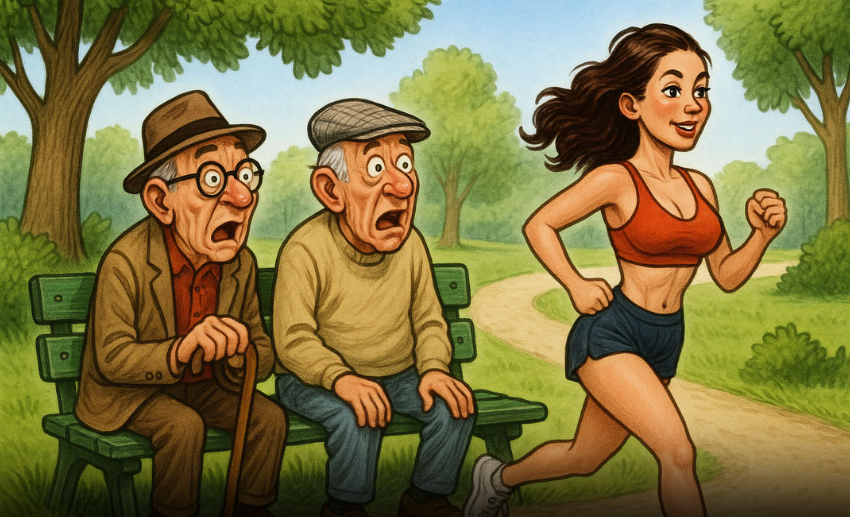
The familiar sensation of being watched—a lingering gaze that felt less like observation and more like an unwelcome mark on her space—made the young woman halt abruptly. Every muscle in her body tensed as she spun around to confront the source of her discomfort. On a sunlit park bench sat two elderly men: one with a small, knowing, guilty smile, the other holding his breath in anticipation. The air between them was charged with silent tension as she marched back, ready to unleash her justified anger and demand that the old man withdraw his intrusive stare. But the moment he spoke, the scene shifted, changing the emotional dynamic and leading to a startling, unexpected outcome.
He did not offer the expected apology. Instead, he spoke with a gentle, almost theatrical softness, his voice carrying an inflection that seemed borrowed from a more courteous, bygone era. He delivered a carefully measured line about her natural beauty serving as a sudden reminder that he was still alive. He claimed that seeing her energetic run had briefly pulled him out of the long gray stretch of his later years—a poetic, seemingly harmless reflection on aging and mortality. His words were just sentimental enough, just cracked enough with the sound of genuine age and isolation, that her mounting anger found no purchase. Her shoulders, rigid moments before, visibly dropped; the clench in her jaw released.
A brief, reluctant laugh escaped her. Disarmed by his soft delivery and the pathos of his sentiment, she leaned in quickly and pressed a small, slightly embarrassed kiss to his cheek—a gesture of sudden, unexpected human connection and perhaps misplaced pity. With her impulsive act complete, she trotted away, her ponytail bouncing, resuming her exercise routine and trying to restore the rhythm of her morning.
Silence settled back over the park bench, heavy and undisturbed. The old man, watching her retreating figure, finally exhaled, leaning back into the wooden slats. He then slowly turned to his companion, a mischievous, boyish glint—a piece of arrested development—flashing in his eyes, oddly out of place on such an aged face. “Told you,” he whispered, a smirk playing on his lips. “Three kisses this week.” His friend, who had remained silent throughout, let out a guttural snort—part admiration at the successful deception, part disgust at the manipulation.
In that single, casual act of “scorekeeping,” the fragile moment of shared humanity instantly soured. What had superficially appeared to be a tender, vulnerable human connection—a moment where youth and age briefly transcended the boundaries of time and prejudice—collapsed into a calculated social game. It was revealed as a cynical sport of an old man, brazenly played in plain sight. Exploiting perceived vulnerability in age to extract a reward became clear.
The full weight of the revelation lies in recognizing that outsiders would almost certainly mistake the old man’s predatory technique for genuine elder wisdom or harmless flattery. This psychological manipulation leverages the perception of age-related vulnerability to gain a reward. The true cost of the interaction was not the kiss itself, but the young woman’s shattered belief in the simple goodness of an elder’s sentiment, replaced with the cold, unsettling reality of being a pawn in a covert game to “get a reaction.” This narrative is highly engaging in discussions of relationship psychology and generates strong readership on viral news platforms that explore the darker sides of human interaction and social boundaries.