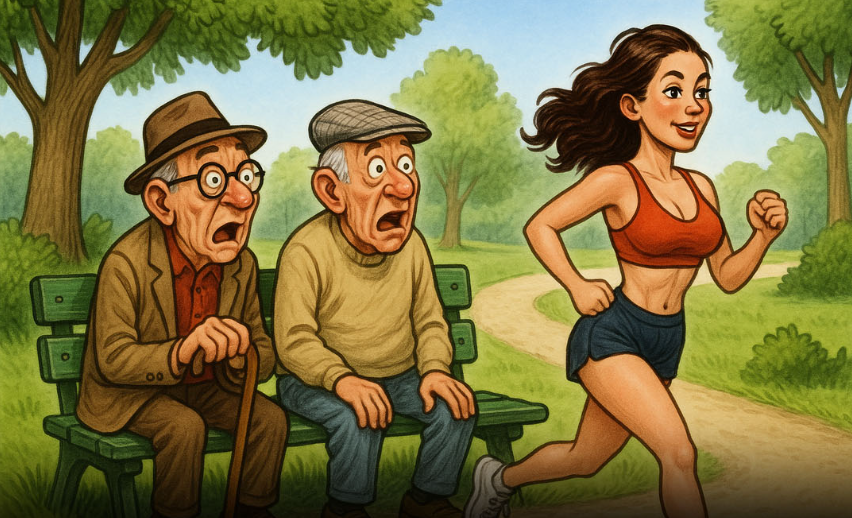
She feels his eyes on her like a stain that won’t wash out. It’s there the moment she steps into the square, subtle at first, a prickling awareness in her skin, then unmistakable, crawling along her spine. Every nerve in her body tightens, as if her muscles remember some distant alert her mind hasn’t yet caught up with. She stops. Turns. The world around her blurs, background fading to nothing but him—an old man seated on a bench, posture slumped yet attentive, a gaze fixed like a spotlight she didn’t ask for. Beside him, another old man watches quietly, arms crossed, breathing shallow, a mixture of apprehension and curiosity in the lines of his face.
The air between them crackles, charged with something unspoken yet immediate, like the snap of a live wire in a storm. She starts walking back, determined to reclaim her space, to strip away that gaze and assert herself, ready to tear it off him with the force of her presence.
But then he opens his mouth, and the words do something unexpected. They don’t apologize, don’t make excuses, don’t plead. They land softly, almost fragile, borrowing tones from a different era: a line about how her beauty reminds him that he is still alive, that her presence, fleeting and kinetic, pulls him, briefly, out of the long gray stretch of his days that has otherwise dissolved into routine and memory. There’s a crack in the sentimentality, an age-worn vulnerability that doesn’t scream for forgiveness but whispers it.
Her anger, built up like a shield for minutes or hours or perhaps years, wavers. Her shoulders drop. Her jaw unclenches. Against her better judgment, she laughs—a sound that surprises even her—leaning in just slightly to plant a quick, embarrassed kiss on his cheek before trotting away, ponytail bouncing like a metronome measuring the moment that just passed.
For a heartbeat, the square is quiet. The wind carries the faint echo of her retreat, footsteps tapping a rhythm of life and liberation. He exhales slowly, letting the breath roll through his chest as though releasing a weight he had carried far longer than she could imagine. He leans back, folding one arm over the back of the bench, and turns to his friend with a glint in his eye that doesn’t belong to a man so old, a flash of boyishness preserved stubbornly against the erosion of years. “Told you,” he says casually. “Three kisses this week.”
The friend snorts, a half-laugh, half-grimace, caught somewhere between admiration and disgust. In that single, offhand scorekeeping, the tenderness they had shared—or that she had briefly ignited—curdles into something else entirely. What had looked like a fragile, human connection shrinks under the weight of repetition, habit, and the strange, stubborn rhythms of age. It becomes a trick, an old man’s game played in plain sight, while the world around him mistakes it for wisdom, for charm, for harmless eccentricity. But beneath the performance lies something more delicate, more real: a life measured in stolen moments, in glances held a fraction too long, in laughter that survives where it should have been silenced. He knows, perhaps better than anyone, that tenderness is a currency that must be spent carefully, that gestures small enough to be overlooked are often the ones that matter most. And for a moment, just a fleeting one, it is enough—enough to feel alive, enough to feel human, enough to carry on playing the quiet, dangerous, beautiful game he has been rehearsing his entire life.