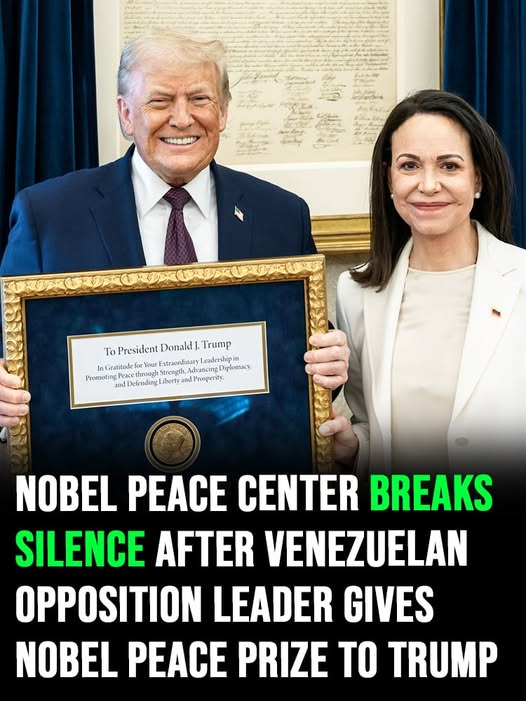
In the high-stakes world of global optics, the line between a genuine accolade and a carefully staged performance is often blurred by the weight of celebrity and political theater. This dynamic was on full display during a recent, widely publicized encounter between Donald Trump and Venezuelan opposition leader María Corina Machado. The event, meticulously orchestrated to present a moment of ultimate vindication for the former U.S. president, revolved around a gesture that seemed to challenge the traditional protocols of international recognition: the symbolic “handing over” of a Nobel Peace Prize. While the resulting imagery sparked intense media coverage and social media debate, it also compelled one of the world’s most prestigious institutions to step forward and issue a rare public clarification about the sanctity of its honors.
For years, Donald Trump has openly expressed his desire for the Nobel Peace Prize, often lamenting what he perceived as a snub by the Norwegian Nobel Committee. To his supporters, the oversight symbolized institutional bias; to critics, it reflected an insatiable need for external validation. When Machado—a woman whose own struggle for democratic reform in Venezuela earned her the 2024 prize—presented him with the gold medal during a televised photo-op, the narrative seemed to reach a climax. The visual was powerful: the president who long demanded the award was now seen clutching the gold, standing alongside a laureate praising his “unwavering commitment to freedom.” For a brief moment, spectacle seemed to eclipse substance, allowing Trump to claim, at least visually, a title that had eluded him.
Yet the world of international honors does not operate on the logic of staged photographs. The Nobel Peace Prize is not merely a physical object; it is a recognition of specific achievements, a historical mark linked to the individual’s actions. Recognizing that the public could be misled by the high-profile exchange, the Nobel Peace Center and the Norwegian Nobel Committee broke their usual silence. In a move both swift and unusually direct, the institutions sought to separate the physical medal from the prestigious title it represents.
In a carefully worded statement, the Nobel authorities clarified a distinction overlooked by many in the heat of the moment. While the 18-karat gold medal is the personal property of the laureate—meaning it can be gifted, displayed, or sold—the designation of Nobel Peace Prize Laureate is non-transferable. It is an honor awarded by a committee according to the criteria set forth in Alfred Nobel’s will. By emphasizing that Machado remains the sole laureate and that Trump does not inherit the title by mere possession of the medal, the committee effectively neutralized the political power of the stunt.
Oslo’s response was deliberately understated. By avoiding mention of Trump by name, the Nobel Committee sidestepped a partisan confrontation that could have fueled more controversy. Instead, it relied on institutional precedent and the clarity of its rules. The message was precise: owning the gold does not mean owning the achievement. This distinction is especially important in an era when viral images often carry more influence than established authority.
For Machado, giving away her medal was likely intended as a gesture of gratitude and a strategic move to secure continued U.S. support for the Venezuelan opposition. The medal functioned as a diplomatic symbol, linking the fight for Venezuelan democracy to Trump’s support. However, by treating the medal as a transferable token, the event exposed the tension between personal sacrifice and political branding. The Nobel Peace Prize exists to celebrate “fraternity between nations” and the “reduction or abolition of standing armies,” ideals often at odds with transactional politics.
The fallout illustrates the enduring power of institutional integrity. In a time when traditional authorities are frequently challenged by populist movements, the Nobel Committee’s refusal to allow the prize to be redefined by a photo-op reaffirmed the value of merit over optics. What Trump’s supporters saw as a vindication was, to the awarding body, a misinterpretation of the prize’s meaning.
After the event, the image of Trump holding the medal remained central to his campaign visuals but was now shadowed by the Nobel Center’s clarification. The occasion did not create a new laureate but reinforced the limits of political influence. Trump walked away with a symbol of high value, yet the actual honor remained with the woman who had risked her life for her country.
This episode highlights the delicate relationship between material symbols and authentic achievement. When an object—a medal, trophy, or crown—is divorced from the narrative of its earning, it becomes an empty icon. The Nobel Committee’s intervention preserved the integrity of the prize, ensuring that it remains a testament to human accomplishment rather than a pawn in political theater. By drawing a firm line, the Committee protected the legacy of past and future laureates, demonstrating that while gold can change hands, the honor itself is inseparable from genuine contributions to the world.
Ultimately, the Florida spectacle and Norway’s response reflect two colliding realities. One operates in a media-driven world where the image is reality and symbolic victories are everything. The other belongs to a realm of tradition, where process is sacred and recognition is earned through sustained effort. In the end, the Nobel Peace Center’s measured statement did more than correct a headline; it reaffirmed that some distinctions are beyond the reach of even the most powerful, existing in a space where theatrics cannot replace the quiet, arduous work of making peace.