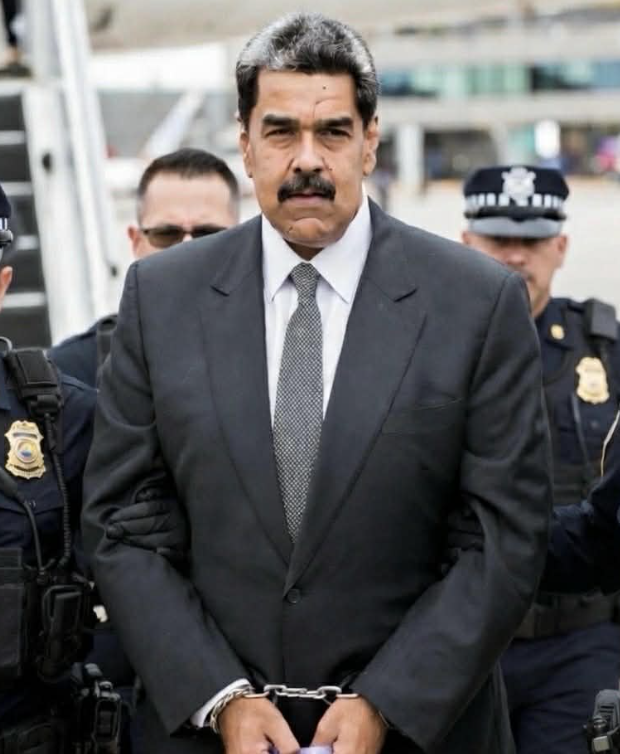
Before dawn broke over the Venezuelan capital of Caracas, the quiet of the city’s streets was shattered by the thunderous roar of U.S. warplanes slicing through the early morning sky. Residents, still groggy from sleep, felt the vibrations ripple through their windows and walls as highly trained aviators executed precision maneuvers designed to paralyze the Venezuelan military’s rapid response capabilities. This was not a simple display of force—it was the culmination of years of clandestine preparation, intelligence gathering, and legal maneuvering, a carefully orchestrated operation that had been months, if not years, in the making. Within the span of a few hours, the man who had long been considered the most untouchable figure in Venezuelan politics, Nicolás Maduro, and his formidable wife, Cilia Flores, were apprehended, their political power stripped away almost instantaneously, leaving them staring at the grim reality of federal charges on U.S. soil.
The operation itself resembled a military ballet of extraordinary precision. For months, the United States had been building a network of surveillance, logistical support, and diplomatic cover that would allow the strike to unfold with minimal collateral damage. Satellites tracked Maduro’s movements; human intelligence operatives mapped out key points of vulnerability; elite Navy SEALs and Delta Force operatives rehearsed the extraction in simulations that mirrored the layouts of Caracas’s fortified palaces. On the ground, U.S. special operations teams struck critical military installations, disabling air defenses, communications nodes, and security checkpoints. Each strike was calculated to neutralize threats without causing unnecessary harm to civilians. By the time the ground extraction team moved in, the path to the presidential inner circle had been cleared, leaving the operatives with a narrow window to capture Maduro and Flores before reinforcements could arrive.
The capture itself was swift and decisive. Maduro, the man whose government had operated for years under a mixture of fear, intimidation, and political maneuvering, was handcuffed within moments of confrontation. Cilia Flores, equally powerful behind the scenes as the political architect of Maduro’s inner circle, was detained simultaneously. Both were transported to a secure extraction point under heavy guard, where armored helicopters and jet escorts ensured a rapid flight out of Venezuelan airspace. The operation demonstrated not just military might but logistical mastery, highlighting the precision that modern special operations forces bring to high-stakes scenarios. By dawn, the two former leaders were aboard U.S. soil, confronting the full weight of the American legal system.
Hours later, Attorney General Pam Bondi addressed the nation, announcing a comprehensive indictment against both Maduro and Flores in the Southern District of New York. The charges were extensive and historically significant: narco-terrorism, conspiracy to import cocaine into the United States, and illegal possession and distribution of firearms and destructive devices. Prosecutors painted a portrait of Maduro as the orchestrator of the Cartel de los Soles, a network that weaponized Venezuela’s state apparatus to facilitate mass cocaine trafficking in coordination with the Revolutionary Armed Forces of Colombia (FARC). Flores, often described as the “first combatant” behind Maduro, faced identical charges, signaling that the U.S. government was intent on dismantling not only the regime’s public face but also the powerful inner core that had maintained control for nearly two decades.
The legal stakes could not be higher. Maduro, who once ruled Venezuela with near-absolute authority, now faced the prospect of long-term imprisonment in a foreign country, subjected to judicial procedures governed by due process—a stark contrast to the extrajudicial power he had wielded at home. Flores, who had been instrumental in managing the regime’s political machinery, was equally ensnared, her reputation and influence reduced to the vulnerability of facing an arraignment and trial under the unforgiving scrutiny of the American judicial system. The indictment was both symbolic and practical: it sent a message that crimes of this magnitude—international drug trafficking, corruption, and the manipulation of state power—would not be tolerated, no matter how shielded by domestic authority the perpetrators might believe themselves to be.
Observers noted that the operation represented a new chapter in U.S. foreign policy—a blend of military precision, legal enforcement, and diplomatic signaling. While past administrations had relied heavily on sanctions, diplomatic pressure, and covert operations to influence Venezuela’s political landscape, this direct action marked a stark departure: a willingness to hold leaders personally accountable in a tangible, immediate way. For the millions of Venezuelans who had suffered under hyperinflation, food shortages, and mass emigration, the capture of Maduro and Flores was a moment of reckoning, a rare instance where international power intersected directly with their lived reality.
The global implications were equally profound. Allies and adversaries alike were forced to recalibrate their understanding of American resolve. Regional governments, some of whom had navigated a delicate balance with Caracas, now faced the immediate reality that U.S. intervention was not theoretical or rhetorical—it could manifest in high-stakes operations executed with military and legal precision. Analysts predicted a period of intense geopolitical reverberations, with the potential for shifts in regional alliances, a reassessment of security protocols, and heightened attention to the networks that supported Maduro’s regime. In essence, the operation did not just remove two individuals from power; it disrupted the entire infrastructure of an authoritarian government, sending ripples that would extend far beyond Venezuela’s borders.
Meanwhile, the meticulous coordination between military and legal agencies underscored the unprecedented nature of the mission. Unlike traditional regime-change operations, where military force is often accompanied by prolonged occupation or nation-building efforts, this operation emphasized targeted accountability. The goal was clear: remove Maduro and Flores from power, bring them to justice, and minimize long-term entanglement in the day-to-day governance of Venezuela. By doing so, the United States projected both strength and restraint, demonstrating that its capabilities extended beyond conventional combat to include sophisticated enforcement of international law.
As the former Venezuelan leaders arrived on U.S. soil, media coverage exploded, highlighting the magnitude of the moment. Headlines emphasized the unprecedented nature of the capture, the depth of the indictments, and the legal and moral questions raised by such an operation. Commentators debated the balance between international law, sovereignty, and the urgent moral imperative to address systemic drug trafficking and corruption. The public, meanwhile, witnessed a real-time demonstration of American resolve, with the message resounding: leadership that exploits state power for criminal ends will eventually face accountability, regardless of borders.
The story of Nicolás Maduro and Cilia Flores, once untouchable figures at the center of Venezuela’s political machinery, now serves as a cautionary tale for leaders worldwide. Their fall illustrates that even the most entrenched authority can be challenged when military strategy, intelligence precision, and legal enforcement converge. It is a reminder that power, while formidable, is never absolute when weighed against coordinated international action and the mechanisms of law. For the United States, the operation represented not only a tactical success but a profound demonstration of the nation’s capacity to enforce justice across borders, setting a precedent that may reshape how the world confronts state-backed criminal enterprises in the future.