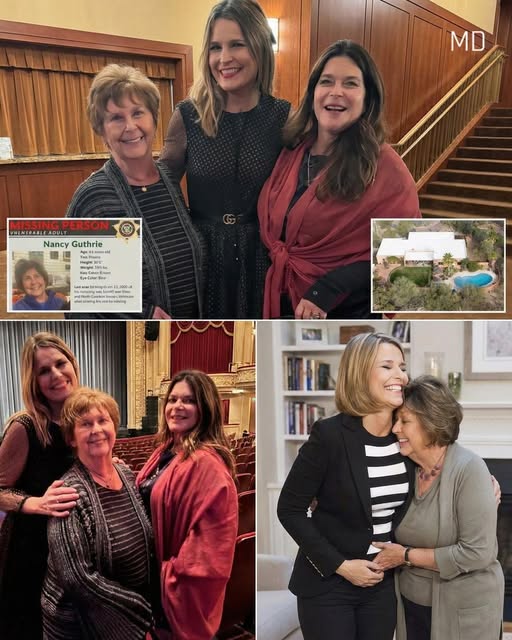
The investigation into the disappearance of Nancy Guthrie, mother of acclaimed television journalist Savannah Guthrie, has entered an intense and critical new phase as authorities meticulously reconstruct the final hours before she vanished from her Tucson-area home. What initially appeared to be a routine welfare check has evolved into a complex, multi-layered missing person case that has gripped the nation, casting an unflinching spotlight on the terror and uncertainty families endure when a loved one disappears without a trace. As search teams scour the rugged and picturesque suburbs of Catalina Foothills, new insights into Nancy’s last known interactions are providing a somber, hour-by-hour account of the evening she was last seen, deepening both the urgency and the emotional weight of the investigation.
Investigative reports, family testimonies, and statements from close friends indicate that Nancy’s final confirmed contact occurred during the evening of January 31. She spent that night with her daughter, Annie Guthrie, sharing what has been described as a completely ordinary, warm, and uneventful family dinner. According to those present, Nancy’s demeanor was calm, her conversation reflective of routine life, and there were no indications—verbal or behavioral—of distress, fear, or plans to depart unexpectedly. By all accounts, the dinner was the kind of Saturday night gathering that epitomized stability and family tradition. Following the meal, Nancy returned to her home in the Catalina Foothills, a neighborhood known for its winding desert roads, rocky terrain, and tranquil, affluent atmosphere—a place where neighbors routinely leave doors unlocked and life flows at a slower pace.
The shift from serene normalcy to urgent alarm began the following day, when family members found Nancy unreachable by phone, an unusual departure from her consistent communication habits. Repeated calls went unanswered, and messages left on voicemail received no response. The alarm escalated rapidly into concern for her safety, prompting a family visit to her residence. Upon arrival, authorities were confronted with circumstances described only as “concerning,” the specifics of which have been withheld to preserve the integrity of the ongoing investigation. These initial observations immediately suggested that Nancy’s disappearance was not voluntary, triggering an expansive, high-priority search effort that has mobilized local, state, and federal resources.
Nancy Guthrie’s particular vulnerability has heightened the stakes. Family members have publicly stated that she has limited mobility and is dependent on daily medications to manage chronic health conditions. These factors sharply diminish the likelihood that she could have traveled a significant distance on her own. Law enforcement has classified her as an “endangered” missing person, a designation that activates additional investigative resources, intensive search protocols, and a heightened sense of urgency across multiple agencies. Every passing hour without her necessary medications compounds the risk to her health, adding a literal countdown to an already fraught situation.
The Catalina Foothills community has become the nerve center of this multi-agency investigation. Teams of search and rescue personnel comb the hilly terrain for signs of Nancy’s presence, while investigators pore over digital evidence, neighborhood surveillance, and data collected from cell phones and doorbell cameras. Detectives are constructing a detailed “life map” for Nancy, tracking her movements in the hours before her disappearance, analyzing financial transactions, reviewing security footage, and canvassing for any vehicles or individuals who might have been out of place during that critical window. Every phone ping, every delivery slip, every overlooked visitor is being examined for potential clues that could illuminate her path—or the path of a potential perpetrator.
At the center of public attention is Savannah Guthrie, who has been thrust into the unimaginable position of becoming the subject of the kind of breaking news she has spent decades reporting. Savannah has leveraged her platform to keep her mother’s story front and center, balancing personal anguish with a public campaign to solicit any information from the community. She has repeatedly emphasized that Nancy is not a faceless statistic, but a vibrant, beloved matriarch whose absence leaves a palpable void in the lives of her family, friends, and community. Savannah’s requests are precise and urgent: any observations, no matter how seemingly trivial—a passing vehicle, a person on a neighborhood trail, or a fleeting sound—could be the missing link in solving this crisis.
Public engagement has been remarkable. Residents of Catalina Foothills and surrounding areas have actively participated in distributing flyers, monitoring trails, and sharing updates through social media. Volunteers have combed streets and open spaces, creating a web of civilian surveillance that complements the professional investigative work underway. Law enforcement, while appreciative of the community support, has emphasized the need to maintain the integrity of the case, reminding the public that all tips must be channeled through official channels to avoid contaminating evidence. Despite the significant volume of leads pouring in from across Arizona and beyond, investigators have not yet reported a definitive breakthrough, underscoring the meticulous, high-stakes nature of the operation.
The psychological impact on the Guthrie family has been profound. Annie Guthrie, who spent the last evening with Nancy, now carries the complex burden of being the final confirmed point of contact—a position that often holds subtle but crucial insights into a missing person’s intentions, movements, or state of mind. Investigators have maintained close contact with both Annie and Savannah, treating their observations, memories, and interpretations as essential contributions to the reconstruction of Nancy’s final hours. Every seemingly inconsequential detail—a casual comment about a neighbor, a fleeting remark about errands, a minor shift in tone—could provide the breakthrough investigators need.
Time is a critical and unrelenting factor. The desert environment of Arizona presents both beauty and danger: rocky, uneven terrain, temperature fluctuations between day and night, and limited mobility for someone with chronic health issues all compound the risk to Nancy. Whether her disappearance was accidental, self-initiated, or the result of criminal interference, the passage of hours increasingly complicates the ability to trace her movements and preserve forensic evidence. The Pima County Sheriff’s Department and partnering agencies are operating under the assumption that every moment is vital, coordinating an intricate effort that spans land, digital, and human intelligence.
This unfolding crisis highlights the fragility of security and the suddenness with which ordinary life can be disrupted. The Guthrie family’s ordeal mirrors the experience of countless families who endure “ambiguous loss,” the type of grief that exists in limbo due to a lack of closure or tangible answers. Their home, once a haven of routine and comfort, has been transformed into a hub of anxiety and vigilance. Friends, neighbors, and concerned citizens watch, hope, and assist where possible, yet the pervasive uncertainty remains a constant weight on the community’s collective consciousness.
Law enforcement continues to appeal for public vigilance. Authorities are specifically seeking observations regarding any unusual activity near Nancy Guthrie’s home between late night January 31 and early February 1. While the investigation evolves, the overarching goal remains unwavering: the safe recovery of Nancy Guthrie and her return to her family. The Guthries, while understandably seeking privacy amid the media storm, continue to champion the search publicly, appealing to anyone with information to come forward in the hope that the next lead may bring her home.
As the investigation presses forward, it stands as a testament to both the meticulous work of professional investigators and the enduring power of community engagement. Each tip, each observation, and each shared piece of information represents a small but vital step toward resolving a case that has shaken a family and a city. While the challenges remain formidable, the combined determination of law enforcement and the public offers the best hope that the darkness surrounding Nancy Guthrie’s disappearance may soon be illuminated, and that she may be returned safely to the family who waits for her.