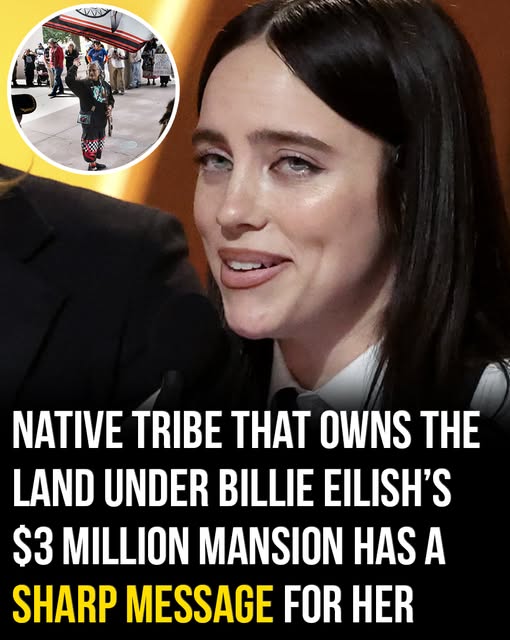
The intersection of celebrity activism and historical reality reached a peak during the 68th Annual Grammy Awards, when Billie Eilish used her acceptance speech for Song of the Year to deliver a pointed political message. On February 1, 2026, at the Crypto.com Arena, standing alongside her brother FINNEAS, Eilish sparked a firestorm of debate that quickly extended beyond the music world. “As grateful as I feel, I honestly don’t feel like I need to say anything but that no one is illegal on stolen land,” she declared, punctuating her statement with a sharp critique of Immigration and Customs Enforcement (ICE).
The singer’s comments, referencing centuries of European colonization and the displacement of Indigenous peoples, prompted immediate and polarized reactions. Supporters praised the 24-year-old for using her platform to highlight systemic issues of sovereignty and immigration. Critics, however, highlighted a perceived inconsistency between her rhetoric and her lifestyle, particularly pointing to her high-profile real estate holdings—including a Los Angeles mansion valued between $3 million and $14 million, located on the ancestral land of the Tongva people.
The Tongva Nation Responds
As online discussions intensified, the Gabrieleno Tongva tribe—the original people of the greater Los Angeles area—issued a measured response. A tribal spokesperson acknowledged that Eilish’s visibility brought attention to the concept of “stolen land” but noted she had yet to engage directly with the tribe regarding her property.
“We appreciate the opportunity to provide clarity regarding Billie Eilish’s recent comments,” the spokesperson said. “As the First People of the greater Los Angeles basin, we recognize that her home is on our ancestral land. While Eilish has not contacted our tribe directly about her property, we value public figures who raise awareness of the true history of this land.”
The tribe emphasized the need for specificity, noting that broad references to “stolen land” can obscure the living histories of Indigenous nations. They urged Eilish to explicitly name the Gabrieleno Tongva in future statements to ensure public understanding that the Los Angeles basin remains their territory.
A Growing Chorus of Critics
While the Tongva sought constructive dialogue, political commentators and lawmakers intensified criticism, demanding that Eilish move beyond symbolic gestures. Debates about “land acknowledgments”—public recognition of Indigenous presence—turned into arguments over whether such statements have meaning without tangible action.
Conservative voices highlighted what they saw as hypocrisy, citing her wealth and property ownership. Senator Mike Lee (R-Utah) argued that anyone publicly acknowledging “stolen land” should immediately give their land to Native Americans. “Otherwise, they don’t mean it,” he wrote on social media. Florida Governor Ron DeSantis called her rhetoric “nonsense,” suggesting she should forfeit her Southern California mansion. Tesla CEO Elon Musk echoed this sentiment with a simple “Exactly.” Critics widely called for a “put up or shut up” approach, claiming that living on land one calls “stolen” contradicts moral activism.
Linking Immigration and Indigenous Sovereignty
Eilish’s critique of ICE further complicated reactions. Her exclamation of “f**k ICE” came amid heightened tensions over federal immigration enforcement, including controversial operations in Minneapolis resulting in the deaths of U.S. citizens Renee Good and Alex Pretti.
By connecting immigration issues to Indigenous sovereignty, Eilish framed the notion of “illegal” status as a modern construct imposed on historically occupied land. Yet commentators like Eric Daugherty challenged her to use her resources to help migrants directly, suggesting she open her gated estate to asylum seekers as a demonstration of her values.
The Complexity of Modern Restitution
The controversy highlights a broader cultural tension: how should modern society address historical injustices? For some, land acknowledgments are crucial steps toward decolonization and public education. For others, they risk appearing as performative gestures, allowing the privileged to feel virtuous without sacrificing comfort or wealth.
The Tongva response points to a middle path: public visibility is appreciated, but direct engagement and specificity are essential. Naming the Gabrieleno Tongva serves as a reminder that land is not abstract—it is home to a living community still asserting its sovereignty.
As of early February 2026, Eilish’s team has not issued a formal response to the tribe or political critiques. Whether she will pursue a partnership with the Gabrieleno Tongva—through land taxes, educational support, or property restitution—remains uncertain. One thing is clear: in a hyper-connected world, celebrity statements are no longer just soundbites—they are being met with demands for concrete, real-world action.