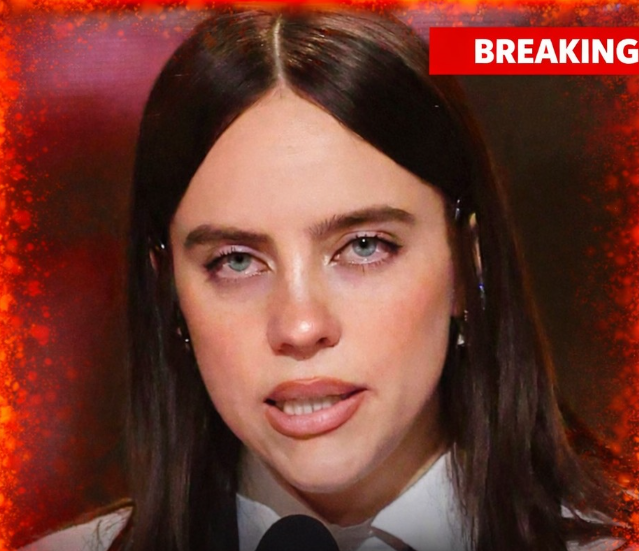
Billie Eilish thought she was making a stand. She stepped onto the stage of the 2026 Grammys, fully aware that her words could stir debate, but she likely did not anticipate the intensity of the backlash that would follow. In a moment of raw defiance, she told the audience, “no one is illegal on stolen land,” and shouted, “f*** ICE.” The statements were meant as a pointed critique of immigration enforcement and a broader statement about colonial history, yet they quickly ignited a firestorm of controversy across social media, news outlets, and political commentary programs. Within hours, the singer, known for her genre-defying music and unfiltered public persona, found herself at the center of a nationwide debate about morality, hypocrisy, and the responsibilities of public figures when addressing historical injustices.
The backlash was swift and multifaceted. Critics from conservative circles accused her of being performative, arguing that she was using a social cause as a stage prop to further her celebrity image. Pundits questioned her sincerity, pointing out the apparent irony that she condemns colonization and oppression while residing in a luxurious Los Angeles mansion reportedly valued at $3 million, built on land originally inhabited by Native peoples. Headlines screamed about hypocrisy, and the conversation quickly expanded beyond music and celebrity culture to touch on broader societal issues: gentrification, land rights, and the lasting impact of colonialism in modern America.
However, the most consequential response came not from critics or political commentators, but from the Tongva people, the original inhabitants of the Los Angeles area and the self-described “First Angelenos.” Unlike the outrage-driven reactions dominating the news cycle, the Tongva issued a measured and thoughtful statement. They confirmed that Eilish’s mansion sits on their ancestral land and noted that, to their knowledge, the singer had never reached out to consult or engage with the tribe. Yet, rather than launching a condemnation or public scolding, the statement struck a different tone. They expressed gratitude that Eilish’s speech had brought renewed attention to the long-overlooked reality of stolen land and the continuing struggles of Native communities to protect their heritage and maintain cultural recognition in urban spaces.
Moreover, the Tongva extended an olive branch, signaling that they were open to dialogue. They reached out to Eilish’s management team with the hope that future public statements would explicitly name the Gabrieleno Tongva people, rather than referring to Native Americans in general. In essence, their message was clear: awareness is only the first step; genuine understanding and accountability require more direct action and engagement. By framing their response as an invitation to educate herself further and connect with the community, the Tongva demonstrated a measured wisdom often absent from the polarized exchanges surrounding celebrity activism.
Eilish’s remarks, initially intended as a bold critique of immigration enforcement and a show of solidarity with marginalized communities, thus sparked an unexpected chain of events. Social media debates surged, with supporters praising her courage and critics questioning her authenticity. Journalists analyzed the historical context of her statements, exploring centuries of displacement and colonization in California and across the United States. Advocacy groups highlighted the ongoing struggle for Native land rights, and the Tongva’s response served as a case study in how communities can respond to well-intentioned, though imperfectly executed, activism.
Ultimately, the incident underscored the complex dynamics between celebrity influence, public accountability, and historical justice. It revealed how a single moment on a televised stage could ripple outward, prompting conversations about ethics, privilege, and the importance of recognizing and engaging with the original stewards of the land. Billie Eilish may have walked into a firestorm, but the Tongva’s response reframed the narrative, turning what could have been a purely negative episode into an opportunity for education, reflection, and collaboration. In a night defined by outrage, their statement offered something rarer than viral condemnation: a thoughtful challenge, inviting the pop star—and the public—to move beyond words and toward meaningful, informed action.