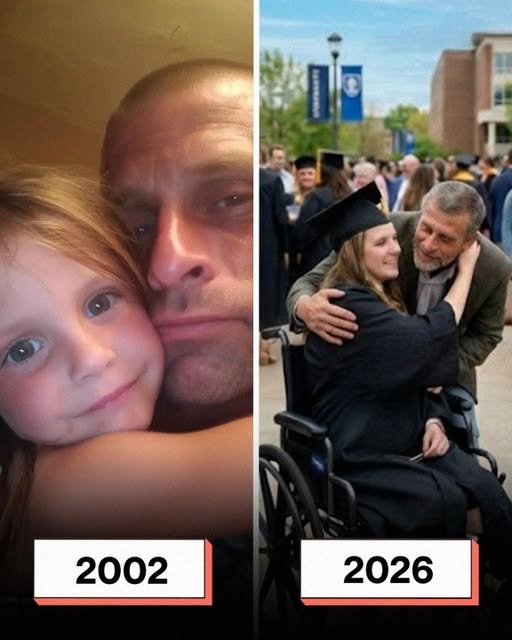
I was twenty-six, and I hadn’t walked since I was four.
When people hear that, they assume my life began in a hospital bed, that everything I am came after tragedy. But there was a before, and fragments of it still live inside me, even if I can’t remember the moment it was taken.
My mother, Lena, sang off-key while cooking. My father, Mark, always smelled of motor oil and peppermint gum. I had light-up sneakers, a purple sippy cup, and very strong opinions. I was tiny, stubborn, and deeply loved.
I don’t remember the accident.
The story I grew up with was short and merciless. There was a crash. My parents died. I survived. My spine did not. Adults spoke softly at my hospital bed, using words like placement and long-term care. They weren’t cruel—they were deciding my future.
Then my uncle Ray appeared.
My mom’s older brother. A large man carved from grit and disappointment, hands rough and scarred from labor, permanent scowl. He listened as the social worker laid out options.
“We’ll find a good home for her,” she said.
“No,” Ray said.
She hesitated. “Sir?”
“I’m taking her. She’s not going to strangers. She’s mine.”
That was it.
Ray had no children, no partner, no clue what he was doing. He brought me to his small house, smelling of coffee, old wood, and fear. He hovered over nurses, memorized instructions, wrote everything down in a beat-up notebook—how to lift me, turn me, check my skin. For the first week, he woke every two hours to reposition me.
“Time to flip the pancake,” he muttered, nightly ritual.
He fought insurance companies on speakerphone, then knelt by my bed when I cried.
“I know,” he whispered. “I’ve got you.”
He built a crooked, splintered ramp for my wheelchair. Washed my hair in the kitchen sink, one hand steady under my neck, water pouring like the most sacred act.
When neighbors stared, he stared back harder.
When kids asked questions, he answered first. “Her legs don’t listen to her brain,” he said. “But she’ll clean you out at cards.”
He made room for me everywhere, even when it cost him.
Puberty came. He awkwardly stood in my doorway with a plastic bag.
“I bought… things,” he said. Pads. Deodorant. Cheap mascara.
“You watched YouTube,” I teased.
“Those girls talk way too fast,” he muttered.
We had little money, but I never felt like a burden. He expanded my universe: shelves at my height, a tablet stand welded in the garage, a planter box for my twenty-first birthday.
“So you can grow that basil you yell at on cooking shows,” he said.
I cried so hard it scared him.
Then he started slowing down.
Keys misplaced, dinners burned, stopping mid-stairs to catch his breath. When we insisted, he went to the doctor. Stage four. Everywhere.
He tried to keep things normal—still made my eggs, brushed my hair. Sometimes bracing against the dresser, breath heavy. Hospice arrived. Machines hummed. Charts covered the fridge.
The night before he died, he asked everyone to leave. Even the nurse.
He sat beside my bed.
“You know you’re the best thing that ever happened to me,” he said.
“That’s depressing,” I joked through tears.
“You’re going to live,” he said firmly.
“I don’t know how to do this without you.”
“I know. I’m sorry. For things I never told you.”
He kissed my forehead and told me to sleep.
He died the next morning.
After the funeral, Mrs. Patel came with an envelope.
“Ray wanted you to have this,” she said.
The letter was in his handwriting. The first sentence broke me:
“I’ve been lying to you your whole life.”
He told me what really happened the night of the crash. My parents were leaving town without me. He had screamed at them. Called them selfish. Saw my father had been drinking. Could have stopped them. Didn’t.
“I looked at you in that hospital bed and saw punishment,” he wrote. “For my anger, for my pride. I resented you at first because you were proof of what my temper cost.”
Taking me home was the last right thing he could do. Everything after was repayment for a debt he could never erase.
Then he explained the money. Life insurance, overtime, a quietly built trust so the state could never touch it. He sold the house. He wanted me to have rehabilitation, equipment, a life beyond that room.
“If you can forgive me, do it for yourself,” he wrote. “So you don’t spend your life carrying my ghost.”
I cried until my face ached.
He played a role in what destroyed my life.
He was also the reason it didn’t end.
A month later, I entered a rehabilitation center an hour away. Strapped into a harness over a treadmill. My legs shook. I cried. I stood for endless seconds.
Again.
Last week, for the first time since I was four, I stood with most of my weight on my own legs. I felt the floor beneath me. Heard Ray’s voice in my head:
“You’re gonna live, kid.”
Do I forgive him? Some days, no. Other days, I realize I’ve been forgiving him in fragments all my life.
He couldn’t undo the crash.
But he carried me as far as he could.
The rest is mine now.