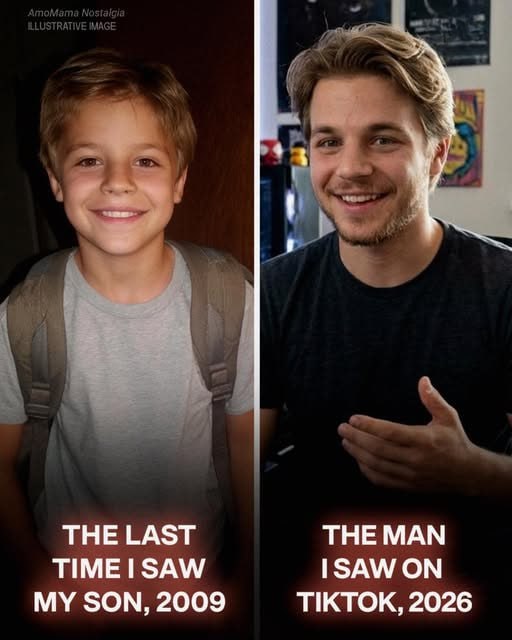
Fifteen years after my son vanished without a trace, I had learned to live with a quiet kind of grief — the kind that never truly disappears, only softens enough for you to keep going. It became part of my daily life, something I carried without thinking. Then, one night, everything I had carefully learned to live with shattered because of a stranger’s TikTok livestream. In a single moment, I saw a face I recognized… and a drawing that should have been impossible. What followed pulled long-buried truths into the light and forced me to face something I never imagined.
In my town, people didn’t really know me as anything else anymore. If you mentioned my name, they’d say, “That’s Megan — the woman whose son went missing.” That was who I had become. Not just a mother, not a wife — but someone permanently tied to a moment of loss that never fully ended.
There were small habits I could never let go of. Sometimes I would take out Bill’s old dinosaur plate without thinking, only to stop and stare at it before putting it back. I still bought his favorite cereal, even though it always sat untouched. One evening, my husband Mike found me standing in the kitchen holding the box like it meant more than food ever could. He didn’t say anything — just looked at me with that same quiet sadness we had both carried for years.
The last time I saw Bill, he was ten years old, full of energy, rushing out the front door in that blue windbreaker he loved so much.
“I’ll bring home my best science project ever, Mom!” he called out.
That was the last thing he ever said to me.
He never came home.
I remember calling the school, then the police, my voice shaking as I repeated the same details again and again. By the time night fell, our house was surrounded — officers, neighbors, volunteers searching with flashlights, calling his name into the darkness. Reporters came. Cameras followed. People asked questions I couldn’t answer.
Days passed. Then weeks. Then years.
And still… nothing.
Mike tried to cope in his own way. Some nights he would hold me while I cried, his face pressed into my shoulder. Other times, he would beg me, quietly, to let go.
“Megan… please,” he whispered once. “Let him rest.”
But hope doesn’t work like that. You can’t turn it off just because it hurts. Even after the case went cold, I kept searching. I followed leads, chased rumors, refused to accept that the story had ended without an answer.
Over time, people stopped asking. Life moved forward for everyone else. Friends slowly disappeared. Even my sister Layla, who had once stood beside me through everything, drifted away after a painful argument one Thanksgiving.
And then, one sleepless night, everything changed.
It was late. The house was quiet. Mike was asleep, and I sat alone in the living room, scrolling through TikTok, trying to distract myself from thoughts that never really left.
That’s when I saw him.
A young man, maybe in his early twenties, sitting in front of a camera, sketching. His hair was messy, his expression relaxed but slightly nervous. Colored pencils were scattered around him.
“Guys,” he said with a small laugh, “I’m drawing a woman who keeps appearing in my dreams. I don’t know who she is, but she feels important somehow.”
Then he lifted the drawing.
My heart stopped.
The woman he had drawn was me.
Not as I was now — but as I had been fifteen years ago. The same hair, the same expression, even the small scar above my eyebrow. Around her neck was the locket I had worn every single day back then.
My phone slipped from my hands.
I picked it back up, my fingers trembling, zooming in as if I could somehow prove it was just a coincidence. But it wasn’t.
There was only one person who could remember those details like that.
My son.
I rushed into the bedroom and turned on the light.
“Mike! Wake up — you need to see this!”
He sat up, confused, as I handed him the phone. He watched in silence, his expression slowly shifting into something serious.
“If this is him…” I whispered, my voice shaking, “we have to find him.”
For the first time in years, hope didn’t feel distant. It felt sharp. Real. Almost frightening.
I sent a message to the account, rewriting it several times before finally sending something simple:
“Hi. You drew me in your livestream. I think we might know each other. Can we meet?”
I didn’t say anything more. I was afraid to.
The reply came at dawn.
“Really? Sure. Here’s my address.”
He lived more than two thousand miles away.
We booked flights immediately.
The trip felt unreal. At the airport, I held one of Bill’s old shirts in my bag like it could keep me grounded. On the plane, Mike kept glancing at me, as if bracing himself for disappointment.
“If it’s not him…” he started.
“Then I keep looking,” I said.
Because stopping was never an option.
When we arrived, the neighborhood looked completely ordinary — quiet, calm, the kind of place where nothing extraordinary seemed possible.
We stood in front of a blue door.
I knocked.
It opened.
And there he was.
Older, taller… but undeniably him.
“Can I help you?” he asked carefully.
My voice barely came out.
“I… I saw your drawing.”
He looked at me more closely. “You look just like her.”
“I think there’s a reason for that,” I said.
Before I could explain, a voice came from inside.
“Jamie? Who is it?”
Then she stepped into view.
Layla.
My sister.
Everything inside me froze.
“Megan?” she said, her voice barely above a whisper.
I didn’t hesitate.
“Is this my son?”
Silence filled the space between us.
The young man — my son — looked from her to me, confused.
“You told me my mom was dead,” he said slowly.
Layla broke down.
The truth came out piece by piece — years of lies built on top of each other. She hadn’t rescued him. She had taken him and raised him as her own.
Everything he remembered — the dinosaurs, the dreams, the voice calling him “Billy” — it had all been real.
It had been me.
“You let me believe he was gone,” I said, my voice shaking. “You let me grieve him.”
She couldn’t look at me.
“I thought I was protecting him,” she whispered.
“No,” I said quietly. “You were protecting yourself.”
We brought him home.
Layla came too — there was no hiding anymore.
When the police arrived, it was my father who had called them. Someone had to make that decision.
She didn’t resist.
As they took her away, she looked back one last time before disappearing through the door.
Later, the house became quiet again.
My son stood there, uncertain, like he didn’t know where he belonged anymore.
“Did you really look for me?” he asked.
I nodded, tears running down my face.
“Every single day.”
He hesitated. “Why didn’t you stop?”
I stepped closer and gently placed my hand on his shoulder.
“Because you’re my son,” I said. “And that’s not something you ever stop fighting for.”
When he finally hugged me, it felt unfamiliar and familiar at the same time — like something lost had found its way back home.
As I held him, the locket pressed between us, warm against my chest.
And for the first time in fifteen years…
it felt like everything had finally come full circle.