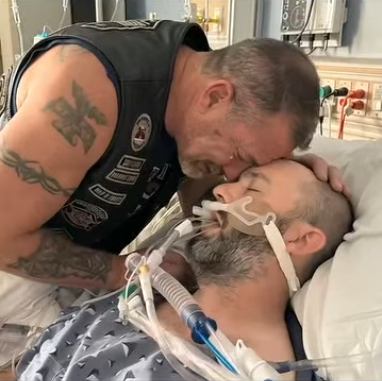
My son told the world his biker father was dead because he was embarrassed by me. Now, as his life slips away, I’m the only one standing at his bedside.
I’m in a sterile hospital room, pressing my lips to my son’s forehead while machines breathe in his place. The last words he ever spoke to me—three weeks before the crash—still echo in my head: “I wish you were really dead.”
Three weeks ago feels like a different lifetime. A time before the call from an unknown number. Before an ICU nurse looked at me with suspicion when I said, “I’m his father.” According to the forms my son filled out, his father had died years ago.
My name is Robert Mitchell. I’m sixty-one years old. My arms are inked, my beard reaches my chest, and my leather vest has more years on it than some of the doctors in this hospital. I’ve been riding motorcycles since I was seventeen, and I never pretended to be anyone else.
Now I’m here, gripping my son’s lifeless hand while the damage caused by a drunk driver slowly takes him from me.
There’s no brain activity. They’ve checked again and again. The machines are only keeping his heart beating because I haven’t told them to stop. They’re waiting on my decision—the one no parent should ever have to make.
I can’t stop looking at his face. Beneath the swelling and bruises, I still see the little boy who used to sit on my shoulders, who fell asleep leaning against my back on long rides, who once begged me for a matching tattoo when he was thirteen.
That was before he grew ashamed of the man who raised him.
Tyler was born when I was twenty-seven. His mother, Lisa, loved my rebellious side at first—the bikes, the freedom, the thrill. But once Tyler arrived, everything changed. Suddenly I was “reckless.” My friends were “bad influences.” The repair shop I built with my own hands wasn’t a “real career.” She wanted me neat, quiet, predictable.
I tried. I really did. But pretending to be someone you’re not only works for so long. She left when Tyler was seven and took me to court, claiming I was an unfit father. Her lawyer paraded photos of my tattoos, my bike, my vest—as if those things defined my ability to love my child.
She got primary custody. I got two weekends a month.
Later, she married a dentist. Perfect smile. Perfect manners. Perfect life. Tyler adapted quickly. By twelve, he was calling the dentist “Dad,” saying it was easier that way.
Still, every other weekend, he climbed onto the back of my bike. We ate greasy diner food, worked on old engines, laughed like nothing had changed.
Until it did.
When Tyler was sixteen, he invited me to a barbecue at his girlfriend’s house. I cleaned up as best I could, but I wasn’t about to hide who I was. Her father took one look at me like I was trash. Then he pulled Tyler aside and whispered—loud enough for me to hear—“That’s your father? You said he was a business owner. Not… that.”
And my son replied, “He’s not really my dad. My real father is Gregory.”
I left without a word and rode home in the dark, tears freezing on my face.
From there, the distance grew fast. College. New friends. A life built around appearances. Calls became short. Visits stopped. Eventually, he told me people wouldn’t respect him if they knew who I was.
Three years ago, the calls ended completely. On his birthday, his wife answered and said Tyler wanted no contact. My letters came back unopened. Gifts were returned. I was blocked everywhere.
He erased me.
Three weeks ago, I tried once more. I drove to his office—not on my bike, but in my truck, hoping I’d look less like the man he despised. When he saw me, his face hardened.
“I told you to stop,” he said.
“I’m your father.”
“You’re not. Gregory is. You’re just some biker my mom used to date.”
When I reminded him I raised him, he leaned in and whispered, “As far as I’m concerned, you’re dead. I wish you were.”
Those words nearly destroyed me.
Then the call came. His wife, shaking. “There’s been an accident. Tyler’s critical. You should come.”
I rode nearly 850 miles without stopping.
The hospital tried to block me. “Family only,” they said. “His father is listed as deceased.”
“I’m his father,” I said. “I’m Robert Mitchell.”
His wife stepped in and let me through.
Later, she showed me something she found in his office. A box. Inside were every letter, every card, every photo I’d ever sent. None thrown away. All carefully kept.
Then she showed me a letter Tyler had written two weeks before the crash.
In it, he admitted everything. His shame. His fear. His lies. He wrote that he wanted to call me, apologize, bring the kids to meet me, fix what he had broken.
He ended with:
“I love you, Dad. I always did.”
I stayed with him for three days. I held his hand. I told him I forgave him. I told him I loved him.
When the doctor asked me if it was time, I kissed his forehead and said, “I’m here, son. I never stopped being your dad.”
Then I let him go.
At the funeral, the room was filled with polished shoes and expensive suits. They stared when dozens of bikers walked in behind me.
I spoke. I told them who Tyler really was. I read his letter aloud.
Everyone cried.
Now I help raise his children. They ride bikes in my yard. They call me Grandpa. One day, his son said, “Dad should have been proud of you.”
I smiled and said, “I think he finally was.”
A father’s love doesn’t die. Not when it’s rejected. Not when it’s denied. Not even when the world believes you’re gone.
I wasn’t dead.
I was waiting.
And the last words my son left behind weren’t spoken in anger—they were written in regret and love: