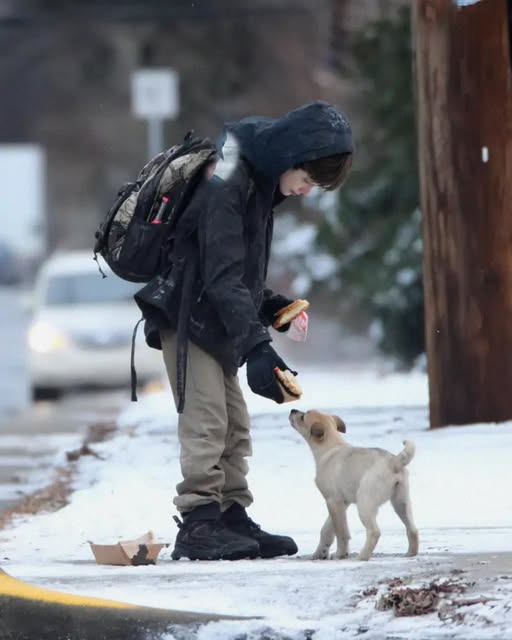
In a small town where mountains cast long shadows and the echoes of more prosperous days lingered in the air, Brooke worked double shifts at Millie’s Diner. The diner was a place of chipped ceramic mugs and a jukebox stubbornly stuck on Patsy Cline, where the floorboards groaned under the weight of history and the tips barely kept the lights on. Brooke was raising her ten-year-old son, Eli, alone—a task she had carried since he was three, after his father decided the burdens of parenthood were too heavy to bear. But Eli was not like other children. Brooke often said he had an “old soul,” a quiet, observant spirit that moved through the world with a gentle reverence. He thanked bus drivers, flipped beetles upright on the sidewalk, and treated every living creature as if it contained a spark of the divine.
The mystery began in late spring, as the frost finally retreated from the valley. Brooke noticed that their pantry was being raided with uncanny precision. Peanut butter vanished. Loaves of bread disappeared at a rate that seemed impossible. At first, Brooke assumed it was a pre-teen growth spurt—but the pattern grew stranger. Every day, Eli’s lunchbox came home not merely empty, but polished clean. Concerned that her son wasn’t eating—or perhaps that someone else was taking his food—Brooke decided to follow him one Tuesday afternoon.
She trailed him at a distance as he deviated from his usual route. Instead of heading toward their modest apartment, Eli cut behind an abandoned hardware store, a skeletal building with peeling red paint and a sagging fence. Crouching behind a rusted dumpster, he unzipped his backpack and pulled out a sandwich wrapped in wax paper. But he didn’t eat it. Carefully, he tore it in half and placed a portion on the concrete. From beneath the dumpster’s shadows emerged a creature that broke Brooke’s heart: a scrappy, matted stray dog, ribs sharp beneath its skin, eyes wide with fear and desperate hope. Eli sat cross-legged in the dirt, talking softly to the animal as they shared the meal. “Don’t forget to hydrate,” he whispered, sliding a makeshift water bowl toward the dog.
Brooke stood frozen, hand over her mouth, tears blurring her vision. Her son hadn’t been hungry; he had been giving. That night, she didn’t confront him. Instead, she packed double the food, adding honey and extra fruit, silently honoring the secret pact Eli had made with the world. For weeks, this became their ritual. Eli named the dog Buddy, and the alley became a sanctuary.
But in a small town, secrets are like mountain mist—they eventually dissipate. Gossip spread about the “Turner boy” feeding strays. At school, cruel children began barking at him in hallways, calling him “Dog Boy.” Eli remained unfazed. “Buddy doesn’t care about their laughing,” he told his mother, his resolve as steady as the mountains.
Everything changed when a passing teenager snapped a photo of Eli cradling Buddy’s head in the golden afternoon sun. She posted it online, praising the purity of a child’s heart. Within twenty-four hours, the image went viral. Thousands were moved, but Eli remained unimpressed. “Buddy doesn’t have Facebook,” he reminded his mother. “He just likes sandwiches.”
A few days later, the quiet alley was interrupted by a sleek, red SUV—out of place against the cracked pavement. Beside it stood a man in a sharp gray suit, Richard Hollis, rigid and perfectly coiffed, yet with eyes that held a haunting recognition. As Brooke approached, she heard him whisper a single word: “Shadow?” Buddy froze, then erupted in frantic joy, whining and barking as he lunged toward the man.
Richard fell to his knees, composure shattering. He explained that Shadow had belonged to his son, Michael, who had died in a car accident two years earlier. After the funeral, the dog had vanished. Richard had searched for months, losing hope, until a friend sent him the viral photo. “I’ll take him home now,” Richard said, voice thick with emotion. But Shadow stopped, sitting firmly at Eli’s side, resting his head on the boy’s knee—a silent, heartbreaking choice.
“He doesn’t want to go,” Eli said softly. “He’s happy here.” When Richard insisted, Eli met his eyes. “He doesn’t care who he belongs to. He just wants someone who stays.” The words, born from Eli’s experience with a father who had left, struck Richard like a physical blow. He didn’t argue; he nodded and drove away, leaving the dog behind.
The story didn’t end with that departure. That night, Eli sent a peace offering—a sandwich and a note—to the red SUV. “He likes it with honey,” the note read. “Please don’t be mad if he follows me tomorrow.” Moved by the boy’s persistence and Shadow’s happiness, Richard returned three days later, this time wearing a flannel shirt instead of a suit. He made an announcement that would change the town forever.
Richard decided to honor his son Michael’s memory by opening an animal rescue foundation in town—and he wanted Eli as his partner. That summer, the man, the boy, and the dog worked side by side to renovate an old barn into “Michael’s Haven.” They hammered fences, built kennels, and healed together. Richard found laughter again, and Eli found a mentor. The shelter became a beacon for the community, a place where the broken were mended and the forgotten fed.
Years later, the young oak tree they planted at the shelter’s gate had grown tall, shading a yard where dogs napped and children played. Eli, now a teenager, remained devoted to the haven. Richard, no longer a stranger in a suit, was a grandfatherly figure in worn work boots. And Shadow, though graying and slower, still followed Eli with unwavering loyalty.
From her porch, Brooke finally understood that while she hadn’t given her son a life of luxury, she had given him the capacity to love without reservation. The most important thing she ever packed in that lunchbox wasn’t food at all—it was the quiet, transformative power of a willing heart.