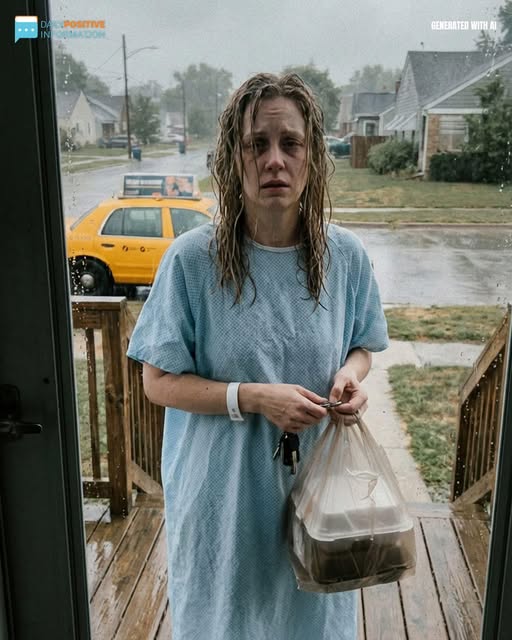
The taxi driver hesitated before easing away from the curb outside the elegant two-story colonial home in the quiet Ridgewood, New Jersey suburb. In his rearview mirror, he watched the elderly woman standing alone on the sidewalk—leaning heavily on a wooden cane, a small overnight hospital bag resting at her feet like something forgotten.
“Are you sure you’re alright, ma’am?” he called through the open window, concern evident in his voice. “It doesn’t look like anyone’s home. I can wait with you if you need.”
Martha Miller offered a faint smile that never reached her eyes as the cold October wind cut through her thin hospital jacket, seeping into her tired bones. “I’m fine, dear. Really. My son must have just stepped out for a moment. Thank you.”
When the yellow taxi finally drove off and turned the corner, the fragile smile disappeared completely from Martha’s seventy-two-year-old face. She stood there alone in front of the house she had lived in for forty years, and in that moment she felt more abandoned than she had ever felt in her life.
She had just spent fourteen days in the cardiac unit at Valley Hospital recovering from what doctors politely called a “minor cardiac event”—a heart attack that could have easily killed her if the neighbor hadn’t found her collapsed in her garden and called emergency services. Two weeks of machines beeping, fluorescent lights, and nurses checking her vitals while she waited for her only son to come visit.
He never did.
She had called Owen three times to tell him she was being discharged and needed a ride home. No answer. She left voicemails. She sent messages with her shaking, arthritic fingers on the smartphone he had given her the previous Christmas—one he had never bothered to show her how to use properly.
Nothing. Silence.
Now she stood in front of her home—the colonial with the wide porch and oak trees out front that she and her late husband Arthur had bought in 1983, when Owen was still a baby. This was where they had spent every Christmas and Thanksgiving for decades. Where Owen had learned to ride his bike down that same driveway. Where Arthur had taken his last breath six months ago, holding her hand and whispering that he loved her.
Martha slowly made her way up the brick path Arthur had laid himself thirty years earlier, her legs unsteady from two weeks of hospital weakness. She reached into her worn leather purse for her house key—the same one she had carried for forty years.
She slid it into the lock.
It didn’t turn.
Frowning, she pulled it out and tried again, more carefully this time. It wouldn’t even go in properly. A chill crept through her chest as she looked closer at the door.
The lock was new. Polished, untouched, completely unfamiliar.
Someone had changed it.
Her confusion deepened into something colder, heavier. Then she noticed it.
A sheet of white printer paper had been taped to the door with ordinary Scotch tape. The edges fluttered in the wind. The message, printed in harsh capital letters, felt like a blow:
DO NOT KNOCK. THIS IS MY HOUSE NOW. DAD LEFT IT TO ME IN HIS WILL. THERE IS NO ROOM HERE FOR FREELOADERS WHO DON’T CONTRIBUTE ANYTHING. GO FIND A NURSING HOME OR MOVE IN WITH AUNT LINDA. – OWEN
Martha felt the words strike harder than the heart attack she had survived two weeks earlier.
Freeloader.
The word repeated itself inside her mind, hollow and unreal.
She had carried this boy for nine months. Raised him through every illness, every fear, every sleepless night. Worked multiple jobs so he could have opportunities she never did. Built a life alongside her husband for decades in this very house.
And now she was a “freeloader” on her own doorstep.
Owen had been living inside a misunderstanding that had clearly grown in silence since Arthur’s funeral six months ago. He believed in a distorted version of inheritance—some imagined rule where the “only son” automatically received everything. He believed that without explicitly seeing a will, the house must have become his by default. And so, in his mind, his grieving mother had become nothing more than an unwanted occupant in what he now believed was his rightful property.
A younger Martha might have screamed and pounded on the door until her fists were raw and bleeding. A more fragile version of her might have collapsed on the porch and cried until a neighbor came to help.
But Martha did neither.
She stood there for a long moment, staring at the note, and a strange, icy clarity washed over her. The grief she had carried for the son she believed she had raised—the son she thought would care for her after Arthur’s death—slowly shifted into a deep, painful understanding of her late husband.
Her hand rested against the cold wood of the door Arthur had refinished years ago.
“Oh, Arthur,” she whispered into the sharp October air, her breath faint in the cold. “You were right about him. I defended Owen for so long. I kept telling you he would change, that he just needed time. But you knew. You always knew who he really was.”
She didn’t knock. She didn’t scream. She didn’t press herself against the windows or beg for entry. She refused to give Owen the satisfaction of seeing her break.
Instead, she walked slowly to the wooden bench on the porch—the one Arthur had built with his own hands decades earlier—and lowered herself onto it carefully, mindful of her fragile recovery. From her purse, she took out her phone with hands far steadier than expected.
She didn’t call Owen. She didn’t call her sister. She dialed a number she had memorized years ago—one she had hoped she would never need.
“Mr. Henderson,” she said when the call connected. Her voice was calm, controlled. “It has happened, just as Arthur said it would. Owen changed the locks and left me a note telling me to leave. I’m outside the house now. Please bring the file. You know which one. And… bring a locksmith. You may also need to bring the sheriff.”
She ended the call, wrapped her coat tighter around her, and waited.
Not as a victim.
But as someone who already knew the outcome.
Inside the Celebration Turning Into Something Else
Inside the warm living room, the atmosphere was one of triumph and entitlement.
Owen Miller lounged in his father’s old leather chair, holding a glass of expensive scotch he had taken from Arthur’s cabinet. Across from him, his wife Jessica was already planning renovations, holding up paint samples and imagining a complete redesign.
“I hate this wallpaper,” she said, wrinkling her nose. “It’s dated. We should tear everything down—open concept, modern kitchen, big island. The works.”
Owen laughed without warmth. “Do whatever you want. It’s ours now.”
Jessica hesitated. “Are you sure she won’t come back?”
“She’s gone,” Owen said confidently. “I changed the locks this morning. Paid a locksmith. She’s got nothing to come back to. This is mine now. I’m the son. That’s how it works.”
He raised his glass. “Finally, I get what I deserve.”
They toasted, completely unaware of what was happening outside.
Then came a sudden mechanical noise at the front door—drilling, loud and deliberate.
Owen stood up instantly, scotch spilling onto the chair. “What the hell is that?”
Jessica panicked. “Is she trying to break in?”
“I’ll handle it,” Owen snapped, storming toward the entrance.
But before he reached it, the front door opened.
Not forced by a trespasser—but unlocked legally.
Standing there was Martha.
Behind her were two sheriff’s deputies, a calm-looking attorney holding a briefcase, and a locksmith packing away his tools while the newly installed lock lay dismantled.
Owen froze. “This is my house! Get out!”
The attorney stepped forward calmly. “I strongly suggest you lower your voice. This property is not yours.”
Owen’s face twisted. “It IS mine!”
The attorney opened his briefcase and removed a document. “You are mistaken.”
He placed it on the table.
“Your father transferred ownership of this house to your mother five years ago. It is legally hers. You have no ownership rights.”
Owen shook his head in disbelief. “That’s impossible…”
Martha finally spoke, her voice quiet but firm.
“Your father knew exactly what you would do,” she said.
Then the attorney opened a sealed envelope and began reading Arthur’s final letter—words that confirmed everything, explaining that he had anticipated his son’s greed and ensured Martha’s protection long before his death.
The house, the money, everything—had never truly been Owen’s.
And in that moment, everything he believed collapsed.
The silence that followed the reading of the letter was deafening.
The words seemed to hang in the air like a final verdict delivered from beyond the grave—unforgiving, absolute, and inescapable.
Owen stood frozen in the center of his mother’s living room, the legal document trembling in his hands. Everything he had built his arrogance on—the belief that he was the rightful heir, that the house and estate were his by default—collapsed in a matter of minutes.
He wasn’t the heir to anything.
He was the mistake. The disappointment. The son his father had deliberately shielded his wife from.
Jessica, realizing in an instant that the house and wealth she had already mentally claimed no longer existed for her, turned on Owen with the sharp cruelty of someone whose affection had always been conditional.
“You told me this was yours!” she shouted. “You said we were secure for life! You lied to me!”
Martha looked at her son—truly looked at him—for what might have been the first time in years without the soft filter of maternal protection. She didn’t see a villain. She saw something far worse: a hollow, broken man who had failed the only responsibility that ever truly mattered.
“I hoped he was wrong,” Martha said quietly, her voice shaking but steady. “Every single day for five years, I prayed that when Arthur was gone, you would step up. That you would care for me the way a son should. That you would prove him wrong.”
She lifted the note Owen had taped to her door.
“I prayed I would never have to read this.”
Her expression hardened, grief turning into something firm and unyielding. “But he was right. About everything.”
She turned to the sheriff’s deputies. “Officers, these individuals are not residents of this property. They entered without permission and changed the locks on my home. That is unlawful entry.”
Then she looked back at Owen, and for the first time in his life, he saw it clearly—no love, no disappointment, no hope left.
Only indifference.
“I am not a cruel woman,” she said. “I will not press charges for breaking and entering. But you will leave my property immediately.”
Owen’s voice cracked. “Mom… where are we supposed to go? We gave up our apartment yesterday. We have nowhere—”
“That is not my concern,” Martha replied calmly.
She glanced at the hallway clock.
“You have thirty minutes to collect your belongings and leave. If you are still here after that, you will be arrested for trespassing.”
A pause.
“And Owen… leave the scotch. That belonged to your father. You didn’t earn that either.”
The Exit
The next thirty minutes were a frantic, humiliating scramble.
Under the silent supervision of the sheriff’s deputies, Owen and Jessica shoved their belongings into garbage bags—stripped of dignity, stripped of certainty, stripped of the life they had arrogantly believed was already theirs.
No arguments were exchanged. No comfort was offered. Only silence, anger, and disbelief.
Jessica moved with bitter rage, throwing things into bags as if each object was to blame. She barely looked at Owen anymore.
Owen moved mechanically, still clutching his father’s letter like it might somehow rewrite itself if he stared at it long enough.
At exactly twenty-eight minutes, they stepped outside with their garbage bags.
Owen paused at the threshold. He turned back, as if searching for a final word that could undo everything.
But Martha simply stepped forward and closed the door.
The click of the lock was final.
Absolute.
Irreversible.
Mr. Henderson closed his briefcase with quiet precision. “You handled this exactly as Arthur intended,” he said gently. “He would be proud of you.”
“Thank you,” Martha replied softly. “For keeping his secret all these years.”
“It was an honor.”
The deputies left with respectful nods. The locksmith followed shortly after, leaving the new keys on the table.
And then, finally, Martha was alone.
Aftermath
The house settled into silence again.
The tension faded, replaced by the familiar stillness of a home that had belonged to her for decades. The scent of old wood, lemon polish, and something faintly reminiscent of Arthur lingered in the air.
Martha walked slowly through the hallway, her cane tapping softly against the floor, until she reached the mantel.
She picked up Arthur’s photograph.
He was smiling in it—calm, knowing, as if he had always seen the ending long before anyone else did.
Tears finally came, but not from heartbreak.
From recognition.
“You stubborn, brilliant man,” she whispered. “You didn’t leave me wealth for comfort. You left me strength.”
She pressed the frame lightly against her chest.
“The ability to stand on my own. The ability to say no. The dignity to not be anyone’s victim.”
She placed the photograph back and walked into the kitchen.
For the first time in two weeks, she made herself a cup of tea in her own home.
Outside, Owen and Jessica drove away into a future they had never prepared for.
Inside, Martha sat at her table, sipped her tea, and let herself cry—not from loss, but from gratitude for a man who had protected her even after death.