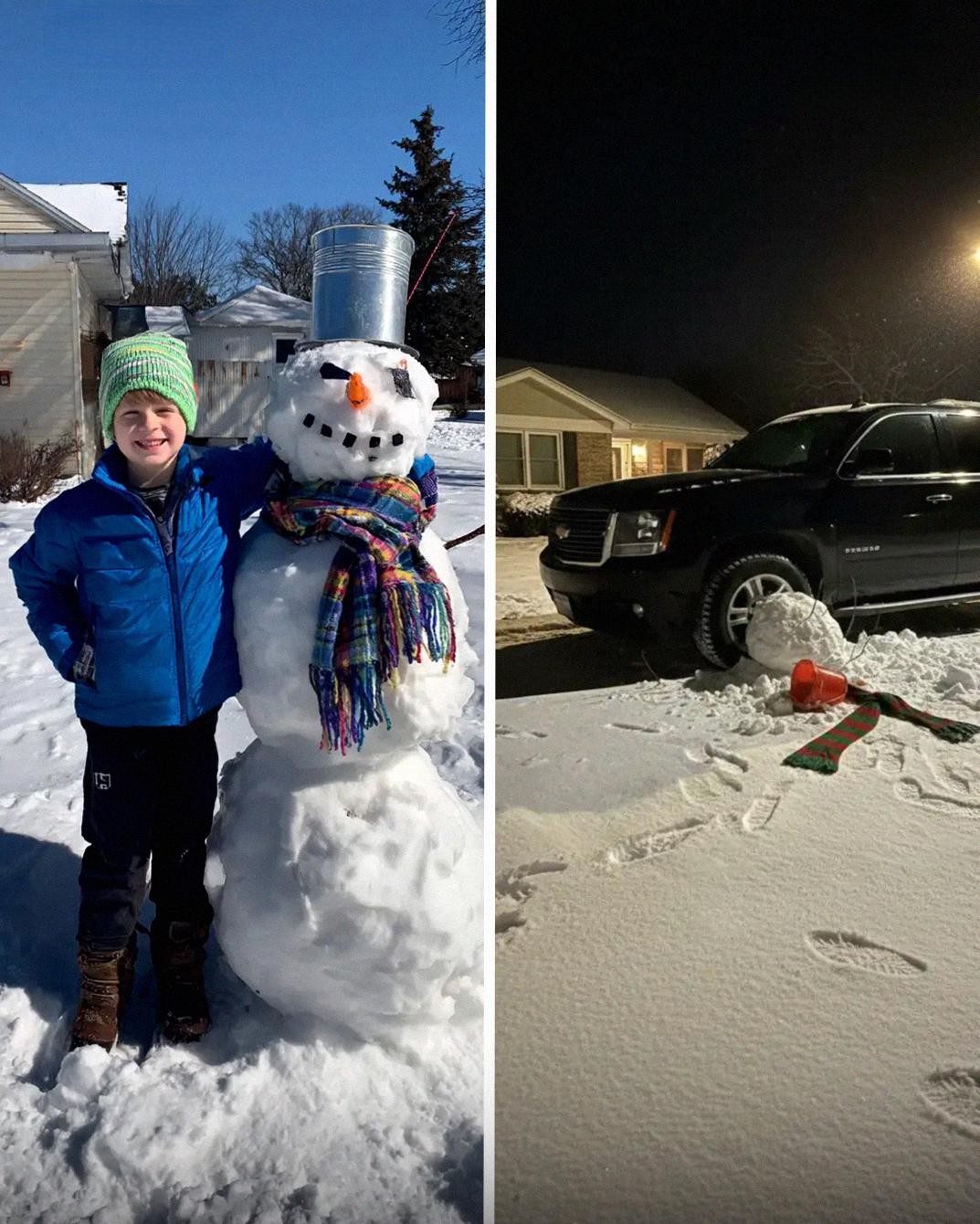
That winter, my eight-year-old son Nick became convinced our front yard was meant for snowmen. Not the occasional one other kids make and forget about, but a whole ongoing project. For him, it wasn’t playtime—it was purpose. Every snowfall meant another creation, another character brought to life by cold fingers and total dedication.
He never built just one. Sometimes there were several in a single week, sometimes one every afternoon. And he always chose the same place: the corner of our yard near the driveway. It was clearly part of our property, just far enough from the road to be safe—or so we thought. To Nick, it was sacred ground.
Each day after school, he burst through the door red-cheeked from the cold, backpack hanging halfway off his shoulder, already planning his next build.
“Can I go out now, Mom? I need to finish Winston.”
I’d smile. “Who’s Winston?”
He’d roll his eyes like I was slow. “The snowman. Today’s snowman.”
He wrestled into his coat, hat sliding sideways, refusing my help to fix it.
“It doesn’t matter,” he’d say. “Snowmen don’t care how I look.”
Outside he went, carefully rolling uneven snowballs, packing and smoothing them like clay. Sticks became arms. Pebbles turned into faces. And always—always—that old red scarf. According to Nick, it made them official.
Each one had a name. A personality.
“This is Jasper. He loves space stuff. This one’s Captain Frost—he watches over everyone.”
When he finished, he’d step back, hands on his hips, nodding seriously. “Yep. He’s a good one.”
Watching from the window, it was impossible not to smile. An eight-year-old treating snowmen like coworkers instead of toys.
Then came the tire tracks.
Our neighbor, Mr. Streeter, had lived next door long before we arrived. Late fifties, gray hair, a permanent scowl—as if happiness personally offended him. For years, he’d cut across the corner of our lawn when pulling into his driveway. It saved him seconds and cost us grass, but I’d ignored it to keep the peace.
Until Nick’s first snowman was destroyed.
He came inside unusually quiet, snow clinging to his gloves. He sat down slowly, like the weight of the day had settled into his bones.
“Mom,” he said softly. “He did it again.”
My stomach dropped. “Did what?”
“Mr. Streeter drove on the lawn. He ran over Oliver. His head came off.”
He tried not to cry, but failed. Wiped his face angrily.
“He saw him,” Nick whispered. “And he still did it.”
That part hit me hardest. Not that snow melted or sticks broke—but that an adult saw a child’s work and chose to ruin it anyway.
That evening, when I heard Mr. Streeter arrive home, I stepped outside.
“Hi,” I said carefully. “Could you please stop driving over that part of the yard?”
He turned, annoyed. “Yeah?”
“My son builds snowmen there every day. It really upsets him when they’re destroyed.”
He glanced at the wreckage and scoffed. “It’s just snow. Tell your kid not to build where cars go.”
“That’s not the street,” I said. “That’s our lawn.”
“Snow’s snow,” he shrugged. “It melts.”
“He spends an hour on them,” I said. “It matters to him.”
He waved me off. “Kids cry. They get over it.”
And he went inside.
The next snowman was crushed. Then another. Each time Nick reacted differently—sometimes tears, sometimes silent anger. Once I suggested moving them closer to the house.
He shook his head. “That’s my spot. He’s the one doing something wrong.”
He was right.
I tried again a week later. Same response. Same smug dismissal.
That night, I told my husband Mark everything.
“He’s doing it on purpose,” I whispered. “He thinks Nick doesn’t matter.”
Mark sighed. “He’ll face consequences eventually.”
We didn’t expect them so soon.
A few days later, Nick came in from outside with snow in his hair and a strange calm in his eyes.
“It happened again,” he said.
I braced myself. “Which one?”
“Winston,” he said. Then, quietly: “You don’t have to talk to him anymore.”
That stopped me.
“I have a plan,” he added.
I warned him—no hurting people, no breaking things. He promised.
The next day, I watched from the window as Nick built his biggest snowman yet—right around the fire hydrant at the edge of our yard. I noticed flashes of red beneath the snow but didn’t fully register it.
That evening, I heard the crash.
Metal. Water. Shouting.
Mr. Streeter’s car had slammed straight into the hydrant. Water exploded into the air, flooding the street. At the base lay the remains of the snowman—sticks, scarf, snow everywhere.
Nick stood beside me.
“I put him where cars aren’t supposed to go,” he said calmly. “I knew he’d drive there.”
Mr. Streeter pounded on our door, furious.
“You set me up!”
I stayed calm. “You admit you were driving on our lawn.”
Silence.
The police and city workers confirmed it. He was responsible.
From that day on, Mr. Streeter never drove over our grass again.
Nick kept building snowmen all winter. None were destroyed.
And every time I look at that corner of the yard, I think about my eight-year-old—who taught me that sometimes boundaries don’t need shouting.
Sometimes they just need to be impossible to ignore.