Every Sunday, my son Mark and I walked the same path around the lake.
We’d been doing it for two years, ever since his mother passed. It didn’t matter if I was exhausted, drowning in paperwork, or barely holding myself together. Sundays were sacred. Just him and me, side by side, walking in silence or talking about nothing at all.
Mark needed it. I did too.
He’s a gentle kid—sometimes painfully gentle. The kind of child who apologizes when someone else bumps into him. Since his mom died, that softness has deepened. Loud noises make him flinch. He asks questions about death at random moments, then watches my face closely, as if measuring whether I might vanish too.
Some days, I still forget she’s gone. I’ll turn to tell her something ordinary, and there’s just empty air. Those moments hit like a punch to the chest, but I swallow it down. Mark can’t see that part of me. He needs his dad steady, not unraveling.
So we walk.
That Sunday seemed ordinary enough. Pale blue sky, joggers with earbuds, families pushing strollers. We were halfway around the lake when Mark stopped so abruptly I almost ran into him.
“Mark?” I said.
He didn’t answer. He was crouched low, pulling something from the weeds.
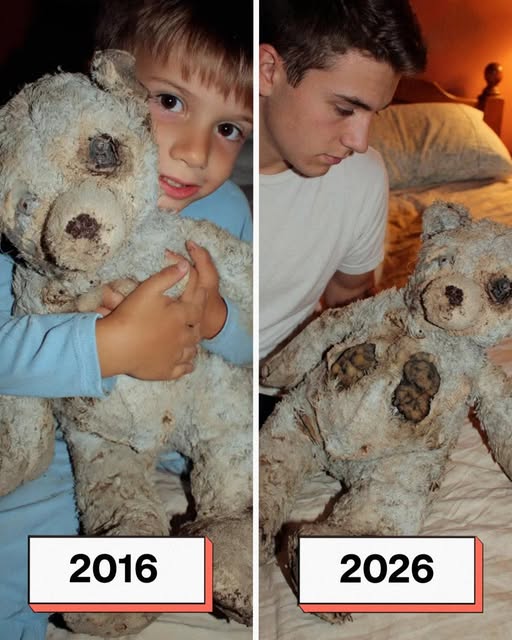
It was a teddy bear.
And it was disgusting.
Its fur was matted with mud, one eye missing, the other scratched and cloudy. A seam along its back had split, stuffing clumped and gray with age. It looked like trash—the kind of thing you normally wouldn’t touch.
But Mark cradled it like it was precious.
“Buddy,” I said gently, kneeling beside him, “it’s filthy. Let’s leave it here, okay?”
His grip tightened.
“We can’t,” he said. “He’s special.”
His voice wavered. I saw that look—the one where he holds himself together with sheer will, trying not to cry. It wrecked me every time.
“Alright,” I said quietly. “We’ll take him home.”
At home, I spent over an hour cleaning the bear. I didn’t soak it—Mark wanted to sleep with it that night. I scrubbed carefully, vacuumed out dirt, disinfected it, and stitched the torn seam as neatly as I could.
Mark hovered the entire time, touching the bear every few minutes, asking when it’d be ready. As if it might vanish if he looked away too long.
That night, he fell asleep clutching it to his chest.
I stood in the doorway, watching him breathe. Love and fear tangled tight in my chest. I reached down to straighten his blanket. My hand brushed the bear’s belly.
Something inside clicked.
A sharp burst of static crackled through the room. Then, a tiny, trembling voice seeped from the fabric:
“Mark… I know it’s you. Help me.”
My blood ran cold.
That wasn’t a toy sound. Not a prerecorded laugh or malfunctioning speaker. It was real. A child’s voice. And it said my son’s name.
Mark slept on, oblivious. I carefully slid the bear from his arms and backed out of the room, closing the door as softly as I could. My heart hammered so hard I thought it might wake him anyway.
In the kitchen, under the harsh overhead light, I ripped open the seam I’d just sewn.
Stuffing spilled out. My fingers brushed against something hard.
A small plastic box. A speaker. A button. Duct tape holding it all together.
Before I could think, the voice spoke again.
“Mark? Mark, can you hear me?”
I swallowed hard and pressed the button. “This is Mark’s dad. Who is this?”
Silence.
Then, faintly: “It’s Leo. Please help me.”
Leo. The boy Mark used to play with at the park every weekend—bright smile, scraped knees, endless energy. Then one day, he stopped coming. Mark asked a few times, then stopped. I assumed they’d moved.
Apparently, they hadn’t.
The connection cut out again. I sat there for hours, staring at that bear, the weight crushing my chest.
The next morning, Mark asked for Bear the moment he woke.
“I’ll give him back,” I said, “but we need to talk first.”
When I asked about Leo, Mark nodded immediately. He said Leo didn’t want to play tag the last time. Said his house was loud now. Said grown-ups didn’t listen. That was enough.
After dropping Mark at school, I drove to the blue house a block from the park. The door opened slowly. Leo’s mom looked tired, distracted, embarrassed.
I told her everything.
She covered her mouth as I spoke, tears filling her eyes. She admitted she’d been overwhelmed with work, missing the signs she should have seen. Leo had hidden the device in the bear himself, desperate to reach the one person he trusted—Mark.
We talked for nearly an hour. Real plans formed. Real changes.
That Saturday, we met at the park again.
The boys ran toward each other like no time had passed. They played until they were breathless, the bear sitting quietly between them—just a toy now.
That night, Bear went on a shelf above Mark’s bed.
It never spoke again.
But I listen better now—to pauses, to silence, to the small signs someone needs help but doesn’t know how to ask.
Sometimes the quietest cries are the most important ones.