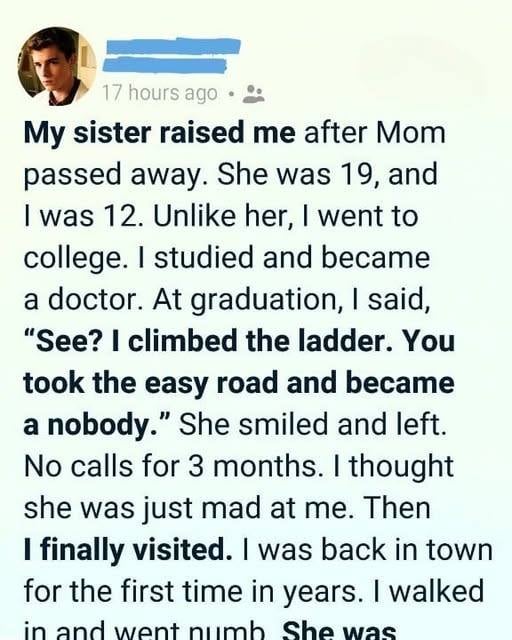
She saved my life. I called her a nobody.
Years of sacrifice erased in a single careless sentence.
For so long, I believed I had escaped our broken past through sheer willpower. I told myself I had climbed out alone — clawed my way up through grit, discipline, and intelligence. I wore that belief like armor. Then one afternoon I pushed open her unlocked front door, stepped into that stripped-bare house, and finally saw what my success had truly cost her.
The silence inside felt wrong. Not peaceful — hollow. The walls were bare where photographs once hung. The old couch, the dining table, even the curtains were gone. Rooms that used to carry the warmth of overcooked dinners and late-night laughter now echoed with absence. At first, I thought she was moving. Downsizing. Starting fresh. That’s what I told myself to avoid the creeping truth forming in my chest.
I used to believe my story began the day I slipped on a white coat and strangers began calling me “Doctor.” That was the day I thought I became someone. The day I believed I had finally outrun the smallness of our childhood. But my story began long before that — with a nineteen-year-old girl in a borrowed black dress standing beside a twelve-year-old boy at their mother’s funeral. Her hand trembled as she held mine. Mine trembled because I was a child. Hers trembled because she had just decided she no longer could be one.
In that moment, she chose to become what she herself had never been given: safety, certainty, protection. She stepped into a role no one formally assigned to her. There was no ceremony, no recognition, no applause. Just a quiet decision made through grief — that I would not fall apart the way everything else had.
She traded her youth for responsibility so gradually I didn’t notice the exchange. She worked double shifts and told me she “liked staying busy.” She skipped meals and said she “wasn’t that hungry.” She stopped going out with friends because she “didn’t feel like it.” I mistook her sacrifice for simplicity. I confused her exhaustion for stability. I treated her love as inevitability — as if it were something owed to me by the universe rather than given to me by a young woman who deserved her own life.
When college acceptance letters arrived, I celebrated like I had won a private war. I never asked how tuition would be covered beyond the scholarships. I never noticed which pieces of furniture quietly disappeared over the years. I didn’t question why the house grew emptier while my opportunities expanded. I thought determination alone carried me forward. I thought I had built myself.
The day I opened that door and found her collapsed on the living room floor — in a house stripped of nearly everything — the illusion shattered. The ambulance lights painted the empty walls red and blue. I remember kneeling beside her, calling her name, realizing with a sickening clarity that there was nothing left in that house because she had sold it — piece by piece — to build me.
The degrees on my office wall. The accolades framed in polished wood. The speeches I gave about perseverance and personal grit. None of it could compete with the brutal, ordinary heroism of someone who sells memories to pay tuition they will never use. Someone who starves their own dreams so yours can eat. Someone who stands in the background of your triumph and claps the loudest while quietly disappearing.
I once called her a nobody. I said it in anger, in arrogance, in the blind confidence of someone who confuses visibility with value. I believed status was earned only when the world recognized it. I did not understand that the greatest forms of strength often operate unseen.
Now, every life I help save carries her fingerprint. Every patient who thanks me is unknowingly thanking her. My steady hands were steadied by her sacrifice. My education was funded by her absence — by the things she gave up so I would never have to.
My success is not mine alone. It is written in her invisible labor, in the nights she lay awake calculating bills, in the opportunities she quietly declined, in the dreams she folded up and placed on a shelf so I could chase mine freely. It is built on her quiet greatness — the kind that does not demand recognition, that does not seek applause, that loves without keeping score.
I thought I had climbed out of our broken past by myself. Now I understand the truth: I did not climb. I was carried. Over and over again, she chose me. And that choice — repeated in a thousand unseen ways — is the foundation beneath every step I take.
She saved my life. And the world may never know her name. But everything I am stands on it.