The air in my father’s dining room felt like a physical weight, thick with the scent of lilies and the sharp, metallic tang of unspoken resentment. I sat there in my combat boots and OCPs, having caught a red-eye from Fort Bragg to Albany just to make it to the funeral. I hadn’t even washed the dust of the motor pool from my skin before the lawyer, Robert Chen, began the grim business of dividing a life into columns of assets. Across the table, my younger sister Megan looked like she had stepped off a runway—perfectly coiffed, draped in silk, and wearing a smile that didn’t reach her predatory eyes.
When Chen reached the final section of the will, silence fell like a curtain. Megan was awarded the Miami penthouse, a glass-and-steel monument to the life she had curated through social climbing and proximity to our father’s business interests. I was left with the “Old Property”—a secluded cabin and two hundred acres of rugged Adirondack wilderness.
“A cabin fits you perfectly, you stinking woman,” Megan said, her voice dripping with saccharine venom. She looked at my uniform and shivered theatrically. “A shack in the woods for the girl who lives out of a duffel bag anyway. Dad really knew his audience. Some of us were born for the city, and others… well, others were born for the dirt.”
I felt the eyes of our relatives burn into me, but I didn’t look up. I looked at our mother, Helen. She sat at the head of the table, hands folded so tightly her knuckles were white, staring at the tablecloth as if she could disappear into it. She didn’t defend me. She never did. In this family, Megan was the jewel, and I was the jagged stone that didn’t fit the setting.
The mockery continued into the hallway. “Don’t be dramatic, Sarah,” Megan sneered, following me toward the door. “You were always off playing soldier while I stayed here and handled real life. You don’t even know how to use a walk-in closet, let alone manage a luxury condo.”
I stopped and turned, my military bearing making me seem a foot taller. “You didn’t handle real life, Megan. You handled Dad. You learned exactly where to stand to be in the light, and you made sure I was always in the shadow.”
Her laugh was sharp. “Well, enjoy the shadows in your leaking shack. Don’t call me when the roof caves in.”
I left without another word. On the porch, my mother offered a lukewarm olive branch. “She’s under a lot of stress, Sarah. She doesn’t mean it.”
“She just inherited a property worth millions, Mom,” I said, the engine of my truck idling. “What exactly is she stressed about? Choosing the right marble for the foyer?”
My mother flinched and retreated back into the house. It was the final confirmation: I was an outsider in my own bloodline.
The next few days were a barrage of condescension. Megan texted “advice” on how to sell the cabin for scrap, while my mother suggested I let Megan “manage” the land. But a nagging memory persisted—the quiet, observant eyes of my father. He wasn’t a man who made mistakes. He planned.
Driven by a mix of spite and curiosity, I drove north. The Adirondacks rose to meet me, ancient and indifferent. By the time I reached the dirt road leading to the property, Albany was a distant memory. The cabin looked exactly like Megan had described: a shack. The porch sagged, windows shuttered like tired eyes, and the silence of the woods was heavy. I sat in my truck for a long moment, engine ticking, wondering if this was my father’s final joke.
But when I stepped inside, the air didn’t smell like rot. It smelled of cedar, old leather, and a faint lingering trace of coffee. The place was immaculate. On the mantle sat a black-and-white photograph I’d never seen: my father as a young man standing in front of this cabin next to a woman with a face like flint. “With Grandma Rose, where everything began,” the back read.
A knock at the door made me reach instinctively for a weapon I wasn’t carrying. Outside stood Jack Reynolds, a retired neighbor and my father’s old friend, holding a casserole dish. “Your dad came up here a week before he died,” Jack said, eyes searching mine. “He told me his daughter might arrive one day looking like the world had turned on her. He told me to tell you that the most valuable things are often hidden in the places people laugh at first.”
He pointed toward the kitchen table. “When you’re ready, check under the floorboards.”
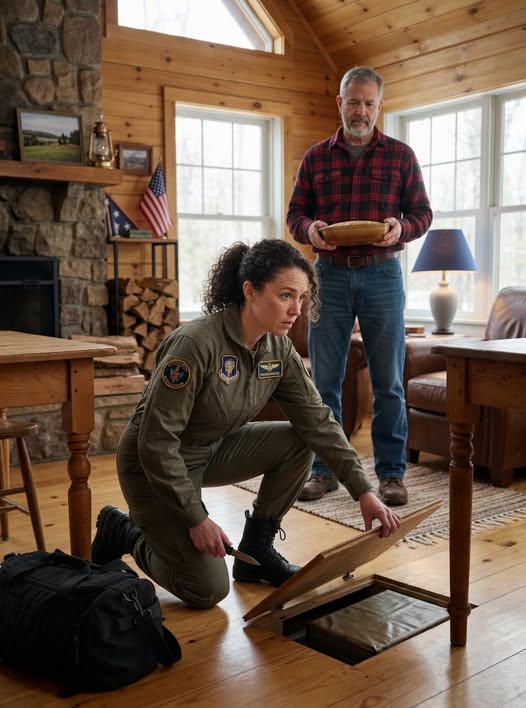
After Jack left, the cabin felt electric. I moved the heavy oak table and knelt on the scarred pine floor. Near the corner, a loose board yielded to my pocketknife. Beneath it, wrapped in oilcloth and tucked into a metal box, lay the “shack’s” true inheritance. The lock opened on the third try—the year 1945, the date Grandma Rose purchased the land. Inside were neat rows of gold bullion and a stack of land deeds revealing that the two hundred acres sat atop a massive, untapped vein of high-grade mineral deposits.
But it was the letter that broke me. “To my strongest daughter,” it began. My father knew Megan would see only a shack and sell it for a quick profit. But he knew I understood the value of a fortress. Grandma Rose had built this life from nothing, hiding wealth as a safeguard against a world that had once tried to take everything from her. “The Miami apartment is a cage of glass,” he wrote. “This land is a throne. I didn’t give you the cabin because you have nothing, Sarah. I gave it to you because you are the only one I trust to keep it.”
I sat on the floor, the weight of gold in my hands and my father’s respect in my heart. For years, I had been the discarded child. Now I realized I was the one he had chosen for the truth.
The next morning, my phone buzzed. Megan’s voice was tight. “Sarah, listen, I’ve been looking at the property taxes. There’s some interest from a developer. We should talk about a joint sale. It’s for the best.”
I looked out at the morning mist clinging to the pines, at the ancient mountains now mine to protect. A slow smile spread across my face.
“No, Megan,” I said, my voice cold and clear as the mountain air. “We really don’t. And for the record? The roof doesn’t leak at all.”