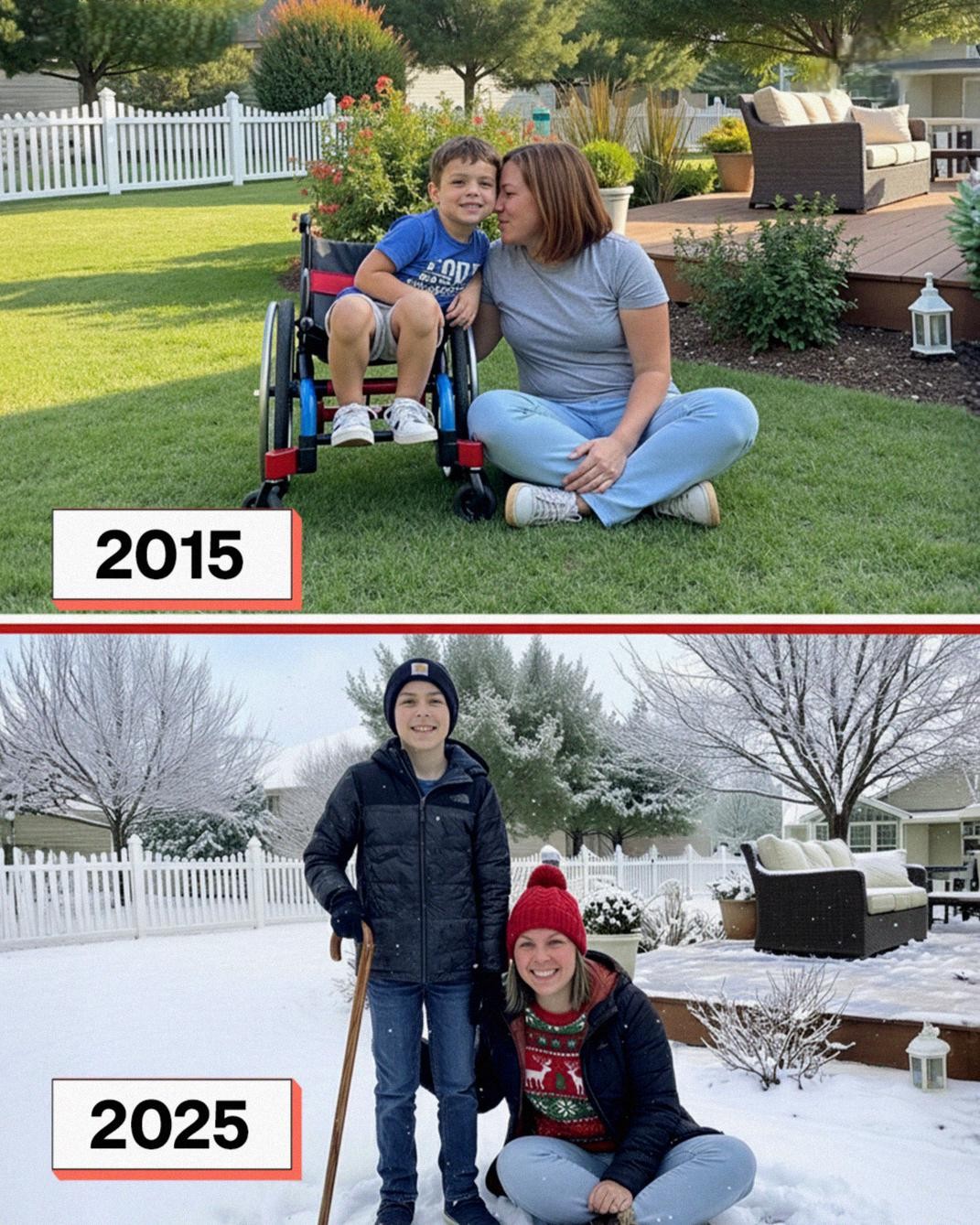
My name is Amy. I’m thirty-seven now, but the real beginning of my story goes back ten years, to when I was twenty-seven. At that point in my life, I wasn’t building a career or starting a family—I was just trying to survive New York City. My world revolved around a tiny Queens apartment, the greasy smell of hash browns from the diner where I worked mornings, and the dusty comfort of old books at the bookstore where I spent my evenings. I was exhausted, broke, and constantly worried about rent, bills, and instant noodles. Becoming a mother was nowhere in my plans.
Still, I had always adored my nephew, Evan. He was born while I was in college, a bright-eyed child with a laugh so pure it could briefly make the world feel whole. But life hadn’t been kind to him. He was born with a serious congenital condition affecting his legs. Heavy braces, endless physical therapy, and constant pain were part of his daily life. Yet, despite everything, Evan carried an unshakable joy that seemed to defy his reality.
One Friday night is burned into my memory with painful clarity. I was drained after a long double shift, dreaming only of a hot shower and mindless TV. Instead, as I turned onto my street, I saw them. My older sister, Lila, stood beneath a flickering streetlight. Beside her was Evan, only four years old, holding a small suitcase covered in cartoon stickers. The metal of his leg braces glinted under his jeans.
“Lila?” I called, confused and tired.
She didn’t smile. Her face was stiff, empty, like someone who had already made an irreversible choice.
“Amy,” she said flatly, avoiding my eyes. “I can’t do this anymore.”
My stomach dropped. “What do you mean?” I whispered.
She inhaled deeply and nudged Evan toward me. “I’ve met someone. He doesn’t want children. He’s offering me a new life—a better one. I deserve that.”
I stared at her, stunned. “You’re leaving your son?” My voice broke.
“You don’t understand,” she snapped quietly. “He’s exhausting. I want a normal life.” Then, softer, she added, “You love him. You’ll take better care of him than I ever could.”
She bent down, kissed Evan’s forehead without emotion, dropped his suitcase, and walked toward a black car waiting at the curb.
“Lila! Stop!” I screamed. She never turned back.
I stood frozen on the pavement, my body aching, my mind spinning. Evan tugged my coat. “Auntie… where is Mommy going?”
I dropped to my knees and pulled him into my arms. “I’m here,” I whispered. “I’m not leaving you. I promise.”
I had no idea how I would keep that promise. I had no money, no space, no plan. But that night, as Evan slept beside me after a cup of hot cocoa, I knew there was no other choice.
The days that followed were brutal. Lila vanished completely—no calls, no messages. I was suddenly responsible for doctors, therapists, medical equipment, and confusing Medicaid forms. I worked sixteen-hour days, sold my car, begged neighbors for help, and filled my apartment with therapy gear. I was overwhelmed and terrified.
But Evan never gave up. He faced pain and setbacks with courage far beyond his years. “One day I’ll run,” he’d tell me, gripping my hand. “You’ll see.”
His determination kept me going.
I endured the stares, the whispers, and the low expectations from teachers who mistook his physical struggles for intellectual limits. Evan proved them wrong. He was brilliant, curious, and relentless. By ten, he was walking short distances with crutches—not a miracle, but the result of years of love, effort, and sheer willpower.
Years passed. I became a manager at the bookstore. We moved into a small house with a backyard big enough for therapy equipment. Somewhere along the way, I stopped being “Aunt Amy.” I was simply Mom.
At fifteen, Evan came home glowing, holding a certificate for academic excellence.
“I want to be a physical therapist,” he said proudly. “I want to help kids like me.”
I cried as I hugged him. Every sacrifice suddenly felt worth it.
I thought that was our happy ending.
A week later, there was a knock at the door.
Lila stood on my porch, polished and thin, with a man in a suit beside her.
“We need to talk,” she said casually.
The man introduced himself as her lawyer. They were filing for custody.
I laughed in disbelief. “Now? After eleven years of nothing?”
“I heard he’s doing well,” Lila said eagerly. “Colleges are interested. Scholarships. He’s… valuable now.”
That word cut deep.
Evan stepped outside then, standing tall on his crutches. He looked at her, then at me.
“Mom?” he said—looking only at me.
Lila smiled brightly. “Sweetheart—”
“You’re not my mom,” Evan said calmly. “She is.”
He squeezed my hand. “Do I have to talk to her?”
“No,” I answered. “You don’t.”
The legal battle was painful, but the truth was undeniable. Evan even testified.
“She left me,” he said. “Amy stayed. She helped me walk. She’s my mom.”
The judge agreed. Full custody. No visitation.
A week later, Evan brought me adoption papers.
When everything was final, we stood outside the courthouse, hand in hand.
“Mom,” he whispered, smiling, “we did it.”
That word—earned, chosen, and forever—was the happiest sound I had ever heard.