After my husband passed away, I moved into my grandmother’s old house, thinking it would give me a fresh start. What I didn’t expect was that my son would start leaving food for the quiet man next door—or that one day, that same man would knock on my door with a photograph and a truth that would change everything I thought I knew about my life.
I’m 34. My husband has been gone for eleven months.
My son, Eli, is seven.
After losing my husband, I couldn’t stay in our apartment anymore. Every corner held memories—his habits, his presence, the small sounds that no longer existed. The silence became unbearable.
So I did the only thing I could think of. I went back.
I moved into my grandmother’s house.
It had been empty for years, occasionally mentioned by relatives who never actually did anything with it. The moment I asked to stay there, everyone suddenly agreed.
“It should stay in the family,” my aunt said.
At the time, I was grateful.
Then there was the neighbor.
The house sits on a quiet street where everyone seems to know everything, but no one says much. People were polite—but watchful.
And then there was him.
“Difficult,” they said.
“Quiet.”
“Doesn’t like people.”
But what unsettled me wasn’t his distance.
It was the way he looked at me.
Not often. Not for long. But enough to notice.
There was something in his eyes—something that felt like recognition.
Then Eli noticed him.
And everything changed.
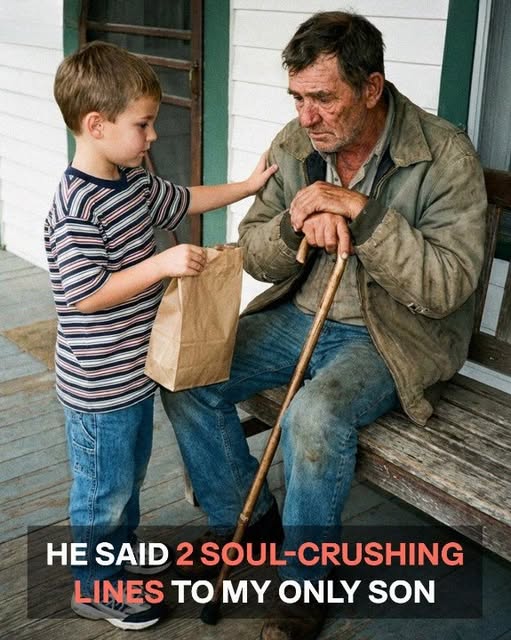
One rainy afternoon, I walked into the kitchen and saw Eli carefully wrapping half his sandwich in foil.
“Why are you doing that?” I asked.
Without looking up, he said, “Mr. Larkin eats dinner alone.”
I blinked. “How do you know?”
“He told me. Yesterday. When I was outside.”
“He has a dog?”
“He used to,” Eli said.
That caught me off guard.
“Why are you giving him food?” I asked gently.
Eli looked at me like the answer was obvious.
“Because he eats alone.”
I told him maybe we shouldn’t do that without asking first.
He nodded—but it didn’t change anything.
The next day, he did it again.
Every afternoon, he’d wrap something—half a sandwich, a cookie, fruit—and leave it by the man’s porch, next to a blue flowerpot. He’d knock once and run back.
The door never opened.
But the food always disappeared.
One evening I tried again.
“Sweetheart, maybe Mr. Larkin doesn’t want us bothering him.”
Eli kept drawing.
“Mom,” he said quietly, “I think he’s sad all the way inside.”
I stopped.
“Why do you think that?”
He shrugged. “Because he says thank you before he opens the door.”
I didn’t understand at first.
Then Eli explained—he sometimes hid nearby and heard him say, “Thank you, buddy.”
After that, I stopped trying to stop him.
Still, every now and then, I’d catch Mr. Larkin looking at me with that same strange recognition.
Then today happened.
It was gray and rainy. Eli was in the living room building a fort. I was sorting mail when someone knocked.
I opened the door—and froze.
Mr. Larkin stood there.
Up close, he looked worse than I’d ever seen him—pale, tired, eyes red like he’d been crying.
He held an old photograph.
For a moment, neither of us spoke.
Then he said, his voice unsteady,
“I finally understand who you are. I’ve been looking for you my whole life. Your son helped me.”
My chest tightened.
“What?”
He lifted the photo.
“You need to see this.”
I took it.
The picture was old, faded. My grandmother stood on the front steps of this house, much younger. Beside her was a teenage girl. And next to them—
Him.
Younger.
His arm around the girl.
And in her arms—a baby wrapped in a yellow blanket with a crooked white edge.
I recognized it instantly.
That blanket had been in my grandmother’s chest my entire childhood. She always said it belonged to a cousin.
My fingers went numb.
“How is this possible?” I asked.
He swallowed.
“Because that baby is your mother.”
“No.”
He nodded once. “Yes.”
“My mother was my grandmother’s daughter.”
“That’s what everyone believed.”
I stepped back. “You need to leave.”
“I know how this sounds,” he said, his voice breaking.
“No, you don’t.”
“I do,” he said. “They told people she was unstable.”
Eli appeared behind me. “Mom?”
“Go to your room,” I said quickly.
He hesitated—but went.
I turned back. “You have one minute.”
He took a breath.
“The girl in the photo was Anna—your grandmother’s oldest daughter. They said she was unstable. She got pregnant. They sent her away. When the baby was born, they brought her back and told everyone the child was theirs.”
My knees weakened.
“Your mother grew up believing your grandmother was her mother. Anna became ‘the troubled sister.’ Then she died, and the truth was buried.”
I shook my head. “No…”
“I loved her,” he said. “They told me the baby was gone. I searched for years. I was threatened to stay away. Everything was hidden.”
I stared at him.
“Why now?”
“Because when you moved in, I thought I was imagining things. You look just like her. Then your son kept coming… bringing food. One day I asked your name. Then your mother’s. And I knew.”
I should have closed the door.
Instead, I said, “Wait here.”
I went up to the attic.
After searching through old boxes, I found a tin container hidden away.
Inside were documents.
A birth certificate that didn’t make sense.
Hospital papers.
And two letters.
One from my grandmother:
It is better for the child to grow up clean than under the stain of her mother’s mistake. We will say she is ours. Anna agreed.
My hands shook.
The second letter was never sent:
If my daughter ever learns the truth, tell her her father loved her before he ever saw her.
Signed: Anna.
I sat there, unable to breathe.
When I came back downstairs, he was still there. Eli sat nearby, quiet.
I opened the door.
“You were telling the truth,” I said.
He looked like that hurt more than anything.
“Yes.”
“Do you understand what you’ve done to me?”
“I do,” he said softly.
This time, I believed him.
“My husband is gone,” I said. “I came here thinking something in my life was still solid… and now everything is a lie.”
He lowered his head.
“I didn’t want to add to your pain,” he said. “But your son… he made me feel like I mattered. I couldn’t keep this anymore.”
That broke something in me—but not in the same way.
Eli came closer. “Is he in trouble?”
I let out a small laugh through tears. “No.”
He looked at the man. “Do you want a sandwich?”
The old man covered his mouth, overwhelmed.
And for the first time, I didn’t see a distant neighbor.
I saw someone who had carried grief for a lifetime.
I asked quietly, “Are you my father?”
His chin trembled.
“Yes.”
The word stayed between us.
Eli looked from him to me. “So… he’s family?”
I took Eli’s hand.
“Yes,” I said softly. “I think he is.”
That night, Eli split his sandwich in half.
Mr. Larkin sat beside us, silently crying.
And for the first time since my husband died, the house didn’t feel like a place I had escaped to.
It felt like a place where the truth had finally found me.