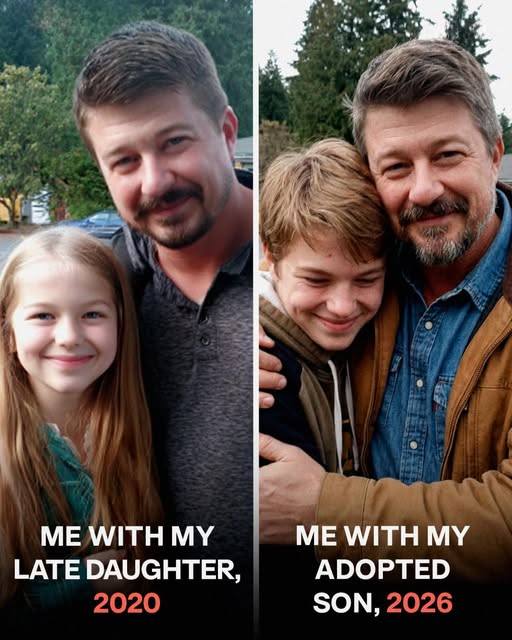
He took my daughter from me.
Sarah was only eleven—still at that fragile age when the world feels vast, full of endless possibility, and completely open to imagination. She had dreams, the kind that only children can hold with unwavering certainty. She wanted to become a veterinarian, carrying with her a small, dog-eared notebook filled with names for the animals she imagined she would one day save. Every page brimmed with hope, every name a tiny promise of a future she believed was hers to shape. She trusted in her tomorrow completely, without fear, without doubt.
Then, in a single, shattering moment at a busy intersection, that future vanished.
The boy behind the wheel was seventeen. His name was Michael. A kid without much guidance or a true support system, he had simply been returning from a sports competition with friends, never imagining that his life would collide with someone else’s in a way that would change everything forever.
In court, he offered no excuses. He didn’t argue or defend himself. He only cried. Over and over, he repeated that it had been a mistake, a terrible accident, and that he would never forgive himself.
And somehow, I believed him.
Standing there, looking into his eyes across the courtroom, I felt something I had never anticipated. I didn’t want to destroy him.
That didn’t mean I loved Sarah any less—I loved her more than words can ever hold—but I realized that punishing him, breaking him, wouldn’t bring her back. It wouldn’t bring back the laughter that had once filled our home or the bright little voice that had called me “Dad” with such unwavering joy.
So I made a decision that cost me almost everything.
I dropped the charges.
And then, against every expectation and every judgment I could imagine, I adopted him.
Most people thought I had lost my mind.
My wife left immediately. She couldn’t bear to live in the same house with the boy tied to our daughter’s death. I didn’t argue; I understood her pain, even though it broke what was left of us. My brother stopped answering my calls. My mother cried whenever she saw Michael, then apologized for it. Everyone questioned my choice. Everyone wondered how I could possibly forgive.
But Michael stayed.
At first, he spoke very little. He threw himself into quiet, relentless work—studying late into the night at the kitchen table, as if discipline could somehow repay a debt no one had asked him to carry. On weekends, he picked up shifts at a hardware store, leaving envelopes of cash on the counter without comment.
“You don’t have to do this,” I told him one night.
He didn’t even look at me. Just shrugged.
“I want to, Dad.”
Somewhere between those late nights, the small shared silences, and his unspoken acts of care, we became something like a family. Fragile, unexpected, but real.
Years passed.
Then my health failed. Kidney failure. The waiting list for a transplant stretched endlessly ahead of me, a grim reminder of how fleeting life could be. For the first time, I understood what it meant to wait for something you might never get, to hope while knowing that hope could betray you.
Michael didn’t hesitate.
“Test me,” he said.
I tried to stop him, but he would not relent.
“Just test me, Dad.”
He was a match. At twenty-two, he gave me one of his kidneys—without hesitation, without complaint, without ever making me feel like I owed him a thing. When I woke from surgery, he was sitting beside me, quiet, steady, a presence I had learned to rely on more than anyone else.
I had lost a daughter… and in the aftermath, somehow, I had gained a son.
But life never balances itself so neatly.
Years later, on my birthday, something in the house felt off. Michael was quieter than usual. I noticed him staring out the kitchen window, coffee untouched, thoughts far away.
“You okay?” I asked.
“Yeah,” he said, forcing a smile that didn’t quite reach his eyes.
I let it go.
I shouldn’t have.
That evening, during a small gathering we had put together, he stood, glass in hand.
“I want to make a toast,” he said. “Dad… there’s something I should’ve told you a long time ago.”
Something in his voice made the air thick and heavy.
“It’s about the night Sarah died.”
I shook my head immediately.
“No… you don’t have to do this.”
But he did.
“What you know… isn’t the truth.”
Before I could stop him, he walked to the door and opened it. Another man stepped inside. Older, well-dressed, tense.
“My name is Greg,” he said. “I was the one driving that night.”
Everything inside me froze.
Greg explained, how he had insisted on driving, how he lost focus for just a second, how Sarah lost control of her bike, and how there was no time to react. But I barely heard him. My attention was on Michael.
“Why?” I asked him. “Why did you take the blame?”
He didn’t answer right away. Then quietly, almost as if speaking to himself:
“Because I had no one. And I figured… if someone had to lose everything, it should be the one who already had nothing.”
Seventeen years old. And he had carried that choice himself.
Greg said he was ready to tell the truth now. He could not live with the lie anymore.
I asked everyone else to leave. Within minutes, it was just the three of us, standing in a silence heavier than anything I had felt in over a decade.
Then Michael placed something on the table: a small, worn voice recorder, with a faded paw print sticker. Sarah’s.
“She had it with her that night,” he said. “I kept it.”
My hands shook as I picked it up.
“You kept this from me?”
“I didn’t know if it would help… or hurt you more.”
I pressed play. Static. Then her voice, clear, alive:
“Dad said he’d fix my bike brakes this weekend… but I think he’s gonna forget again. It’s okay, though. He always makes it up with pancakes.”
And something inside me broke open all over again.
Had I fixed her bike… would she still be here?
Grief didn’t feel old anymore. It felt raw. New. Unfinished.
I couldn’t stop the tears.
“I haven’t heard her voice in eleven years…”
No one spoke. I looked at Greg.
“You kept living,” I said. “You let him carry this for you.”
“I know,” he said. “And I’ll face whatever comes next.”
But my focus was on Michael.
“You don’t carry things alone anymore,” I said.
“Not in this family.”
He nodded, steady, eyes full of everything we had survived together.
Forgiveness isn’t something you do once. It’s something you choose again and again, in different moments, for the same person, even when it seems impossible.
Later that night, the house quiet, I pressed play on the recorder again. Her voice filled the stillness, soft, familiar, gone but not gone. Michael stood silently in the doorway, making sure I wasn’t alone.
“Next time,” I whispered, “we face it together.”
A pause.
“Yeah… okay, Dad.”
Some losses never leave you. You just learn, slowly, how to carry them—with someone standing beside you.