The lessons of my childhood were never hidden in bedtime stories or whispered through lullabies; they were carved into the air of our home with cold, precise intent. My mother, Margot, treated vulnerability as a terminal weakness. When my father walked out on us, she didn’t shed a single tear. Instead, she methodically erased his presence from the house, dropping our wedding portrait into the fireplace as casually as one might discard a piece of junk mail. She turned to me, her five-year-old son, and gave me a smile that felt like a winter frost.
“Now it’s just us, Jonathan,” she said. “And we don’t fall apart. We succeed.”
Margot didn’t simply raise a child; she engineered a legacy. Every piano lesson, every starched collar, every etiquette class was another brick in the fortress she built around me. She wanted me bulletproof—a man so polished and successful that no one could ever find a reason to leave me. By the time I was twenty-seven, I had all the outward markers of her success, but I had long abandoned the hope of truly pleasing her. To Margot, a job well done was merely the starting line for the next demand.
When I told her I was seeing someone, I chose one of her favorite high-end bistros, a place as stiff as her expectations. She sat across from me in her signature navy blazer, her eyes sharp and predatory. I spoke about Anna, a dedicated nurse. For a moment, I saw a flicker of genuine interest—nursing was “brave” and “respectable.” But when I added that Anna was a single mother to a seven-year-old named Aaron, the atmosphere dropped like a stone. Margot sipped her wine slowly, her silence more deafening than a shout.
“That is a great deal of baggage for a man with your potential, Jonathan,” she said, her voice calm but cutting.
A few weeks later, a forced meeting at a coffee shop only widened the gap. Anna arrived late, weary and with her son in tow. Margot greeted them with a clinical detachment that bordered on cruelty, asking Aaron one perfunctory question about school, rolling her eyes when he spoke of art, and paying only for herself before leaving without a backward glance. Later, Anna’s voice was soft but resolute.
“She doesn’t just dislike me, Jon. She thinks I’m a mistake in your ledger.”
The breaking point came two years later in a grand piano showroom, Margot’s so-called “sanctuary of legacy.” Among polished Steinways, I told her I had asked Anna to marry me. Her hand, grazing the lid of a grand piano, fell to her side.
“If you marry into that life, Jonathan—if you choose that ready-made family—don’t ever look back. You are walking away from everything I built for you. You are choosing to be ordinary.”
I said nothing. I didn’t argue. I didn’t beg. I walked out and into the life I actually wanted.
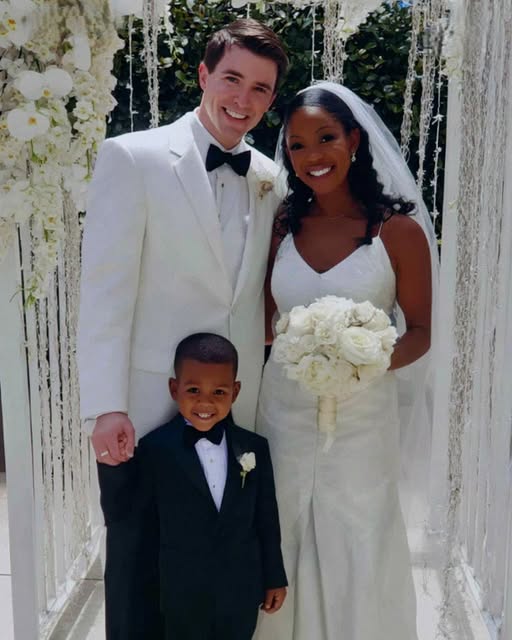
Anna and I married under strings of golden backyard lights, surrounded by friends who valued laughter over lineage. We moved into a modest rental with a lemon tree and drawers that stuck in the summer humidity. It wasn’t the flawless life Margot had envisioned, but it was vibrant. Our home quickly filled with the evidence of life lived out loud: green handprints on Aaron’s walls, mismatched mugs from yard sales, Saturday morning cartoons.
The moment that truly healed me came three months into our marriage. In a grocery aisle, Aaron looked up and asked, “Can we get the marshmallow kind, Dad?” It was effortless, unforced—a small, perfect confirmation that love didn’t need perfection to exist. I went home and cried into the laundry, finally understanding that love could be real without fear.
Three years passed in silence from Margot. Then, unexpectedly, her name appeared on my phone.
“I’m in town,” she said, crisp, judgmental, and unapologetic. “Send me your address. I want to see what you gave everything up for.”
The next day, she arrived, an emissary from a world of control and precision, stepping into our home as if it were a crime scene. Her eyes scanned our secondhand sofa and the scuffed coffee table, finally resting on the green handprints Aaron had left in the hallway. She walked through our home as if the floorboards might collapse under the weight of my “failure.”
Then, she heard the music.
In the corner, Aaron sat at a peeling upright piano I’d bought for a few hundred dollars. The pedals squeaked. The lacquer flaked. And yet, as he played a Chopin nocturne—the same piece Margot had made me practice until my fingers bled—the room transformed. Aaron’s playing was tentative but tender, driven by love for the sound rather than fear of the teacher.
“Who taught him that?” she whispered, voice cracking.
“I did,” I said. “He wanted to learn. He plays because he loves it.”
Aaron finished and handed her a drawing: our house, with me, Anna, and him on the porch. Margot was depicted in an upstairs window, surrounded by a riot of colorful flowers.
“I didn’t know what flowers you liked,” Aaron said. “So I drew them all. We don’t yell here, Grandma. Daddy says yelling makes the house forget how to breathe.”
Margot stared at the drawing as if it were a map of a country she had never visited. For the first time, she said something personal:
“You could have been great, Jonathan,” she said, voice soft.
“I am great, Mom,” I said firmly. “I just stopped performing for an audience of one. I stopped being bulletproof so I could finally feel something.”
She looked at Anna, then back at the drawing, and told a story of her own father—a man colder than she had ever been—who convinced her that life was wasted without perfection.
“You traded connection for control,” I said. “And you lost us anyway.”
She left quietly, leaving a small envelope under the mat. Inside was a gift card to the local music shop and a note: For Aaron. Let him play because he wants to.
I stood in the quiet of our lived-in home, feeling a weight lift I hadn’t realized I carried. It wasn’t the ending Margot had written. It wasn’t the legacy she planned. It was something far better. It was a beginning.