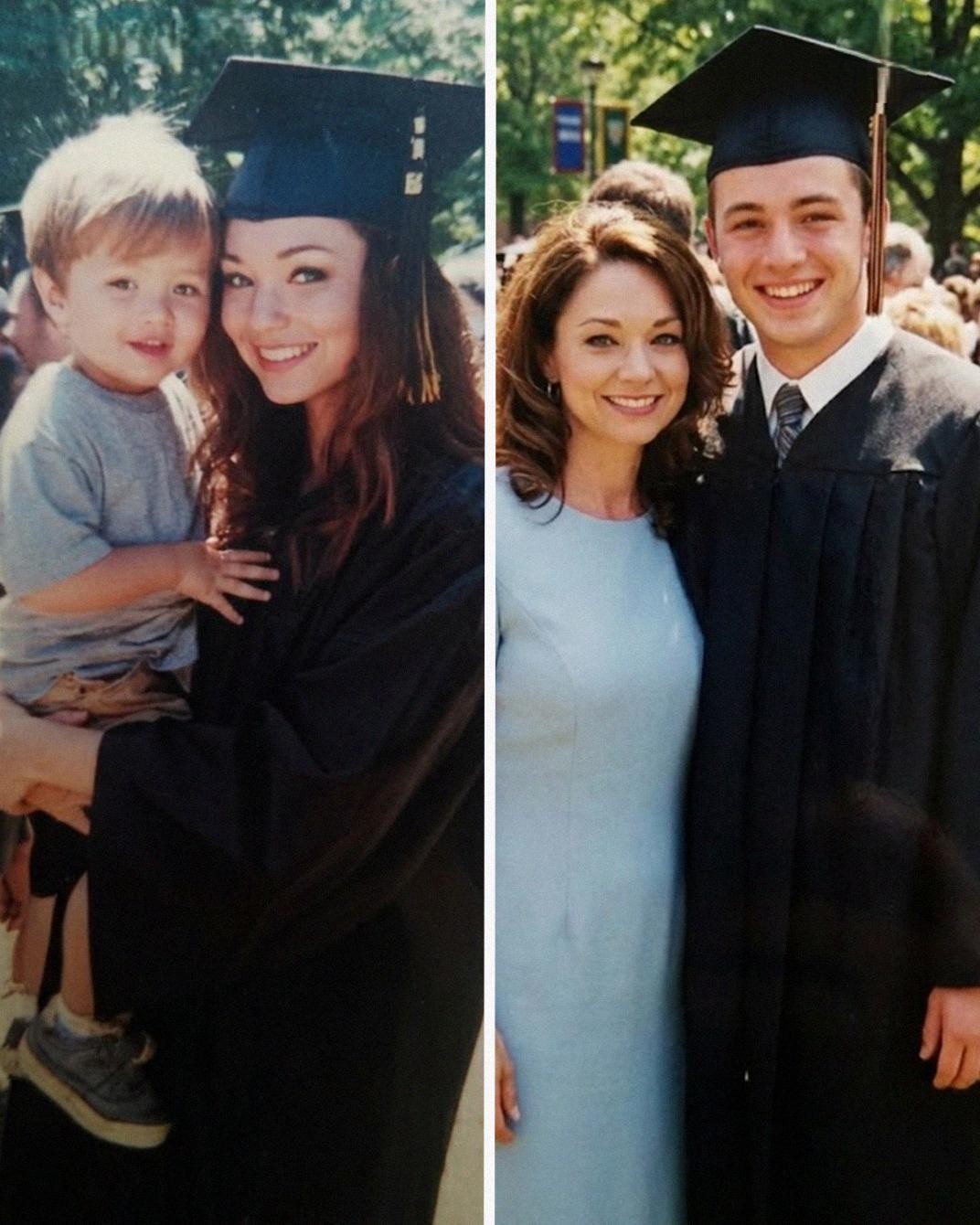
For twenty-two years, the architecture of my life had rested on a single, unshakable foundation: it was Evan and Laura against the world. My mother had raised me alone with a grace that bordered on heroic. She was the one who fixed the leaky faucets in our cramped apartments, taught me how to parallel park, and read to me every night until I fell asleep. Her story was consistent, calm, and resolute. She told me she had fallen pregnant at twenty, during her junior year of college, and that my father had simply disappeared upon hearing the news. “He wasn’t ready,” she would say with a shrug that felt like a closed book. I never doubted her. I grew up believing I was the product of a man’s cowardice—a reality that made me love my mother even more for choosing to stay.
My college graduation was meant to be the culmination of that two-person journey. It was a crisp spring morning in Chicago, the kind where sunlight glints off the campus buildings, but the air still carries a sharp, wintry bite. My mother was easy to spot in the crowd—radiant in a light-blue dress, wearing the pearl necklace reserved for the most significant milestones of my life. When I walked across the stage to receive my diploma, she was on her feet, clapping with a ferocity that made me feel like the only graduate in the stadium.
After the ceremony, as we stood in the courtyard amidst a sea of black gowns and popping champagne corks, I noticed a man near a stone bench. He was well-dressed, in his mid-forties, staring at me with an intensity that felt almost physical. It wasn’t the gaze of a stranger; it was the look of someone trying to recognize a ghost in a living face. When he finally approached, my mother’s hand tightened on my shoulder. Her body went rigid, and the blood drained from her face.
“Evan?” he asked. I nodded, confused. He glanced at my mother, whose eyes were wide with terror and fury. “I’m sorry to interrupt,” he said, his voice trembling slightly. “But I need to talk to you. I’m your biological father.”
A nervous laugh escaped me. The absurdity of the statement felt like a glitch in reality. But the man, who introduced himself as Mark, was dead serious. He told me everything I had been told was a lie—not necessarily malicious, but a lie nonetheless. He claimed he had been told for twenty-two years that I didn’t exist. “She told me she lost the baby,” he said, looking at my mother. “I believed for two decades that there was no child.”
The celebratory atmosphere of the graduation evaporated. We moved to a quiet patch of grass at the edge of the parking lot, away from the prying eyes of classmates. There, the story of my origin was dismantled and reconstructed in real-time. Mark explained that he and my mother had dated in college and, though young and immature, he hadn’t intended to leave. But his parents—wealthy, powerful people with an extensive network—had intervened behind his back. They pressured my mother, threatened custody battles, and tried to buy her silence to “protect” their son’s future.
Finally, my mother spoke, her voice a ragged whisper. “I never took their money,” she said, tears streaming down her face. “But I was twenty years old and alone. They made it sound like they could take you from me the moment you were born. I was terrified. So I told Mark the baby was gone, and I disappeared. I protected you the only way I knew how.”
Mark didn’t linger. He handed me a business card with a shaky hand and told me there was no pressure—he had only discovered the truth six months prior through a mutual friend. Then he walked into the crowd, leaving me standing amid the wreckage of my own history.
That night, our apartment felt suffocatingly quiet. My graduation cap and gown hung over a chair, discarded symbols of a day hijacked by the past. We sat at the kitchen table with cold mugs of tea. My mother looked smaller than I had ever seen her, the exhaustion of carrying a twenty-two-year secret finally etched into the lines around her eyes.
“I should have told you,” she admitted. “But every year that passed made the truth feel more like a weapon. I wasn’t trying to be a martyr, Evan. I was just a scared girl who wanted to keep her son.”
I looked at her and realized that my entire life, I had seen her as a pillar of strength, forgetting that pillars are often under immense pressure. She hadn’t stayed alone because she had no other options; she had stayed alone to ensure no one could stake a claim on the life she was building for me. I reached across the table and took her hand. “You didn’t abandon anyone,” I said. “You chose me over everything else. That’s the only truth that matters.”
The reconciliation with Mark wasn’t a cinematic explosion of emotion. It was slow, deliberate, and often awkward. I kept his card in my wallet for weeks before sending a text. We began meeting for coffee once a month, navigating the minefield of our shared DNA. He told me about his regrets, his life, and his career, but never blamed my mother. He seemed to understand, perhaps better than anyone, the shadow his family had cast.
Over time, anger softened into a complex, quiet understanding. I realized that the absence I had felt growing up wasn’t a void of love, but a byproduct of fear and the desperate choices a young woman under pressure had made. My mother eventually made peace with the situation too. One evening, months later, as we sat watching an old movie, she saw Mark’s name pop up on my phone and smiled gently. “I’m glad you’re talking,” she said. “Whatever you decide, I trust you.”
I didn’t gain a “father” in the traditional sense. Two decades of absence cannot be replaced by a few hours of conversation. But I gained the truth, and in doing so, I saw my mother for who she truly was—not a victim of a man who left, but a protector who stayed at any cost. Our roles shifted; I wasn’t just her child anymore. I became the person who could help carry the weight she had borne alone for so long. My life hadn’t been ruined on graduation day; it had finally been completed.