Grief has a way of hollowing out time. When my husband Ryan died, the world kept moving, but mine stopped. Every sound felt distant, every movement unreal. I was still learning how to exist in a life where the one person who anchored everything was suddenly gone. I thought the funeral would be the hardest part. I was wrong.
Two days after we buried him, my mother-in-law made her move.
When I married Ryan, I never pretended that his mother liked me. Margaret’s disapproval wasn’t subtle; it lived in her tight smile whenever I entered a room and in the way her questions were always directed at her son, never at me. My children, Emma and Liam, were invisible to her unless she needed proof of a story she had already written in her head. To her, I wasn’t a wife. I was a threat.
Ryan saw it. He always did. He defended us quietly but firmly, setting boundaries even when it hurt him. He chose us. He bought our home, built a life where my kids could feel safe, and made it clear that his family included all of us. For a while, that was enough to keep Margaret at bay.
Then came the accident. One phone call. One drive I don’t remember. One doctor whose expression told me everything before words could. Ryan was gone. Just like that. The man who promised he’d always protect us was reduced to memories, a hospital room, and a silence that felt violent.
At the funeral, Margaret didn’t cry. She sat rigidly in the front row, accepting condolences like transactions. Afterwards, she cornered me and said what she’d been holding in for years. She told me Ryan’s death was my fault. If he hadn’t been rushing home to me and the kids, he’d still be alive. She said it coldly, without shame, as if grief gave her permission to finally speak the quiet part out loud.
I didn’t respond. I couldn’t. I had two children clinging to me, trying to understand why their world had collapsed. I swallowed her words because that’s what mothers do when their kids are watching.
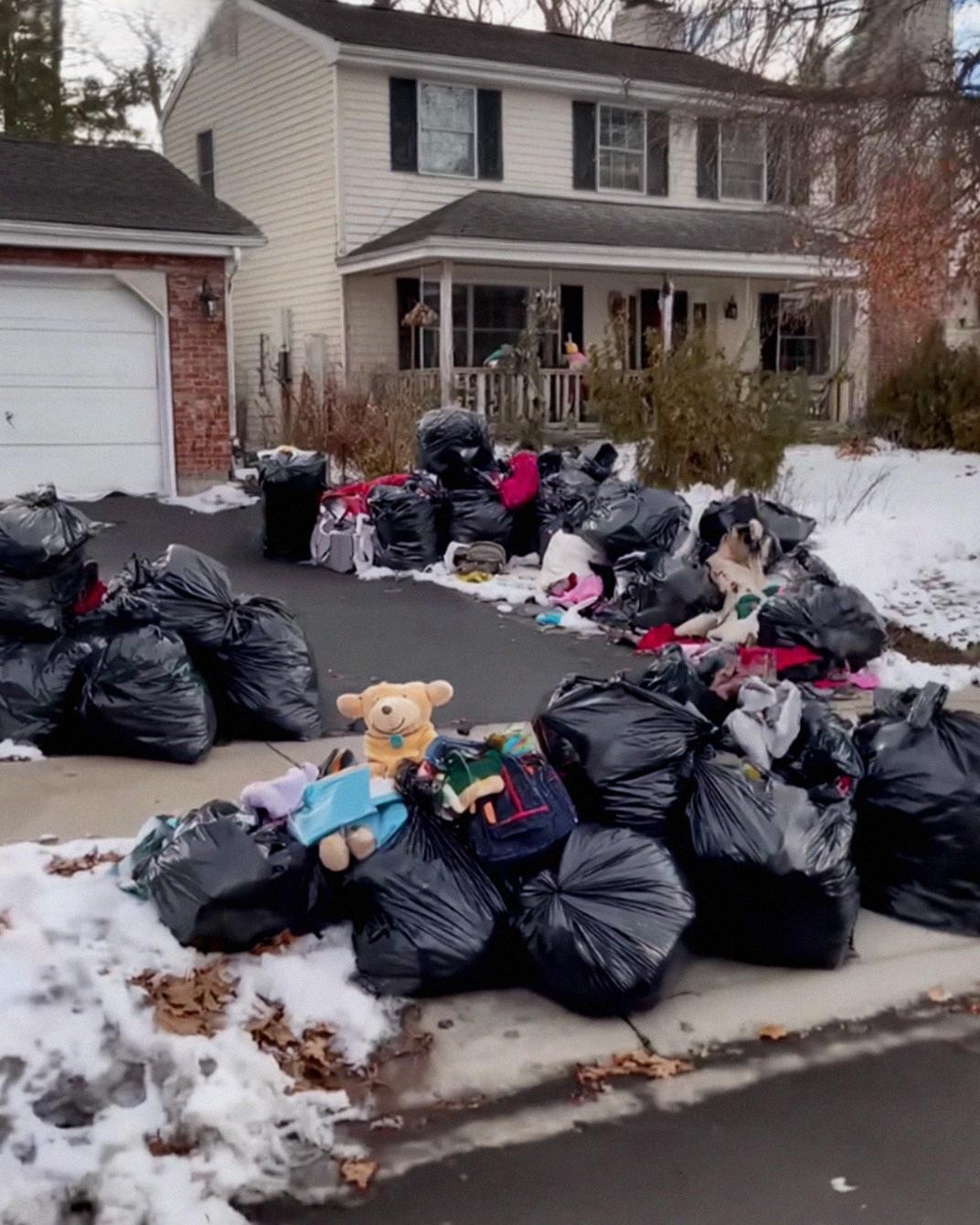
Two days later, I took Emma and Liam out for ice cream, desperate for something normal. When we returned, the sight in front of our house stopped me cold. Our belongings were piled on the curb in black trash bags—clothes, toys, blankets, pieces of a life discarded without ceremony.
My key didn’t work. The locks had been changed.
Margaret opened the door when I knocked. She stood there as if she owned the place—because in her mind, she did. She told me the house was hers now. That I had no rights. That my children and I needed to leave. She called them “those kids.” She smiled when she said it.
That night, my children slept in the backseat of my car.
I told them it was like camping. I told them we’d be fine. I lied because the truth was too heavy for a five-year-old and a seven-year-old. Liam stayed awake, staring at the car ceiling, whispering that his dad wouldn’t have let this happen. He was right.
The next morning, after dropping the kids at school, I called Ryan’s lawyer. My hands shook as I explained what Margaret had done. There was a long pause on the other end. Then he spoke, his voice sharp.
Ryan had known.
Six months earlier, he had updated his will. He’d anticipated exactly this scenario. He left everything to me: the house, the savings, the investments. Margaret was left a substantial sum—but with one condition. If she ever tried to evict me, interfere with my rights, or claim the house, she would forfeit everything.
What she didn’t know was that her cruelty had just cost her everything.
The emergency court hearing was swift. Margaret argued entitlement. The judge cited the law. The ruling was immediate: she had no legal standing. The house was mine. She was ordered to vacate.
By the time I returned with new keys, her belongings were stacked on the curb in the same black bags she had used for ours. When she arrived and saw them, she screamed, threatened, and called the police. They didn’t side with her.
Changing locks without an eviction notice is illegal. Breaking and entering is illegal. Unlawful eviction is illegal. Grief does not override the law. Officers explained this calmly as they led her away, while she hurled accusations about betrayal and children who “weren’t even his.”
I didn’t argue. I didn’t need to.
Later, she learned about the will, about the money, about how her actions had redirected it straight to the people she despised most. I didn’t celebrate her downfall. I didn’t feel joy. What I felt was closure.
That night, my children slept in their own beds again. Emma asked if Grandma Margaret could hurt us anymore. I told her no. Liam told me I was brave. I told him bravery looks like standing up even when you’re broken.
Ryan’s last gift wasn’t just financial security. It was foresight. Protection. Love that extended beyond his life. He knew who his mother was, and he made sure that when she finally showed it, we would be safe.
Grief still lives with us. It always will. But so does justice. And in the quiet moments, when the house is still and the kids are asleep, I understand something I didn’t before: love doesn’t always end when someone dies. Sometimes, it shows up exactly when you need it most.