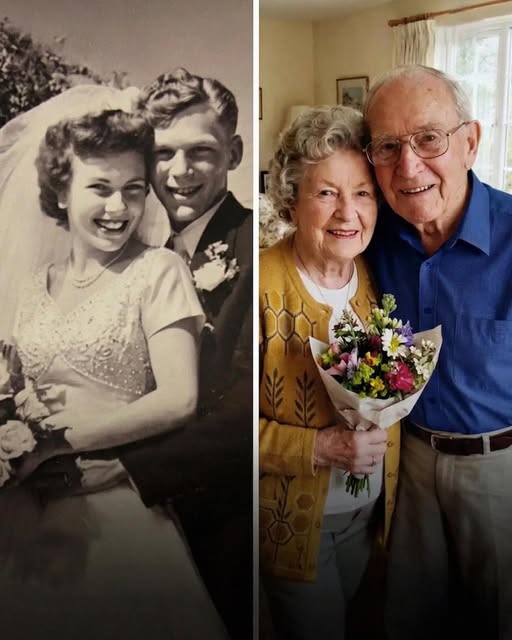
My name is Daisy, and at eighty-three years old, I have come to understand that time is both a thief and a poet—stealing moments while quietly writing meaning into the spaces they leave behind. For sixty-three years, my husband Robert was the steady rhythm of my life, the quiet pulse beneath everything I did. He proposed on Valentine’s Day in 1962, in a cramped college dorm kitchen that smelled of burnt garlic bread and cheap spaghetti sauce. He didn’t have wealth or stability then—only a small bouquet of roses wrapped in yesterday’s newspaper and a silver ring he had earned through weeks of washing dishes. But what he gave me that day mattered more than anything material: he gave me his word. He promised that no matter where life carried us, he would always find his way back to me—with flowers.
And he kept that promise.
Through six decades of life that shifted between joy and hardship, Robert spoke to me through flowers. Wildflowers during our early years when money was scarce. Long-stemmed roses when his career finally began to flourish. Simple daisies during the devastating year we lost our second child, when even speaking felt too heavy. The flowers were more than gifts—they were his language, his quiet way of saying “I am still here,” even when words failed us both.
When Robert died four months ago, that language disappeared, and so did the music of our home. The house turned into something hollow and unfamiliar: his slippers still resting beside the bed, his coffee mug still hanging on its hook in the kitchen, untouched. I spoke to his photograph daily, filling the silence with updates about a life that no longer felt like it was moving forward.
So when the first Valentine’s Day without him arrived, I braced myself for the weight of it.
The silence that morning felt almost physical, pressing against the walls. I sat at the kitchen table with a cup of tea, staring at his empty chair, half-expecting the memory of his footsteps or the sound of a knock that would never come again. But then—sharp, real, undeniable—a knock echoed through the house.
I hurried to the door, but when I opened it, no one was there.
Instead, resting carefully on the doormat, was a bouquet of fresh roses wrapped in brown paper and tied with twine. It looked exactly like the bouquet he had given me on that first Valentine’s Day in 1962. My breath caught when I saw the envelope tucked between the petals. Inside were a heavy brass key and a letter written in Robert’s familiar, slanted handwriting.
My hands trembled as I read.
He told me that if I was holding this, then he was already gone. But more than that—he told me he had been keeping a secret for nearly thirty years. He gave me an address I had never heard of and asked me to go there. A cold fear settled into my chest immediately. My mind betrayed me with the worst possibilities: late-night meetings, hushed phone calls from decades ago, a hidden life I had never seen. I feared I was about to uncover a version of Robert that would rewrite everything I thought I knew.
By the time I called a taxi, my heart was racing with dread.
The building stood in a part of town I had never once visited: a modest brick structure with a faded green door. My fingers shook as I inserted the key into the lock. I expected betrayal. I expected devastation.
Instead, I was met with a scent that struck something deep inside me—lemon oil, old paper, polished wood.
Memories I had buried without realizing it came rushing back.
I stepped inside and flicked on the light.
What I saw stole my breath completely.
It wasn’t a secret apartment. It wasn’t a hidden life built in shame.
It was a music studio.
A grand upright piano stood in the center of the room, its mahogany surface glowing softly in the light. The walls were lined with shelves that stretched upward, filled with sheet music, recordings, and thick books on music theory. Everything was carefully arranged, preserved like something sacred.
On the piano bench lay stacks of scores—Debussy, Chopin, Beethoven.
My pieces.
The ones I used to play when I was young, before life slowly replaced dreams with responsibility, and before I quietly set my music aside in favor of everything else I had to become.
On a small table nearby sat medical records dated six months before Robert’s death. They confirmed what I already feared—he had known his heart was failing long before he ever told me.
Next to them was a legal document ensuring this place would be maintained and that the key would be delivered to me exactly when I needed it most.
But the most devastating and beautiful discovery was the journal resting on top of the piano.
I sat down slowly and opened it.
The first entry was dated twenty-five years earlier.
Robert wrote about a day we were cleaning out the garage together. He had seen me pause over my old sheet music, thinking I hadn’t noticed. But he had. He saw the flicker in my expression—the quiet grief of someone who had once dreamed of a stage but had learned to live without it.
That moment changed something in him.
He made a private vow: he would return that part of me to myself.
He rented this studio in secret. And then, for twenty-five years, he learned the piano—not as a hobby, but as devotion. He wrote about the stiffness in his fingers, the frustration of starting so late in life, and the countless nights he practiced until his hands ached. He didn’t want to simply give me a piano. He wanted to understand the language I had once loved so deeply.
He wanted to play for me.
As the journal moved closer to the present, his handwriting became more fragile, more urgent. He knew time was running out. In his final months, he tried to compose something original—a piece of music that would carry sixty-three years of love, memory, and shared life.
The last entry broke me completely.
He apologized for not finishing it.
He wrote that he had run out of time.
I turned slowly toward the piano and saw it: a handwritten score titled “For My Daisy.” The melody was breathtaking—delicate, intentional, full of emotion—but halfway through the second page, it simply stopped. The final measures were left blank, the silence on the page heavier than anything I had ever read.
I sat there for a long time, unable to move.
Eventually, I placed my hands on the keys.
I hadn’t truly played in decades, but something inside me remembered before I did. I began to play the melody he had written—each note a memory, each chord a breath of him. It felt like he was there beside me, not as a memory, but as something closer, something felt rather than seen.
When I reached the place where his composition ended, I did not stop.
I let the music continue through me.
Not as a replacement for him—but as a continuation of everything we had been.
When the final note faded, I noticed another envelope beneath the music stand.
Inside was his final message.
He wrote that this studio was mine now. He had prepaid the lease, arranged everything, and left a fund to maintain it. He begged me not to let my music die with him. He told me that even though he was gone, he would exist in every note I played, every chord I shaped, every silence I filled with sound.
And he reminded me of something I had forgotten long ago—that he had loved me from the moment he first saw a young woman carrying sheet music under her arm.
And he would love me forever.
Now, I return to that green door twice a week.
I sit at that piano and reclaim the part of myself I thought was lost to time. I record my sessions and place them beside the recordings he left behind, as if we are still speaking through music across different worlds.
My hands are older now. Less steady. Sometimes I miss notes I once would have caught without thinking.
But it doesn’t matter.
Because in that room, the music never ends.
Robert kept his promise.
He found his way back to me one last time—not just through flowers or letters, but through sound itself.
And in doing so, he taught me the final truth of love:
it does not hold on to you forever.
It leads you back to yourself.