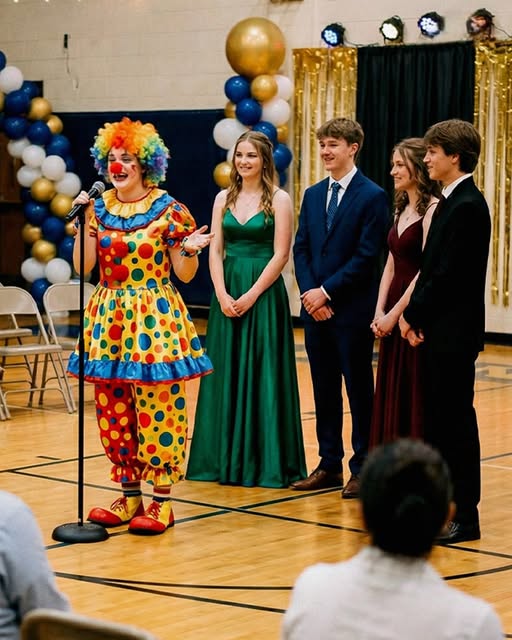
The air in the high school gymnasium was heavy with the scent of floor wax and floral arrangements, a suffocating sweetness that made my chest tighten. For most parents, this morning was a milestone of joy. For me, it was a funeral in disguise. It had been exactly three months since the accident that took my daughter, Olivia, and being here felt like a betrayal of her memory. I clutched her graduation cap, the blue fabric wrinkled by my white-knuckled grip, wondering how the world could keep spinning when her heart had stopped.
I didn’t want to be here. My husband, Brian, had offered to come with me, but I had pushed him away. I needed to do this alone—or perhaps I simply didn’t want anyone to see how close I was to shattering. Olivia’s room remained a frozen shrine; her prom dress still hung on the door, and her favorite perfume lingered in the curtains. She should have been here, complaining about her hair or fretting over her valedictorian speech. Instead, there was only a gaping hole in the front row where she belonged.
As the band began the slow crawl of “Pomp and Circumstance,” a wave of nausea rolled over me. I sat on the hard bleachers, surrounded by families laughing and taking selfies, feeling like a ghost among the living. A text from Brian blinked on my phone: “How’s it going, sweetheart? You doing okay?” I couldn’t find the words to reply. My grief wasn’t quiet today; it was a physical weight pressing the air from my lungs.
Then, the procession began.
At first, everything seemed normal. Seniors filed in, their faces a mix of boredom and excitement. But as the middle of the line reached the center of the gym, the atmosphere shifted. I saw a flash of bright red. A student had pulled a foam clown nose from their pocket and slipped it on. Another followed. Then a girl in the third row donned a neon yellow wig.
A murmur rippled through the crowd. Confusion, judgment, disapproval. “Is this a prank?” a mother hissed to her husband. “How disrespectful,” muttered a father nearby.
I felt a surge of protectiveness. I didn’t know why they were doing it, but the sight of those bright, clashing colors in a sea of serious blue robes felt like a spark of life. As more students joined—some in oversized polka-dot ties, others in squeaky clown shoes—the principal, Mr. Dawson, stepped to the microphone, flustered.
“Seniors?” he asked. “Is this… a prank?”
That’s when Kayla, Olivia’s best friend, stepped out of line. Her eyes were red-rimmed and fierce, and they found me.
“Renee?” she called over the PA. Silence fell. Every head turned toward me. “This isn’t a prank. It’s a promise. A promise we made to Olivia.”
I remembered the note I had found earlier that morning in Olivia’s jewelry box, written after a terrifying lupus flare left her bedridden: “If anything ever happens and I can’t go to grad, promise me you’ll go for me, Mom. Please don’t let that day disappear.”
Kayla took a deep breath. “Olivia told us graduation didn’t just belong to the ‘perfect’ kids. She said it belonged to the ones who were struggling, the ones who felt invisible, and the ones who were scared. She made us promise that if she couldn’t be here, we’d show up as clowns. She wanted us to remember that life is too short to be serious all the time, and even in the middle of the hardest year, we have to make each other laugh.”
One by one, students shared stories I’d never heard. Marcus, a quiet boy, wore a rainbow wig: “I was getting bullied last year. Olivia saw it and sat with me at lunch every day until I felt safe. She said, ‘Nobody eats alone in my universe.’”
A girl named Sarah, wearing giant glasses, whispered: “I had a panic attack during finals. Olivia found me in the bathroom and made funny faces until I started laughing. She told me a grade doesn’t define my worth.”
The stories kept coming—a litany of small, beautiful acts of kindness painting a portrait of my daughter I hadn’t fully realized.
“Renee, would you come down here?” Mr. Dawson asked.
I walked down the bleachers in a daze. When I reached the floor, students surged forward, a chaotic, colorful wave, and pulled me into a massive group hug. I smelled cheap polyester and hairspray, and for a moment, I felt Olivia there.
Then Kayla signaled to the class. Every student removed their wig or clown hat, turning it inside out. On the white lining, bold words were written: Brave. Kind. Seen. Loved. Worthy. Enough.
“She made us feel these things,” Kayla said, pressing Olivia’s favorite pen into my hand. “She isn’t gone, Renee. She’s in every one of us.”
I finally understood. Olivia hadn’t wanted a somber memorial; she had wanted a revolution of joy. She had known grief would try to swallow me whole and had enlisted her friends to ensure it wouldn’t.
As I walked out of the gym, clutching Olivia’s diploma and cap, the weight in my chest hadn’t vanished—it had changed. It was no longer a stone; it was a seed. I looked up at the morning sun and whispered, “You did it, baby. You made them laugh.” And for the first time in three months, as I drove home with her cap in the passenger seat, I didn’t feel like I was carrying a ghost. I felt like I was carrying a legacy.