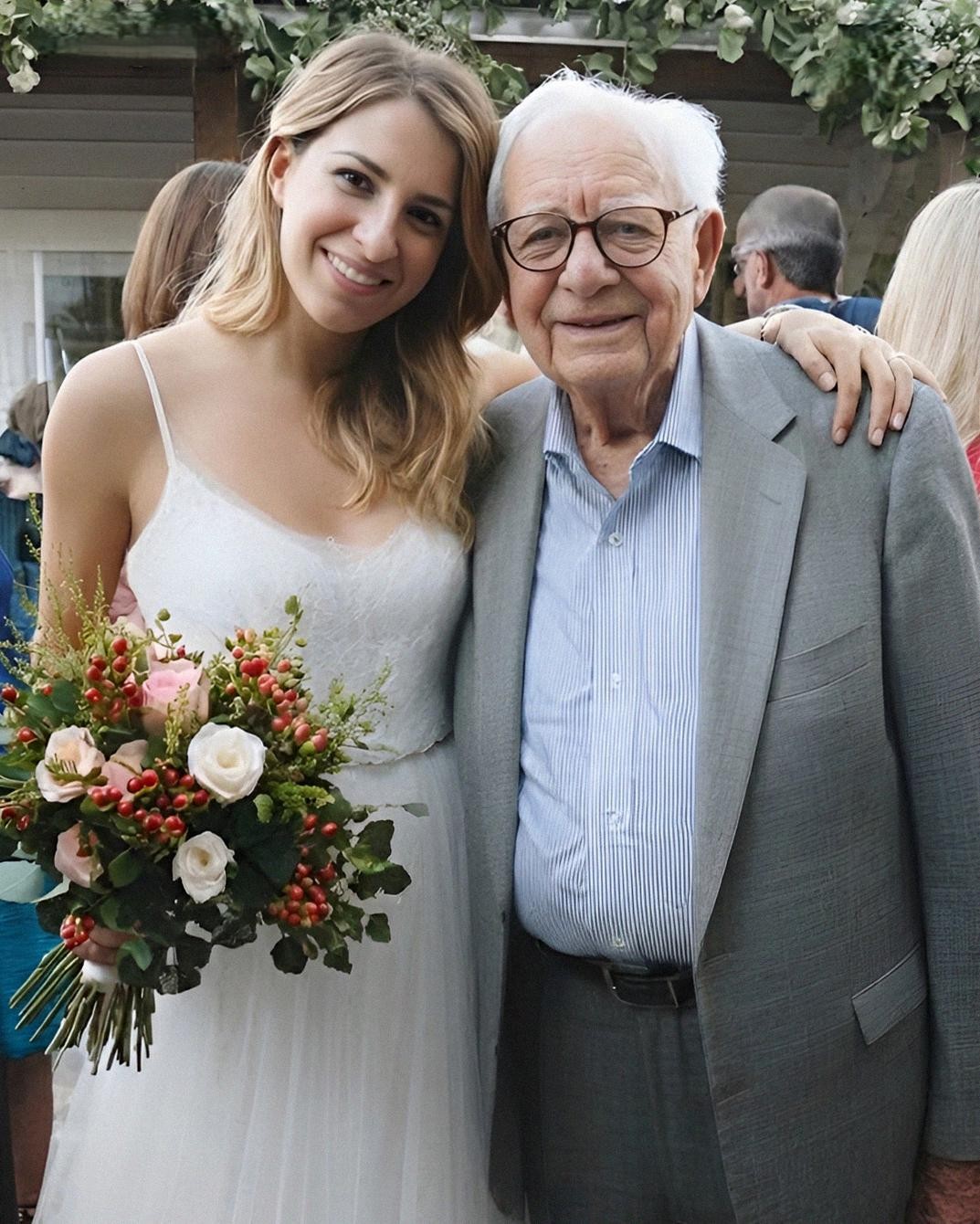
The clash of two worlds rarely occurs in silence; more often, it arrives with a resounding force that strips away social facades to expose the raw truth of who we are. My wedding day was supposed to be a celebration—a new beginning for Ethan and me, the man I loved. Instead, it became the battleground for a silent war of values that had been simmering since we announced our engagement. My name is Anna. I am a doctor—a title that commands respect in the sterile halls of a hospital. But the foundation of that title, and every achievement I’ve ever claimed, was built by the calloused hands of my father, Joe.
For over thirty years, my father has worked as a sanitation worker for the city. To the casual observer, he’s just a man in a neon vest, a background figure in the urban landscape handling what others find repulsive. But to me, he’s a moral giant. My mother passed away from cancer when I was just three years old. In the silence left behind, my father stepped up to fill two roles—both provider and protector. We lived in a cramped apartment, the heat unreliable, but the security unwavering. I grew up hearing the rhythmic click of the front door at 4:30 AM as he left for work in the biting cold or humid summer air. He returned each day smelling of exhaust, his back marked by the physical toll of lifting the city’s burdens. He never apologized for his work, calling it “honest labor,” using his modest income to ensure I never lacked for a single book, a warm coat, or the tuition that eventually placed a stethoscope around my neck.
When I met Ethan during my residency, I waited for the usual reaction. I had dated men before who, upon learning of my father’s job, would offer a polite but patronizing “Oh, that’s… noble.” Ethan didn’t flinch. He came from a family of wealth, of polished boardrooms and summer estates, yet he had a rare respect for the dignity of labor. When I told him about Joe, he simply asked if my father was proud of his work. In that moment, I knew Ethan understood the world the way I did. Unfortunately, his family didn’t.
From the moment our engagement was announced, Ethan’s mother and sister treated me like a curiosity, a project. I was a girl from the wrong side of town with a medical degree but lacking the “pedigree” they valued. I overheard their whispered concerns about how our union might affect their social standing and business interests. Ethan defended me with fierce loyalty, but the poison of their elitism had already tainted the wedding planning.
The ceremony itself was hijacked. What Ethan and I had envisioned as an intimate occasion became a bloated, high-society affair aimed at impressing their corporate associates. The venue was a grand ballroom, opulent with crystal chandeliers and velvet drapes, curated to reflect “a certain standard.” On the morning of the wedding, my father arrived early. He looked striking in his suit, though his thick, scarred hands, worn by years of manual labor, seemed out of place against the silk linens. He didn’t notice the disdainful stares from Ethan’s side of the family—he only had eyes for me, his daughter, standing in a white gown that his thirty years of work had helped provide.
As the reception began, the subtle social maneuvering became overt. Ethan’s mother began steering the “important” guests away from my father’s table. I watched, seething with quiet anger, as the chairs around him remained empty, as though his presence were a contagion. Then came the ultimate betrayal. Ethan’s parents pulled my father aside in a secluded corner of the ballroom, their smiles tight and clinical. They told him that, for the sake of “appearances,” it would be best if he left early to avoid “awkwardness” with their business partners. They were trying to eject the father of the bride from his own daughter’s wedding.
I was ready to tear the room apart. I wanted to scream, to rip the floral arrangements from the walls, and to walk out of that den of snakes. But my father, the man who had weathered countless storms, placed a hand on my arm. He looked at Ethan’s parents with a gaze that was chillingly calm. “I understand,” he said softly. “But before I go, I’d like to offer a toast.” Thinking they had silenced him, they ushered him to the microphone.
The room fell silent as my father stood before the glittering crowd. He didn’t mention the champagne or the décor. He spoke of 1994, the year my mother passed away, leaving him with a toddler and a mountain of medical bills. He spoke of the dignity in a day’s work and the pride of raising a daughter who had dedicated her life to helping others. Then his voice deepened, quiet but commanding.
“There’s one story I’ve never told,” he said, looking directly at my father-in-law. “Thirty years ago, after a massive flood, I was working near a new construction site. I found a leather briefcase half-buried in the debris. Inside were permits, contracts, and insurance papers. I knew that without those documents, that business would’ve been sued into bankruptcy before it ever got off the ground. I didn’t ask for a reward, didn’t leave my name. I cleaned off the mud and turned them in anonymously because doing the right thing doesn’t require recognition.”
A heavy silence descended. My father-in-law’s face turned pale, and my mother-in-law’s hand flew to her throat. They realized in that moment that their entire wealth—everything they used to exclude others—was built on the actions of a “lowly” sanitation worker with more integrity than they could ever dream of.
“I raised my daughter to know her worth,” my father said, his voice echoing through the hushed ballroom, “and to never be ashamed of the hands that built her future.”
I didn’t wait for the applause that would never come from that stunned crowd. I stood up, my voice shaking with a mix of rage and pride. “My father is staying,” I declared. “And if anyone here feels uncomfortable with a man who has more character than this entire guest list combined, you are welcome to leave. The exit is right behind you.”
Ethan immediately stood, his hand firm on my shoulder. “She’s right,” he said, his voice cold and resolute. “My father-in-law is the guest of honor. If that’s a problem for anyone, feel free to leave.”
The shift in power was immediate. No one left right away, but the atmosphere in the room shifted from one of elitism to palpable discomfort. My in-laws couldn’t meet my father’s eyes for the rest of the evening. Their business associates drifted away early, realizing they were in the presence of someone with far more moral authority than the people they had surrounded themselves with. My father stayed until the last song, holding my hand, telling me he loved me. That day, I learned that true dignity isn’t found in wealth or titles; it’s in the soul. My father may spend his life collecting the world’s refuse, but he is the cleanest man I’ve ever known.