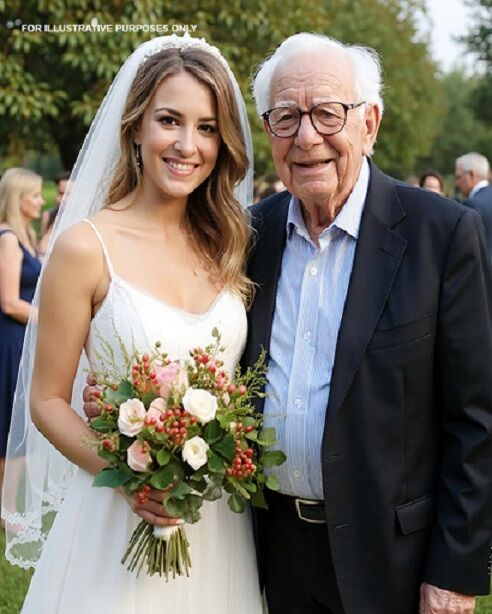
My name is Lena Morales, and the man who raised me has worked for the city for as long as I can remember. His life was never glamorous, never celebrated, yet it shaped everything I am today.
My father, Carlos Morales, has been a sanitation worker since I was a toddler. Some people casually say “garbage collector,” as if it were a punchline. Others use the more formal, sanitized phrase, “sanitation department employee.” But my dad always said it plainly: “I work for the city.” He said it with no apology, no shame, no need to explain. Just a quiet pride in a job that keeps the world moving, even if no one notices. To him, it was not just a job—it was a responsibility, a duty, a contribution.
When I was three years old, my mother died.
Cancer doesn’t announce itself politely. It doesn’t pause for schedules or request permission to enter your life. One morning, she was tired but smiling, brushing my hair before preschool. A few weeks later, she was in a hospital bed, tubes and machines surrounding her. And then she was gone.
There was no dramatic farewell, no tearful goodbye. Just an absence that fell like a shadow, permanent and unyielding, reshaping our little world. And from that day forward, it was just my father and me.
We lived in a modest two-bedroom apartment on the south side of town, the kind with thin walls and floors that groaned under every step. In winter, the radiator hissed and clanged endlessly, filling the apartment with a metallic symphony. In summer, the windows stuck so stubbornly you needed both hands and every ounce of patience to open them. But it was ours. It was safe. It was clean. And it was filled with love, however quiet and unassuming.
We didn’t have much, but what we had was enough. Enough to survive. Enough to feel secure. Enough to know that, despite loss, life could still be ordinary and good. The lights stayed on. The heat worked. The table was filled with simple but nourishing meals—pasta with butter and salt, scrambled eggs with toast, rice mixed with whatever vegetables were on sale. My father never complained. He never made me feel guilty for what we lacked. He carried the weight quietly, with dignity.
He woke every morning at 4:30 a.m.
I remember hearing the soft click of the front door as he left, careful not to wake me. By the time I stumbled out of bed for school, he had already been on the streets for hours, riding the back of a truck through neighborhoods most people never saw or thought about. He smelled of metal, exhaust, and sweat, with a hint of something indescribable—something that smelled like work, like effort, like responsibility. His hands were rough, his shoulders sore, his body heavy with fatigue. Yet, when he came home, he was still my father first. He never missed a parent-teacher conference, never missed a school recital, never made me feel like I was a burden or that my very existence complicated his life.
As a child, I thought all fathers were like him. It wasn’t until I grew older that I realized how rare such devotion truly was.
He never apologized for his work. He never hid it. When people asked, he answered honestly: “I work sanitation for the city. It’s honest work. And it keeps things running.”
Those words stayed with me. I carried them silently, like a treasure. I worked hard in school, not because I was forced, but because I wanted to honor the effort, the sacrifice, the quiet love that had sustained me. Every opportunity I received was a reflection of his dedication, and I intended to make it count.
Years later, after medical school, during my second year of residency, I met Michael Bennett.
He was visiting a friend at the hospital where I worked, and we shared an elevator late one evening. What started as small talk grew into conversation, conversation into laughter, and laughter into connection. He smiled easily. He listened, really listened. He remembered the little details I casually mentioned. He didn’t try to solve problems that weren’t his to solve. He just was. Calm, steady, present.
Three months into dating, we sat in a small diner near my apartment. The topic of family came up.
“It’s just my dad and me,” I said quietly. “My mom passed away when I was little.”
“I’m sorry,” he said, and I believed him.
“My dad raised me alone. He works for the city. Sanitation.”
I watched his reaction closely, bracing for polite nods, subtle discomfort, the quick change of subject that I had grown used to. But Michael simply nodded. “That’s hard work.”
“It is,” I admitted, surprised by the simplicity of his response.
“Is he proud of it?”
“Yes,” I said. “He says it’s honest.”
Then Michael smiled. “Then that’s all that matters.”
I fell in love with him in that moment—not because of grand gestures, but because he saw what mattered, and he valued it.
When I brought Michael home to meet my father, Dad cooked spaghetti with meat sauce and garlic bread—the same meal that had marked every holiday and special occasion in my childhood. He laughed at Michael’s jokes, asked thoughtful questions, and for a brief evening, my apartment was filled with warmth, humor, and mutual respect.
After Michael left, my dad looked at me and said softly, “He’s good to you.”
“He is,” I replied. “And that’s all that matters.”
But the problems began—not with Michael, but with his family.
Michael’s parents were comfortable, not rich but comfortably insulated. They had a worldview shaped by privilege, one that made them believe comfort equaled superiority.
The first time I met his mother, Elaine, she asked politely what I did for a living.
“I’m a doctor,” I said. “Still finishing my residency.”
Her smile remained polite, but her tone was faintly condescending. Later, I overheard Michael’s sister whispering, “She comes from nothing. Are you sure about this?”
I was certain.
Michael shut down every slight with firmness and tact, but the comments never fully stopped. They murmured about appearances, status, and what “others might think.”
When our wedding planning began, we wanted something small and meaningful. Elaine insisted otherwise. “People expect a certain standard,” she said repeatedly. The guest list swelled. The venue became extravagant. The details, precise to the last candle, mattered more than the people attending.
On the wedding day, my father arrived early. He stood quietly at the entrance, adjusting his tie, taking in the grandeur with a mixture of awe and calm dignity. When he saw me, his face lit up.
“You look beautiful,” he whispered.
“I’m glad you’re here,” I said, hugging him tightly.
Michael greeted him warmly, and my father smiled back, calm and steady.
At first, everything seemed fine. Then, the whispers began—the subtle shifting of guests, the silent judgments, the emptying of chairs around him. Elaine subtly steered people away, guiding them to “more appropriate” tables.
Finally, she approached him directly. “We have important guests,” she said, voice polite but firm. “It might be best if you left early.”
I felt my blood boil, but before I could speak, my father raised a hand, steady and deliberate. “I understand. But may I say a few words first? A toast to my daughter.”
Reluctantly, they agreed.
He spoke simply, humbly, about raising me alone, about early mornings, about honest work, about pride and dignity. Then he told a story—years ago, he had found a briefcase at a construction site filled with documents that could have ruined a business if lost. He returned it anonymously. Only later did he realize the documents belonged to Michael’s family.
The room fell silent.
“I didn’t do it for recognition,” he said. “I did it because it was right.”
I stood up, voice steady. “My father is staying. He’s not an embarrassment. He’s the man who raised me.”
Michael stood beside me. “Anyone who has a problem with that is free to leave.”
Some did. My father stayed. And that was all that mattered.
Dignity is not something granted by others. It is something you carry. And my father taught me how. Through quiet sacrifice, unwavering honesty, and an endless capacity for love, he showed me what it truly means to live with integrity.