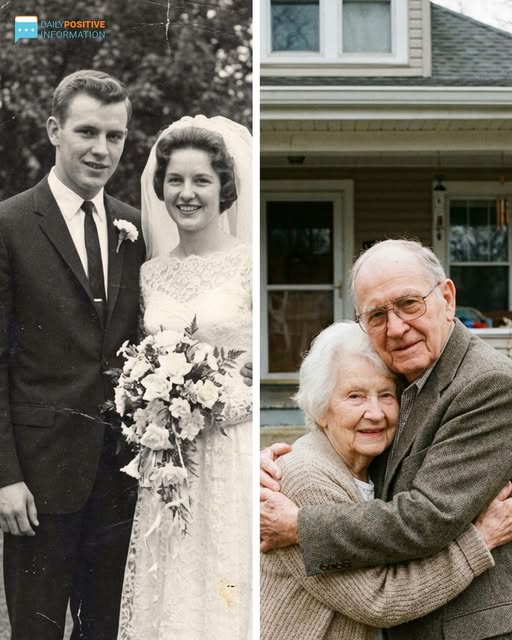
I had always thought I knew every corner of the man I married. Sixty-two years does that to a person—it creates the illusion of complete knowledge, a sense that you have mapped every ridge, every valley, every secret passage of another person’s heart. You believe that no surprises remain, no hidden rooms, no locked doors you haven’t opened or peered behind. You think that after more than six decades, you know the weight of their laughter, the shape of their silences, the way their mind turns in the dark.
I was wrong about all of it.
The funeral service took place on a Thursday morning in October, at St. Catherine’s Church in the neighborhood where Harold and I had raised our family, where our sons had been baptized, where we had renewed our vows on our fiftieth anniversary. The air was crisp, tinged with the scent of fallen leaves, and the autumn sunlight streamed through the stained glass windows. It scattered across the wooden pews in patterns of blues, reds, and golds, colors that felt oddly cheerful for a day devoted to saying goodbye to the man who had been my anchor for sixty-two years.
Harold had been sick for months. The doctors had used words like “progressive” and “irreversible,” which were really just elaborate ways of saying that nothing could be done, that all we could do was wait. And wait we did. I had sat by his bedside for weeks, holding his hand, watching the man I loved shrink before my eyes, piece by piece, until finally, on one quiet Tuesday morning in September, he stopped breathing altogether.
I barely made it through the service that day.
The Girl in the Pew
My sons stood close on either side of me—Marcus on my left, Steven on my right—their hands pressing against my arms as we made our slow passage through the church, shaking hands with people who had known us for decades. The line of mourners seemed endless. Harold had been a good man, the kind who remembered birthdays, who showed up when it mattered, who never spoke ill of another person. Everyone wanted to tell me how much he had meant to them, and I received their condolences with the polite numbness that grief forces upon you. My voice sounded strange even to me, foreign, belonging to someone else entirely. A widow. That was what I was now. The word felt ill-fitting, like clothes tailored for someone else’s body, garments I could never wear comfortably.
The service was ending. People began to drift out slowly. Some stopped for final embraces; others offered only nods, observing the silence that grief demands. And that’s when I saw her.
A girl, no older than twelve or thirteen, moved through the thinning crowd with an unusual purposefulness, as though she had been navigating this moment her entire life. She did not belong to any of the faces I recognized. She was not a parish child, not someone who helped with flowers at Easter or sang in the youth choir. Yet there she was, walking directly toward me, her gaze unwavering.
When her eyes met mine, there was something almost magnetic about the intensity, a certainty that she had been searching for me specifically.
“Are you Harold’s wife?” she asked, her voice clear and direct.
“I am,” I replied, studying her face, trying to place her in my memory.
She held out a plain white envelope, the kind you can buy at any drugstore, unremarkable in itself except for the care with which she cradled it, as if it contained something invaluable.
“Your husband… he asked me to give this to you,” she said, her words deliberate. “On this day. At his funeral. He said I had to wait until this exact day.”
My son Marcus’s hand tightened around my arm.
“Who are you?” I asked, my voice trembling despite my efforts to remain composed.
But before I could ask her name, or how she had known Harold, or why a child was entrusted with such a task, she turned and ran toward the church entrance. By the time I gathered my wits, she had vanished into the golden October afternoon, leaving only the echo of her footsteps and the envelope in my hands.
“Mom?” Marcus asked, concern thick in his voice. “Are you okay?”
“Fine,” I said automatically, sliding the envelope into my purse. “I’m fine.”
I wasn’t fine. Not even close. My hands shook slightly as I touched the envelope, as if it contained a piece of him that had survived his passing. But the funeral service was not the place to unravel, not here among the murmurs, the handshakes, the quiet rituals of mourning. The church had emptied around us, the sunlight fading as shadows stretched across the pews. Yet in my purse, the plain envelope pulsed with the promise of revelation, of a secret Harold had carried to the very end—a final piece of him, entrusted to a stranger and delivered to me when the world was watching.
The Letter
That evening, after the house had emptied of mourners and settled into the particular silence that follows a funeral—the absence of phone calls, visitors, the soft shuffle of footsteps through familiar rooms—I sat at the kitchen table. The envelope lay in front of me, unassuming, almost ordinary in its plain white paper, yet heavy with a weight I could not measure. My hands trembled as I picked it up.
Inside was a letter written in Harold’s careful, deliberate handwriting—the same penmanship I had recognized on birthday cards, anniversary notes, and even small grocery lists for over six decades. Beneath the folded pages, a small brass key rested, its weight solid in my palm. When I tipped the envelope, it clinked against the table, a tiny sound that seemed impossibly loud in the quiet kitchen.
I unfolded the letter slowly, savoring—or fearing—the moment.
“My love,” it began, and I could hear his voice in my mind, that particular tenderness he had reserved for me through sixty-two years of marriage.
“I should have told you this years ago, but I couldn’t find the courage. Sixty-five years ago, I made a promise to someone in need, and I have kept that promise my entire life. It has been the most important secret I have ever kept, and also the heaviest burden. You deserve the truth. The key below opens Garage 122 at the address included. Go when you’re ready. Everything is there. Everything you need to understand. I am sorry for what you will find. But I am not sorry for what I did. All my love, Harold.”
I read it twice. Then three times. The words seemed to slip in and out of clarity, each reading adding new weight. A secret. A promise made sixty-five years ago—long before we had met, long before our family, long before the life we had shared.
I put on my coat without fully understanding why I was doing it. I called a taxi and left, my mind a swirl of questions and anticipation, heading toward a revelation that would change everything I thought I knew about my husband—and perhaps even about my own family.
The Garage
The garage was on the outskirts of the city, a long row of identical metal doors painted an institutional gray, stretching as far as the eye could see. Each door was numbered in white paint, evenly spaced, their utilitarian design unchanged since the 1970s. Halfway down the row, I found number 122.
The key slid into the padlock with surprising ease, as if it had been used recently, which seemed impossible—Harold had spent the last months of his life in a hospital bed. I twisted it, and the lock clicked open, the sound echoing in the quiet lot.
I lifted the metal door.
The smell hit first: the musk of old paper, cedar wood, and years of sealed secrecy. Dust motes hung in shafts of afternoon light that fell across the concrete floor. The odor was intoxicating, a reminder that some things kept long enough take on their own weight and scent.
In the middle of the space stood a massive wooden box, handmade, darkened to almost black with age. It was taller than me, wider than my shoulders, and coated in dust and cobwebs, a silent sentinel of decades of hidden life.
My heart pounded as I wiped the front with a cloth I had tucked in my coat. I found the latch and lifted the lid.
Inside was a life meticulously preserved. Children’s drawings tied with ribbons that had faded to sepia, birthday cards addressed to “Dear Harold” in childish scrawl, school certificates, report cards. Hundreds of letters, each folded with care, ending with the same name: Virginia.
At the bottom, a worn manila folder revealed documents dating back sixty-five years: lease agreements, school enrollment forms, bank statements documenting regular monthly contributions, photographs chronicling Virginia’s life from childhood to adulthood.
A single, inescapable thought rose, insistent and terrible: Harold had another family. A life hidden from me, supported in secret throughout our entire marriage.
I sank to the floor, pressed my hands to my mouth, and whispered, “Oh God… Harold, what have you done?”
The Girl Returns
Then, the crunch of tires on gravel outside the garage caught my attention.
A bicycle skidded to a stop at the open doorway, and the girl from the funeral stood there, cheeks flushed, breath coming in short, quick gasps.
“I thought you might come here,” she said calmly, though her chest heaved from exertion.
“You followed me?” I asked, my shock barely contained.
She nodded, unfazed. “I rode behind the taxi. When I felt the key in the envelope, I couldn’t stop wondering what it opened. Harold told me that what you’d find here was the most important thing I’d ever help with. He said you needed to know the truth.”
Her eyes were steady, unflinching. “What’s your name?” I asked.
“I’m Gini. My mom’s name is Virginia. Gini is short for Virginia, like me, but different.”
I rose slowly, the documents still trembling in my hands.
“Did your mother ever tell you who Harold was to her?” I asked cautiously.
“She called him the man who saved us,” Gini replied. “She said he was very kind to her and to her mother. But Mom never called him her father.”
I swallowed hard. “What was your mother’s mother’s name?” I asked, bracing myself.
“Iris,” Gini said. “She died a long time ago, before I was born.”
The world tilted. Iris. My older sister. The sister who had left home when I was fifteen and never returned. The one my parents never spoke of again because the wound had been too deep. And now, standing in the doorway, was a bridge to that hidden part of my past.
The Hospital
Gini explained that her mother, Virginia, was in the hospital with heart problems. She needed surgery that she couldn’t afford, which was why Gini had been living with a neighbor.
“Can you take me to her?” I asked, the weight of what I had discovered pressing down on me.
We loaded her bicycle into the taxi—an almost-new bike, Harold had given it to her shortly before he passed—and began the thirty-minute drive. Gini spoke in fragments, recounting Harold’s quiet visits, his small acts of kindness, the way he had supported them without seeking recognition.
Every word painted a portrait of a man I had loved for decades, but one whose generosity and courage had extended far beyond what I had ever imagined.
The Hospital
Virginia lay in a narrow hospital bed on the third floor of Harbor General, pale and frail beneath the crisp white sheets. The machines surrounding her beeped softly, monitoring her heart’s erratic rhythm. Tubes snaked from her arms into IV bags, the sterile scent of antiseptic hanging in the room, mixing oddly with the faint scent of sunlight drifting through the window. The room felt clinical, cold, almost unwelcoming, yet a sense of quiet perseverance lingered in the air, a stubborn life clinging to fragile tissues and soft breaths.
“She’s been here two months,” Gini said quietly from the foot of the bed, her voice almost reverent. “Harold used to come by sometimes to check on us. The last time I saw him, he gave me that envelope and made me promise to give it to his wife.”
“Did he say why?” I asked, my voice almost catching in my throat.
Gini shook her head. “I asked where he was going. He just smiled and said his health wasn’t very good anymore.” Her eyes flicked briefly to the machines, to her mother, then back to me. “He trusted you to know what needed to be done.”
I stepped into the hallway and found the doctor on duty—a woman in her fifties, with gray-streaked hair and the kind of tired eyes that had seen too many impossible odds, too many fragile patients slip through cracks.
“The surgery is urgent,” she said bluntly. “Without it, her chances aren’t good. The problem is the cost. She doesn’t have insurance that covers it, and the hospital doesn’t have the funding to proceed. We can send her home to recover as best she can, but the underlying condition will only worsen.”
I stood in the empty corridor, trying to make sense of what I was feeling. Memories of Harold flooded me—his careful letters, the precise way he had arranged for a young girl to deliver a key, the faith he had placed in me to complete something he had started decades ago.
He had known. He had known exactly what would be in that garage, exactly what it would demand of me. And now, I had to act.
The Decision
Two days later, I returned with the money for Virginia’s surgery.
Harold and I had been meticulous all our lives—careful with money, careful with plans, careful with every decision. The money I handed over to the hospital wasn’t just cash; it was decades of careful saving, meant for our retirement, for our children, for the quiet emergencies of old age. Yet spending it didn’t feel like sacrifice. It felt like honoring Harold, fulfilling the commitment he had made sixty-five years ago, a promise that had been silently shaping his life—and now mine.
The surgery lasted six hours. Gini and I sat in the waiting room, drinking bitter coffee from disposable cups, scrolling through magazines we didn’t read, the ticking clock filling the silence with a slow, measured anxiety. When the surgeon finally emerged, he gave a nod and a smile.
“It went well. She’s stable. The prognosis has improved significantly.”
Something shifted inside me, a weight I hadn’t realized I was carrying. Decades of grief, shock, and betrayal all pressed together, then began to lift, leaving space for relief, for hope, for a quiet gratitude I didn’t know I still had.
The Truth Assembled
When Virginia was strong enough to have visitors, I returned to her room. My heart pounded as I introduced myself.
“I’m Rosa,” I said softly, “Harold’s wife.”
She studied me for a long moment, her eyes wide and searching, as if trying to reconcile the face before her with the story she had been told for years. Then her expression shifted, tears forming at the corners of her eyes. She reached out and gripped my hand with surprising strength.
“Your husband saved my life,” she said, voice trembling. “He saved my mother’s life. My daughter wouldn’t exist without him. I wouldn’t be here. We wouldn’t be alive.”
“Tell me,” I urged, sitting beside her. “Tell me everything.”
A few days later, after Virginia returned home and began to regain some strength, she invited me into her apartment—a modest, immaculate space in a quiet neighborhood, just a few miles from the city I had always called home, yet until now, entirely unknown to me.
She brought out a photo album, worn from decades of careful handling. I turned the pages slowly, watching a life unfold that had existed parallel to my own—a childhood documented in photographs, school pictures with forced smiles, holidays, birthdays, milestones I had never known.
Then I turned one final page, and my breath caught in my chest.
There he was—Harold, barely twenty, dark-haired and earnest, the same gentle expression I had loved for decades, standing outside a rooming house. Beside him, a teenage girl clutched a newborn baby, squinting into the sunlight.
I knew that girl.
Not as an adult, not as someone I had met later in life—but as a child. I had shared a home with her. Borrowed her clothes, annoyed her, heard her scold me for every little transgression.
“That’s my mother,” Virginia said softly. “That’s my grandmother, Iris. She passed away twelve years ago.”
The photo slipped from my hands, and I pressed them to my mouth as tears welled and spilled over. The secrets, the sacrifices, the double life Harold had carried—all of it now came into focus. My life had been one of love and devotion, but it had also been intertwined with a hidden network of loyalty, courage, and unseen compassion that had spanned decades.
I sat there, trembling, surrounded by photographs and letters, by the tangible proof of a life I had never imagined. And for the first time since his death, I understood that love, true love, could extend beyond the boundaries of what we see, beyond the knowledge we think we possess.
Harold had been my husband, but he had also been so much more than I could have known.
The Diary
That evening, after the quiet of the house had settled into that peculiar stillness that follows a funeral—the hush of absent footsteps, the absence of ringing phones, the silence of rooms emptied of visitors—I went straight to Harold’s study. Everything was exactly as he had left it: stacks of papers organized with military precision, the brass desk lamp casting a muted glow, the leather-bound diary that had accompanied him for decades, filled with entries written in the same deliberate, meticulous handwriting I had loved for so long.
I sat in his chair, inhaling faintly the lingering scent of his cologne, a combination of sandalwood and cedar, and opened the diary. The first pages I turned to were from sixty-five years ago. The ink had faded to a soft brown, but the words were still precise, almost alive, forming a quiet testament to the man I thought I knew completely.
Each page revealed more than mere records. They revealed intention, care, courage hidden beneath the surface of a quiet life.
Harold had found my sister Iris one rainy evening, huddled beside an old trailer at the edge of town. She was nineteen, shivering in damp clothes, and cradling a newborn baby in her arms. The man who had promised to marry her had vanished without a word, leaving her alone and desperate.
At first, Harold didn’t know who she was. It wasn’t until he noticed a small silver locket she always wore around her neck—two tiny portraits of young girls in matching dresses—that he realized this was my sister, the same sister I had grown up with, shared secrets with, and fought with over petty grievances.
For three years, the diary recounted, Harold had quietly watched over Iris. He brought her food, helped her find work, visited when he could without drawing attention. He never sought credit. He recorded his thoughts in a tone of quiet vigilance, the concern of a man carrying someone else’s burden as if it were his own, a steadfast guardian in the shadows.
But he also knew the delicate balance he had to maintain. My parents had been devastated when Iris left home, the wound of her absence lingering like a shadow over every family gathering. If they had learned where she was, or how harshly life had tested her, it might have broken them entirely. And so, as always, Harold helped quietly, from a distance, preserving lives without revealing his own involvement.
He had continued this silent guardianship for the entirety of his life—through our marriage, through the raising of our sons, through decades that passed like quiet waves lapping against the shore. Until the day he died.
I held the diary against my chest, weeping not just for my loss, but for the secret burden he had carried alone, for the immense love he had rendered in silence, the quiet heroism that had defined his life in ways I had never imagined.
The Family Restored
The next day, I returned to Gini and her mother.
Their kitchen was small, round, and painted a cheerful yellow, as though Virginia had chosen it deliberately to infuse warmth into their lives despite hardship. We sat around the table, and I told them everything—the diary, Harold’s careful chronicling of his years helping Iris, and the truth of why he had kept it hidden.
Virginia’s tears were not of sorrow, but of relief, a light finally shining into decades of uncertainty.
“I always wondered,” she said, gripping my hand across the table. “I always wondered who my father was. My mother never told me. She said only that a good man had helped us when we had nothing. I think she wanted to protect him… and she knew what it cost him.”
I looked at Gini, who sat silently, processing the magnitude of her newfound heritage, the revelation that the family she had never known was, in fact, tied to the life I had lived all along.
“Virginia,” I said carefully, “you are my sister’s daughter. You are my niece.”
Then I turned to Gini. “And you, Gini… you are my great-niece. You are family.”
The kitchen was silent for a heartbeat. Then Gini slid from her chair and crossed the short distance to me, wrapping her arms around me without a word. I held her, thinking of Harold, of the immense weight he had carried, of the quiet courage it took to preserve both families while remaining unseen.
My husband hadn’t just kept a secret. He had preserved life. He had preserved love. Two families: the one I knew and the one I never imagined.
“He really was something,” Gini whispered against my shoulder.
“Yes,” I said, pressing my cheek to the top of her head. “He really was.”
What a Secret Can Hold
Harold had borne this secret for sixty-five years, ensuring no one would suffer the pain of knowing what he had carried alone. My parents would never learn of the hardships Iris endured. My family would never have to revisit the shadow of losing a daughter. And Harold, the quiet hero, had never demanded acknowledgment or gratitude for the sacrifices he had made.
In the end, the secret did not destroy. It restored. It created life, healing, connection.
That October, I added Virginia and Gini to my will. We celebrated Thanksgiving together—the first true family gathering in more than fifty years. We spoke of Iris, of Harold, of love that acts silently and selflessly, of choices made not for recognition, but for the protection of others.
Sometimes, the most powerful love letters are not written—they are lived. Harold’s letter to me had been written over sixty-five years, through quiet deeds, careful silence, and the invisible labor of compassion. A life lived in secret devotion.
That was the man he was. That was the man I had married. That was the man I should have known from the very beginning.